1
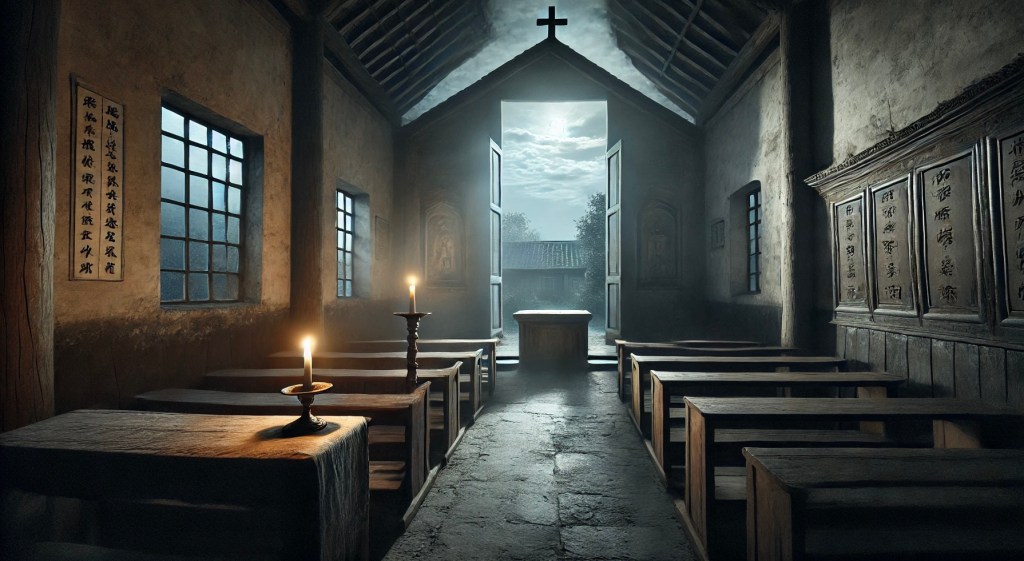
Father Gerbillon, a man of slim, medium build in his late forties, was at the sacristy laying out the sacred host for the morning Mass when he heard light footsteps behind him. He turned around and saw a figure coming down the hall. As the church was dimly lit at this early hour, he initially could not make out who the stranger was. But as the figure came nearer, he realized it was a girl, about fourteen or fifteen, with a skeletal body, unkempt hair, and dressed in a garment so torn and worn out it resembled rags. Father Gerbillon put down the cruet and was just about to say something when the girl stumbled while trying to step onto the raised dais.
With a frightened look in her eyes, she paused suddenly for a brief second, as if waking from a nightmare, then fell forward abruptly. Foaming at the mouth, her teeth clenched tight, she stumbled again and collapsed to the ground like a plank.
Still in his cassock, Father Gerbillon rushed to the girl, but it was too late. She now lay on the ground, lifeless. From the way she was positioned, facedown on the dais, and the displaced service table, he could tell her head had struck the table as she fell. Father Gerbillon knelt next to her and carefully placed his index finger under her nose. There was no discernible breathing. He turned her head slightly to one side to get a better look. Her jaw was tightly clenched, and her eyes were shut just as firmly.
Father Gerbillon couldn’t be certain, but by all appearances, the girl was already dead.
He glanced quickly at the church window. The sky was still dark, yet he knew that very soon—no more than a few minutes—the congregation would begin to arrive for the morning service. He still needed to prepare the Eucharist and change into his liturgical garments. There was not a moment to lose. He had to hide the body—at least temporarily—to avoid unnecessary suspicion. Such things were never easily explained, especially under circumstances like this. A potential scandal was the last thing the church could afford, given the difficulties it had faced in recent years with both the local population and the authorities.
He dragged the body under the altar and covered it with a tablecloth. He took a second look. That would have to do for now, he thought. He quickly stepped back behind the screen in the corner and finished the sacristy preparations in haste—something he had never experienced before. From the hooks on the wall, he took down the alb and pulled it over his cassock, followed by the stole and finally the chasuble.
Just at that moment, he heard footsteps echoing in the hall. The parishioners had arrived.
2
Father Gerbillon stood near the altar, his hands clasped in front of him.
“Welcome, my friends. Pax vobiscum!” he greeted them in both Latin and slightly accented Chinese, nodding and smiling as the parishioners took their seats.
As the parishioners settled, Father Gerbillon bowed his head in silent prayer: “Lord, prepare our hearts to receive You today.”
The congregation followed, bowing their heads, uttering silent prayers, and crossing themselves.
Father Gerbillon then delivered the morning’s homily:
“My dear brothers and sisters, Jesus reminds us today: Do not worry about tomorrow, for tomorrow will take care of itself. This morning, let us entrust our worries to God. In His infinite wisdom and love, He provides for us even in our trials. Let us pray for faith and strength to follow His path.”
He moved to the altar and began preparing the gifts for consecration.
“Blessed are You, Lord God of all creation, for through Your goodness we have received the bread we offer You…”
The congregation responded: “Blessed be God forever.”
He invited the congregation to join in prayer:
“The Lord be with you.”
The congregation responded: “And with your spirit.”
“Lift up your hearts.”
The congregation responded: “We lift them up to the Lord.”
Father Gerbillon then recited and sang the Sanctus for the congregation. Afterward, he lifted the host and chalice, holding them as the congregation remained silent in prayer. Following a few more prayers and hymns, he began distributing the Eucharist to the parishioners, saying to each:
“The Body of Christ.”
Each recipient responded: “Amen.”
Finally, after about an hour, the morning Mass came to an end. As the congregation prepared to leave, Father Gerbillon stood at the altar and gave the final blessing:
“May almighty God bless you, the Father, and the Son, and the Holy Spirit. Please go in peace.”
The congregation responded: “Amen. Thanks be to God.”
3
After the last person had left, Father Gerbillon quickly walked to the sacristy, put away the sacred vessels and his liturgical garments, and returned to the altar.
The service hall was now empty and eerily quiet. He needed to decide what to do with the body—and quickly. But for a long while, he struggled to concentrate; the tragic death of the girl was so out of the ordinary, both for his church and for himself, that he was temporarily at a loss for what to think, let alone take decisive action. For a moment, he considered seeking help from someone he trusted. But his most reliable confidant—the lay minister who helped him with daily church services—was out of town that day. Even if the lay minister had been present, Father Gerbillon would have had misgivings about involving him. Then there was the handyman who lived in the wooden house across the tiny courtyard from the church building. A resourceful man, the handyman could have been helpful, but Father Gerbillon’s limited knowledge of the native language would make communication difficult.
It was now daytime, and the service hall was brightly illuminated. He could not afford to delay; at any moment, someone could enter, and then it would be too late. In the end, he decided to move the body to his private quarters and store it there temporarily. No one would think of entering the priest’s room uninvited. Given the circumstances, this seemed the safest option.
The rear door of the hall led to a small hallway connecting to the church entrance. From the rear door, it was only a few steps to the staircase, and if he could manage to get upstairs, he would be in his room relatively safely, as there were no guests staying at the church that day.
He knelt beside the body to get a good hold of it and then lifted it. He was surprised at how light it felt in his arms. Even after an hour, there was still faint warmth in it. The body was supple, allowing him to carry it as one would carry a sleeping child. Quickly, he crossed the hallway and ascended the stairs.
Once inside his room, he carefully laid the girl’s body on his bed. Straightening himself, he took a deep breath and glanced at the crucifix hanging on the wall above the bed:
Kyrie eleison. Christe eleison. Kyrie eleison. Christe eleison. Kyrie eleison…
He repeated the prayer for several minutes. His breathing was short and heavy at first, but the mantra-like repetition calmed him, helping him regain composure. Still, the mental disturbance lingered—a mix of guilt and unease that was unfamiliar to him.
He continued praying, crossing himself one last time before opening his eyes and turning his gaze to the body. The room was well-lit, sunlight streaming in through the front window. This was the first time he truly saw her. She was about fourteen or fifteen, though it was hard to tell; her body bore the unmistakable signs of malnutrition. Her unwashed hair was deep black but greasy, her face bony and almost infantile in appearance. The tattered clothes she wore barely covered her body and seemed like they had been inherited from someone else.
All signs pointed to her being from an impoverished family, if she had one at all. She might have been an orphan, like so many of the street children he passed daily in the town. He took one more look at her face. Other than the slightly twisted jaw, a result of the seizure during the accident, her face held the peaceful look of a child in sleep.
Father Gerbillon closed his eyes, muttered a prayer while crossing himself, and walked out of the room. Though he wished to stay, there were other duties awaiting him that morning.
4
Directly beneath his room, on the first floor, was the room that served as the church’s school for the town’s children. When Father Gerbillon entered the hall, the students were already waiting. There were about a dozen of them, all boys, dressed in ragged clothes patched in layers, much like what the dead girl had worn. They came from the poorest families in town. As a reward for attending lessons, they were given a free lunch at the church’s kitchen, located in the wooden house across the courtyard.
Father Gerbillon began the day’s lesson with a prayer in Latin, which the children repeated after him: “Benedicamus Domino.”
He then addressed the children:
“Dear children, today we’re going to hear the story of the lost sheep. First, you’ll each copy the story from the book. When you’re done, you’ll take turns reciting it aloud.”
The Parable of the Lost Sheep (Luke 15:3–7)
Jesus told a story about a shepherd who had 100 sheep. One day, one of the sheep wandered off and got lost. Instead of staying with the 99 sheep that were safe, the shepherd left them in the open field and went to search for the one that was missing. When he found the lost sheep, he joyfully put it on his shoulders and carried it home. He called his friends and neighbors together, saying, “Rejoice with me; I have found my lost sheep!”
Jesus explained, “There will be more rejoicing in heaven over one sinner who repents than over ninety-nine righteous people who do not need to repent.”
Sometime before noon, Father Gerbillon ended the class. “Deo gratias,” he prayed, and the children repeated after him. He then walked the boys across the courtyard to the church kitchen for their lunch.
5
After seeing the children off, Father Gerbillon returned to his room for a brief rest. As he closed the door behind him, he crossed himself and uttered a prayer before approaching the bed.
The girl’s face still bore the same unperturbed, almost serene expression. Though her features hadn’t changed much, whatever blood had been in her face that morning when he brought her up was now completely gone; she was as pale as a sheet of paper. For the first time, he noticed she had no shoes. The dried dirt on her feet reminded him of the color of the smudge in the town’s unpaved streets. He turned slightly to look at her hands. They were partially clenched, with dirt lodged under her nails. As he stood there, looking at the body, he prayed:
“Lord Jesus, have mercy on her soul. Lord Jesus, Son of the living God, have mercy on her soul…”
Father Gerbillon’s room was of moderate size. Opposite the bed stood his desk, with his writing slope placed neatly in the center. A few books lay next to it: a copy of The Imitation of Christ, a Latin Bible, and a Chinese-Latin grammar book. In the far corner of the room, next to the tiny rear window, stood a personal altar with a single candle on it. Above the altar hung a modest crucifix, adorned only with a simple IHS monogram. It had been a gift from his mentor, the man who had first inspired him to join the Jesuits.
Despite having prayed, he still felt distressed and uneasy when he sat down at the desk. The prayers had calmed him somewhat, but not enough. Before him lay an unfinished letter to the diocese, meant to report updates on the number of baptisms, new converts, and catechumens. He needed to finish it. But as he spread the paper on the writing slope and picked up his pen, his mind drifted once again.
This was his tenth year at this post. Progress had been slow. The number of converts had not increased significantly, and the congregation remained small. Still, despite the obstacles, his faith in God and the meaning of his work had never wavered.
There was a faint rustle in the room—probably a rat or cockroaches. He got up from the desk and turned to look at the dead girl once more. He had handled bodies before. Why, then, did this one disturb him so much? The streets here were full of children like her, and he had performed the Eucharist for several dying children in their homes. So why was this one different?
That afternoon, he was scheduled to visit a parishioner—one of the earliest recruits when he was first assigned to this post. The old woman was ill and hadn’t been able to receive communion lately. Before leaving the room, Father Gerbillon stood by the bed, crossed himself, and murmured a prayer.
6
Sometime in the early afternoon, Father Gerbillon pulled open the church’s front door and stepped into the street. He was dressed in his black cassock, with his burse slung over his shoulder, containing the pyx, the corporal, and a few other sacred items. He glanced up at the sky—it was overcast. Early summer had arrived, and the rice planting season had just ended. The morning rain had left the unpaved street wet and muddy.
To the right of the church, on the opposite side of the street, stood the house of the well-to-do tea merchant. To the left was a small shop where he occasionally purchased writing materials.
The family he was visiting that day lived near the North Gate, in a neighborhood where the town’s lower-class residents dwelled. The Zhu family—his destination—was among the earliest members of his congregation. It was rumored that they descended from an obscure branch of the Southern Ming royal family.
In 1648, a German Jesuit had successfully converted members of the Southern Ming court while they were fleeing the relentless pursuit of the newly founded Manchu dynasty. The emperor’s grandmother had been given the baptismal name Helena, the Queen Mother, Mary, and the Queen, Anna. Perhaps this connection explained the Zhu family’s devout faith. Father Gerbillon made a mental note to mention this in his unfinished report to the diocese.
At the family’s entrance, they greeted him quietly and led him to the room where the sick person lay. With the family present, he spoke gently to the ailing member, offering words of comfort.
Rising from his seat, he removed the corporal from his burse and carefully spread it on a side table, placing the other sacred items on top. He sprinkled holy water on the person and around the room, then began a short Liturgy of the Word with a prayer: “Lord, open our hearts to listen to Your Word and be transformed by it.”
He then read from John 6:51:
“I am the living bread that came down from heaven…”
Turning to the sick person, he gave them the Eucharist, saying: “The Body of Christ.”
Finally, he offered a blessing: “May the Lord bless you, heal you, and strengthen you in His grace.”
7
Father Gerbillon returned to the church in the late afternoon. As he was about to ascend the stairs, the church’s cook caught sight of him and called out, “Father Gerbillon!” He paused mid-step. The old woman began walking toward him from across the courtyard.
She was a widowed woman in her fifties, had been with the church for many years, and was known to everyone by her baptismal name, “Marie.” She suffered from rheumatism and walked with difficulty, yet she quickened her pace so as not to keep him waiting. It was about some kitchen items that needed restocking, but since the lay minister was away, she needed his approval to make the purchase.
Marie spoke quickly, her thick accent making it hard for him to follow. Still, he managed to grasp the gist of her words and nodded in agreement.
Once inside, Father Gerbillon locked the door behind him and went straight to the bed to see the girl. Her face looked ashen, though it was likely due to the poor lighting. It was late in the day, and only dim light filtered in through the window. He lightly touched her arm—it was stiff. The body had been limp that morning when he had first brought her here. He thought of sitting down but remained standing for a long while.
Evening was drawing near, and the room darkened further. Finally, he sat down, positioning himself to face the body rather than the desk. He didn’t know how long he sat there, his mind empty, his breathing steady. At one point, Marie climbed the stairs, stopping just outside his door. She gave a few tentative knocks.
“Father, your supper,” she said softly.
“You can leave it by the door,” he replied. “Thank you, Marie.”
When the room was nearly pitch black, Father Gerbillon turned and lit the candle on his desk. He then crossed the room to the corner where his personal altar stood, lit the candle there, knelt, and began to pray.
After some time, he rose and returned to the bed. He considered kneeling but changed his mind. He wanted to look at the girl—to truly study her face. It was an urge he couldn’t explain, and he wasn’t sure what had triggered it. He took the candle from his desk and held it above her head, allowing the warm light to illuminate her features.
He reflected that he had been right in thinking she couldn’t have been more than fifteen. Though her eyes had sunk slightly and the skin on her lips had tightened, her features remained intact. Such facial features were common among women in this region and differed markedly from those in northern China. Her face was narrow, with sharply defined contours—a characteristic shared even by the men here.
He hadn’t formally studied the subject of physical anthropology, nor had he done missionary work elsewhere in Asia beyond parts of Pakistan and Kandahar. Yet, he recognized a resemblance.
The night was silent. The candle burned steadily, its flame unmoving in the still air. Yet there was something about the girl’s face that he couldn’t pinpoint. More than half of his life had been spent among Jesuit mentors and brethren, nearly all of whom were extraordinary men—dedicated and inspiring. Since joining the order, his life had been a steady rhythm of work. But in this moment, her face stirred something different within him.
Her features made him want to look inward, as though searching for a face resembling hers within himself. But whose face could it be? It had been so long since he had thought of his mother. Even those rare moments carried no warmth or emotional connection—just a distant, lifeless memory, like a portrait hanging in someone else’s house.
He placed the candle on the edge of the bed, lowered his head, and knelt down. “O God, I am weak and afraid. The weight of this night bears heavily upon me.”
Poor child! He wished he could comfort her, but he felt powerless. Anguish and despair gripped him. He had been trained to perform communion, to praise and sing songs of rejoicing, to care for the sick. But death—death was God’s realm.
He fixed his gaze on the girl and then shifted his eyes to her small arm. He placed his hand on it. The sensation was strange—the skin felt unnaturally soft and spongy, while the muscle beneath was stiff and unyielding. Gently, he touched her hand; it, too, was rigid, almost as if carved from wood or stone.
He stood, picked up the candle, and gave her face one last look. As he walked away from the bed, he wondered what had brought her to the service hall that morning. Could it have been hunger that drove her to search for food? Or was she fleeing abuse at the hands of a family member? He had no memory of ever seeing her at church services or in the church school. Surely he would have remembered if she had been.
He whispered a prayer:
“Forgive my weakness, O Lord, and let Your mercy heal what I have broken.”
At that moment, the familiar sound of the town’s night watchman striking his wooden clapper broke the silence. It was already the second watch. If he was going to do anything about the body, it would have to be that night. The lay minister was due back the next day, but other unforeseen events could arise as well.
From the church’s backyard—where Marie kept her vegetable garden—to the pier was no more than five hundred yards. The church owned a boat, which the handyman used for errands and small repair work. It was always moored at the pier. He calculated he could reach the boat in under four minutes.
At the strike of the third watch, Father Gerbillon stood up. From the closet, he retrieved a spare bedsheet and laid it beside the body. He paused, considering whether he should remove the girl’s tattered clothing and dress her in something clean. But it had been so long since he had been so close to a female body. In the end, he abandoned the idea—he couldn’t muster the courage to do it. Instead, he wrapped the body in the sheet. Before beginning, he whispered a prayer:
“Lord, forgive me for what I must do.
May this act not deepen my sin,
but preserve Your work in this place.
Bless this soul I carry into the night,
and grant me the strength to lay her to rest.”
8
By his estimate, it was halfway between the third and fourth watches. It was time to head out. The body was in full rigor mortis, and it felt heavier than it looked. On his way out, he accidentally kicked over the dinner tray Marie had left by the door. He had completely forgotten about it, and the flying rice bowl and teapot clattered loudly. He paused briefly before continuing on.
There were no lights in the wooden house across the courtyard. Marie had likely gone to bed long ago. The night was clear, with a bright moon, but fast-moving clouds occasionally obscured the light, making the going a bit tricky. Still, he knew Marie’s garden like the back of his hand, and beyond the church’s backyard, it was all rice fields leading to the riverside.
The boat was moored at the pier alongside a dozen or so other boats. This was the pier villagers from the lakeside used when they came to town on market days, but at this hour, the place was utterly silent.
Father Gerbillon untied the mooring line from the wooden post after carefully loading the body into the boat. After seating himself, he began to row toward the lake.
Now and then, the moon emerged from behind the clouds, and he could see, to his left, the silhouette of the town against the hills in the near distance. On the right bank of the river stretched a sea of rice paddies, their flooded surfaces shimmering in the moonlight. The loud, incessant chorus of frogs filled the air, eerie but strangely soothing. Despite having lived here for nearly ten years, this was the first time he had been on the river at night, let alone rowing a boat himself.
He glanced at the stiff bundle in the boat. As the moonlight broke through the shifting clouds, he caught glimpses of it.
Soon, the arched contour of a stone bridge appeared downstream. In the pale light, the white bridge resembled the back of a giant turtle. He maneuvered the boat carefully, making sure it did not strike the structure.
A third of a mile after passing the bridge, the distant shores of the lake came into view. The boat began to drift into the open water, requiring only minimal effort to keep it moving forward.
“This has to be it,” he thought as the boat crossed the shorelines and moved farther into the lake. He stopped rowing and allowed the boat to bob gently on the calm waves.
“O God,” he murmured, his body trembling as he began to pray.
“I am weak and afraid. The weight of this night bears heavily upon me. Grant me courage to act according to Your will, and wisdom to carry this burden with faith. Do not let my fear betray my duty to You.”
A weight stone left in the boat by the handyman lay within reach. He would tie it to the bundle before releasing it, but first, he felt compelled to unwrap the sheet and take one last look at her.
In the moonlight, the stiff body appeared pale, the head tilted upward with the chin protruding. Her eyes had sunk even deeper into their sockets.
Clouds drifted across the moon, plunging the boat into shadow. He wrapped the body again and secured the weight stone to it. As he released the bundle into the water, he prayed:
“Lord, into Your hands, I commend this soul.
In Your infinite mercy, forgive her sins,
and welcome her into the light of Your eternal kingdom.
May she rest in peace, free from the pains of this world,
and may Your love be her everlasting home.
Amen.”
The white bundle sank into the lake, vanishing beneath the water before he could track its descent. There were no ripples, no disturbances—just the stillness of the lake, as though nothing had happened.
At that moment, the moon disappeared behind the clouds, and a light rain began to fall. He remained seated, eyes closed, tilting his face upward to receive the rain. It dripped down his neck and soaked into his cassock. He stayed there, unmoving, as the gentle drizzle continued.
 Yego’s Chronicles