1
We were heading south on Lakeshore Drive. Leigh, my ex, was at the wheel. It was the third day of the week-long national holiday. As for why I was with my ex, and why we were only setting out when the entire nation was already at their holiday destinations—well, that wasn’t something I could explain in a few words. Suffice it to say, we had finally agreed on where to go and were now, at last, on our way.
One good thing about leaving late was the road conditions—there was almost no traffic. It was a cloudy day, and it had rained in the morning. The trees were still dripping with water. The air was heavy with the smell of leaves and torn grass, soaked for too long in the rain.
Traffic on Lakeshore Drive was light even on a regular day, and on this day, it was deserted; you could practically drive with your eyes closed. To our right was an unbroken mountain range, and to our left, the turbid, swollen waters of the lake.
We had just come out of a long bend in the road. In front of us stretched a new motorway, cutting through the low-lying land and offering an unhindered view of the lake, its waters extending as far as the eye could see.
Then, out of nowhere, I noticed a faint, almost mirage-like shadow on the horizon—or more precisely, on the water along the distant shore. As we got closer, the shadow gradually took on a more solid shape. By the time we were passing it, it was clear this wasn’t just a shadow. It was real and concrete—a rise in the lake, standing high above its surroundings, including the shore to which it was connected.
It was a mount of towering, jagged rocks, with groves of pines, cypress trees, and willows nestled among them.
There was something about the place—something on it, or something surrounding it—that unsettled me. I felt it in my bones. I couldn’t pinpoint what it was, but I knew it was there. Maybe it was the color of the trees, the contour of the hillock, the sad mist hanging over it, the gray, low-hanging sky in the distance—or maybe all of the above. I couldn’t tell.
This all happened quickly. Before I realized it, we had already driven past the place. Leigh was a reckless driver, and I always got laughed at on the rare occasions when I was behind the wheel.
“You drive like a girl,” Leigh would say, laughing.
As the car zoomed past, I felt instant regret.
“Can we go back to that place we just passed?” I asked.
“Why?” Leigh said. “Are you crazy? Besides, how am I supposed to turn the car around on a highway?”
I didn’t insist. I knew Leigh. I knew her well enough to love her, even though our relationship had been rocky from time to time.
We kept driving until we reached a toll station.
“Can you please pull over?” I asked.
“What for?” she said, though she pulled over anyway.
When the car came to a complete stop and she turned off the ignition, Leigh looked at me expectantly, her hands still on the wheel.
“We could take the northbound track from here,” I said, pointing at it, my face apologetic—I’m sure of that. “I’d like to get another look at that rocky place in the lake.”
She completely lost it. She used to call me “Jimmie” when she was upset, and she was calling me that now.
“Listen, Jimmie,” she said. “You always complain that I’m not patient with you, but how can I be patient when you do things like this? We still have three hundred kilometers to go today, but you want us to go back so you can look at some old rocks by the roadside!”
I loved Leigh and didn’t want to upset her. I wanted our relationship to work—I didn’t want another breakup. So I apologized and agreed that we needed to keep moving.
2
My relationship with Leigh had never been better since we got back together for the third time, and this trip proved to be another milestone. Since arriving at our destination, every day had been filled with fun. We went kayaking, hiking on trails, and horseback riding. It felt like we genuinely cared for each other this time. In short, we had fallen in love all over again.
Yet, I couldn’t forget the lonely hillock on the lake we had passed on our way here. Every now and then, whether Leigh and I were resting after a strenuous climb or sitting at the bar at night after returning to town, the image of that solitary place would resurface. The dark groves of cypress and pine trees, the jagged rocks, and the mist hanging over the lake—it all came back to me.
What a sad place, I would sometimes think to myself, especially during quiet moments—like when Leigh got up to go to the ladies’ room. What was it about that place? Where did that strange sense of sadness come from? I had no answers.
Occasionally, Leigh would notice my change in mood. She would frown slightly but say nothing. For the most part, though, I was fine. I was in love with Leigh, I behaved well, and I was genuinely happy most of the time. I even started fantasizing about building a life and starting a family with her someday.
But no matter how much I tried, I couldn’t forget that place. I couldn’t shake the feeling it left me with, and as the last day or two of our vacation approached, the feeling only grew stronger. I couldn’t wait to leave the resort. I needed to see that place again.
3
I was a bit apprehensive about bringing up the matter, but I felt I had no choice. I had to see the cape. On our return trip, after leaving the same toll station, I decided to speak up.
“Can we make a stop at the rise in the lake when we get there?” I asked.
Leigh frowned and looked like she was about to say something, but then she checked herself. “Yes, I suppose! It’s just one more stop on the road anyway.”
As we got back onto the northbound lane after the toll station, I could barely contain my excitement. At the same time, though, I felt a sense of apprehension—a kind of uneasiness, almost like dread.
The northbound lane ran along the lakeside, offering a much better and closer view of the lake. The turbid, swollen waters from the recent rain lapped at the tall reeds, half-submerged in the water. Across the lake in the far distance, the other shoreline was clearly visible.
Then I saw it. It looked exactly as I had remembered.
Leigh slowed down as we approached the place. Soon, we noticed a small dirt path curving away from Lakeshore Drive. A sign at its entrance read: “Scenic Area.”
She parked the car on the small dirt patch. We both got out. The place was deserted; we were the only ones there. A strong wind blew in from the lake, and the whole area felt desolate.
“So, this is the place you were so desperate to see,” Leigh said, pulling her jacket tight. She cast a quick, uninterested glance around. “I don’t see what’s so special about it.”
The rise in the water wasn’t an island after all, but a small cape connected to the shore by a rocky stretch of land now submerged in shallow water—apparently due to the seasonal rain. Under the water, swishing back and forth along the two sides, I could see faint traces of a trail leading from the shore to the cape. I walked up to the water’s edge to take a closer look, then raised my head to study the wooded hillock further out in the lake.
“I think we can walk to the hill if we follow this path,” I said.
“How?” Leigh asked in a scornful tone. “Can’t you see it’s underwater?”
“Please,” I said, almost begging.
She relented. “You and your antics, Jimmie.”
We took off our shoes and waded into the shallow water. It was only ankle-deep.
The trail sloped gently upward. About two hundred yards out, we reached higher, dry ground. We put our shoes back on and started heading toward the far end of the cape.
Large rocks flanked the narrow path, and small groves of pointed cypress trees were scattered among them. As we ventured further, the rocks grew larger and the trees denser.
We passed a few shrines, all simple and primitive in design—often just a plain piece of stone, with broken incense sticks still planted in the ground. Around the shrines were caked piles of old ashes from who-knows-how-many years ago.
Finally, we reached the edges of the hillock. Below us lay the lake, its waters choppier here. The wind was strong, and a gray sky heavy with rain clouds loomed over the vast expanse of water.
“Well, what now?” Leigh said. “You’ve seen it. Shall we head back?”
But I felt unsatisfied. This couldn’t be it. The images that had haunted me for days couldn’t have led me here for nothing. I stood there, staring at the surroundings, raising my head to the sky at one point.
I could sense Leigh’s growing impatience—she was barely hiding her irritation. But I didn’t care. Something inside me—a disturbance, or maybe a whisper—urged me to leave the rocky flat and explore further.
“Give me a few minutes,” I said without looking at her. “I’ll be right back.”
I jumped off the path and started making my way through the rugged rocks and dense undergrowth. I had no idea where I was going; everything looked the same—the jagged rocks, the pines, the cypresses, the thorny bushes.
Then I stopped. My breathing was heavy, my heart pounding. Though my mouth was dry, I swallowed hard.
She was standing up there, on the spot where I had been just minutes before.
“Leigh!” I called. “Quick! Come here—get over here!”
She looked down, frowned again, and reluctantly started making her way down the slope.
“A hole in the rocks,” I said, pushing aside some bushes to show her.
“You saw a hole and dragged me into this mess just to see it?” she asked, clearly annoyed.
“No, look,” I said, excitement building in my voice. “This isn’t just a hole. It’s an opening in the rocks. Look around you! All these rocks are huge, like tall walls. There might be a cave or something down there!”
“Jimmie,” she said, displeased, “this is exactly what I don’t like about you! When are you going to grow up and start acting like an adult?”
“Please, Leigh,” I begged. “Please! I just want to go down and take a look. I’ll be quick, I promise!”
She sighed, resigned.
“If you really have to go, I’ll go with you,” she said.
I felt a surge of excitement and was deeply moved by her words.
“I love you, Leigh! I really do love you! You’re my—”
“Alright,” she cut me off. “You can tell me later. Right now, I just want to know how we’re doing this.”
“I’ll go first,” I said. “Once I get a good look, you can follow.”
I lowered myself into the hole, switching on my flashlight before going all the way in. It was pitch-dark inside, but when I shone the light on the wall, I could see rock edges shaped like footholds. This wasn’t some undiscovered cave—it had been accessed before, by someone.
“It’s alright in here,” I called out to Leigh. “You can come down now!”
As I spoke, I thought I heard an echo of my own voice, faint and eerie, coming from deep below.
4
As we reached the cave floor, we shone our flashlights around to take in our surroundings. We realized we were standing on the edge of what appeared to be a spacious hollow, resembling a small hall or a large room. The ceiling was high but uneven, and the rugged walls were streaked with exposed tree roots.
“Kind of an amazing place,” Leigh said, though her face betrayed no amazement.
As we walked deeper into the cave and turned a corner, we were startled to see broad daylight spilling in from the right. The cave opened wide to the lake, revealing a broad front that faced the water.
Astonished, we walked straight to the edge of the lake for a closer look. The rock floor was wet and smooth from the constant crash of small waves and the receding water. Nearby, a few seagulls hovered over the surface of the lake.
“Someone with a boat could easily access this cave,” I remarked. “But without one, the only way to get here would be to swim.”
“Without a doubt,” Leigh agreed.
“Such a strange place,” I said. “You’d never guess it was here just by looking at the cape from the motorway.”
“But I bet the locals around here know about it,” Leigh replied.
“Okay, let’s see what else is in here,” I said.
We turned away from the mouth of the cave and walked toward the back. As it grew darker, we switched on our flashlights. The floor rose slightly as we moved deeper, leading up to the rear walls. The cracks in the walls were filled with deformed tree roots.
Just as we were about to reach the back, I abruptly stopped.
“What’s that over there?” I said, my voice trembling. “Leigh, do you see what I see?”
“What?” she asked, catching up with me. “Where?”
“There!” I said, raising my arm to point.
Almost simultaneously, we both shone our flashlights on the spot I was indicating.
Leigh let out a loud shriek.
It was a human body. Seated on the floor, naked and pale, with its hands hidden behind its back.
I was so stunned, I nearly dropped my phone. In our panic, we both lowered our phones, and the cave plunged into total darkness.
This was the kind of situation where I could keep a clear head, but Leigh couldn’t. It took someone simple-minded, like me, to stay calm.
We eventually managed to get the lights back on, but Leigh refused to look. “I gotta get out of here, I gotta get out of here!” she repeated, gripping my arm so hard it hurt.
“No, no,” I said. “We can’t leave just yet. Let me take you to the front. I need another look at this.”
This time, she didn’t protest.
After sitting Leigh down on a rock near the cave’s entrance, I quickly went back inside. The initial shock had worn off, replaced by a sense of intrigue and curiosity. Without Leigh’s panic distracting me, I was able to examine the scene more closely.
It was clear the woman had been dead for some time. Her head was level, as though she was staring at something in front of her, but it wasn’t natural—her hair had been tied to a pole-like rock, holding her head in place. Her eyes were sunken deep into their sockets, almost dried out. Her skin showed advanced signs of decay.
Her hands were bound behind her back, tied to the same rock. One of her legs rested on the ground, weighed down by a stone, while the other leg was free. The woman was completely naked; there were no clothes on her at all.
I took several photos of the body from different angles, capturing what I thought was significant. When I was done, I returned to Leigh.
It was late afternoon by the time we got back to the car. The scenic area was still empty. We sat in the car, staring out at the gloomy lake view. For a long time, neither of us spoke.
“What do we do next?” Leigh finally broke the silence.
“We can just go back to the city,” I said.
“What about that?” she asked, her meaning clear.
“We’ll make a phone call from the street to report the incident,” I replied. “That way, we’ll save ourselves the trouble of going to the police in person.”
Leigh didn’t respond. After a while, she decisively turned on the ignition, pressed the gas pedal, and sped out of the parking lot.
5
My Leigh wasn’t a perfect woman. But if she had her shortcomings, I didn’t see them—and even if I did, I wouldn’t care. My mother had been like Leigh in that regard. In fact, the two of them had so much in common that sometimes I got confused and started thinking Leigh was my mother—or that my mother had been Leigh before she died.
When Mom was still alive, her vocabulary was full of words like “latrine,” “fricking,” and “this is the end of the eggs.” I always wished she wouldn’t say those things; they were words I had trouble associating with a lady—a caring, loving woman, soft like her breasts, salty like the tears on my face. Speaking of tears, Mom never liked it when a boy cried. If I shed tears, her sarcasm would cut like a knife. When I got emotional about something, she’d ridicule me, and I’d feel ashamed—but, secretly, I loved it.
These days, I no longer have Mom, but I have Leigh. And I love Leigh for the exact same reasons I loved my mother.
Leigh and I had moved in together. She worked for a life insurance company, while I didn’t have a proper job. Every evening, I waited anxiously for her to come home—just as I used to wait for my mother to return from work.
Over dinner, we sometimes talked about the lakeside incident.
“I wonder what’s taking them so long,” I’d say. “I checked the news today, and there’s still no breakthrough!”
Leigh would be on her phone, barely looking up. “I’m sure they’re working on it,” she’d say. “Maybe they’re close to a breakthrough—who’s to say?”
One afternoon, while home alone (again!), I came across an article about China’s “Ten Most Significant Archaeological Findings” since Liberation. On the list was the excavation of the Shi-Zhai-Shan site. Seeing that, I thought, Gee! That’s interesting! That site wasn’t far from the cave Leigh and I explored that afternoon.
Curious, I searched online and was amazed to find the internet brimming with information about the extraordinary discoveries at the site.
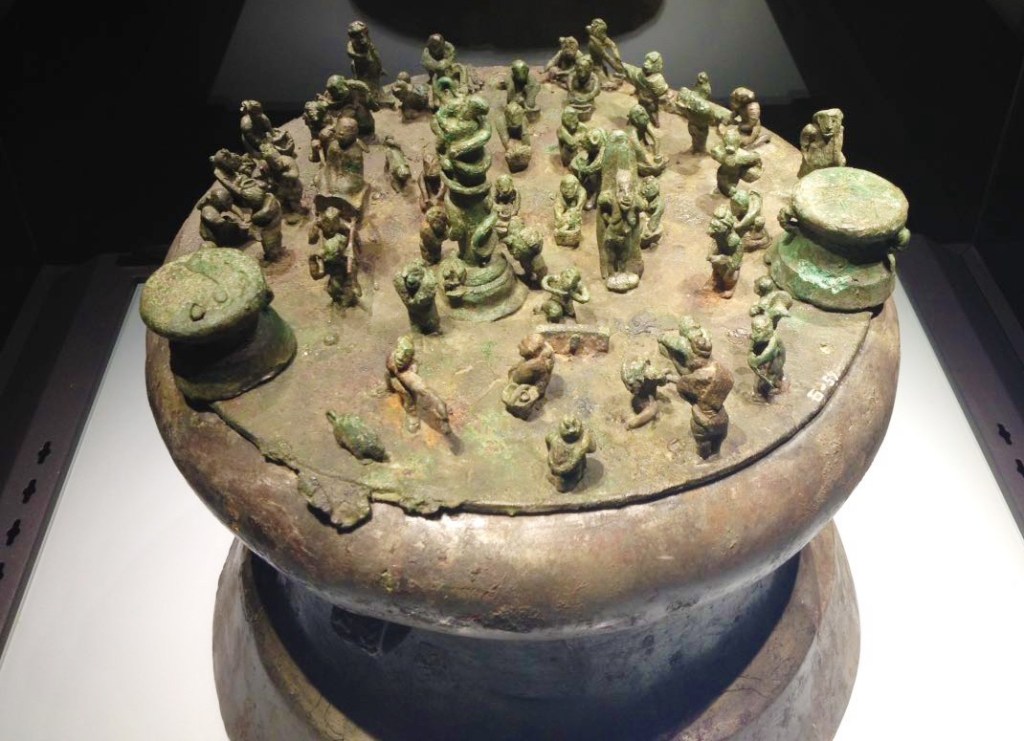
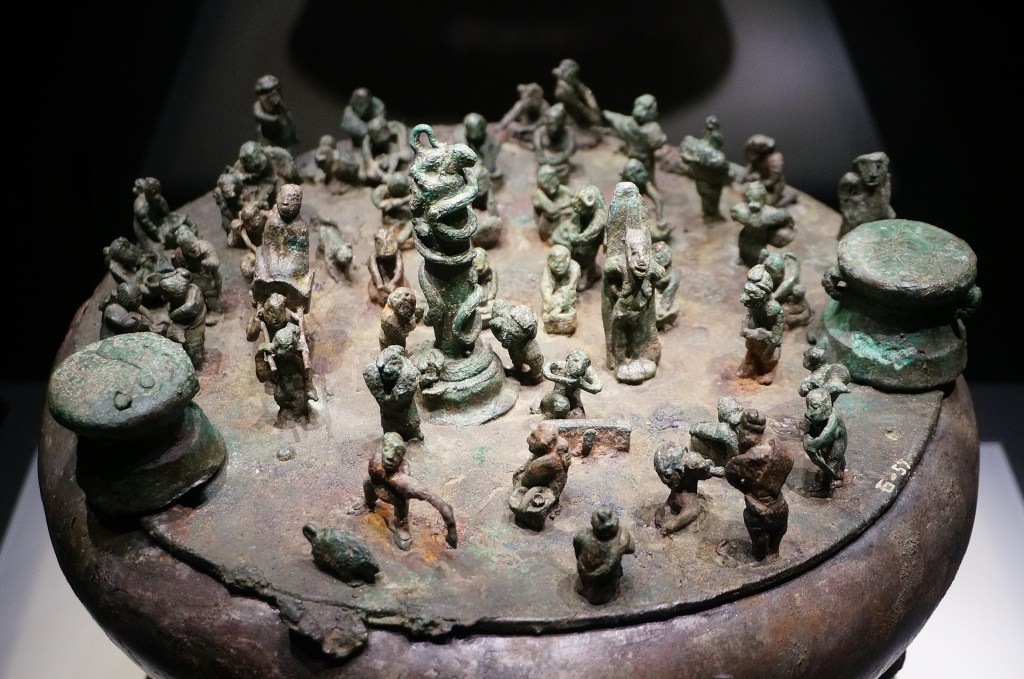
I spent the entire afternoon poring over pictures of the archaeological finds. One image in particular caught my attention—a bronze drum with multiple miniature figures on top. I studied it carefully. The more I read, the more convinced I became that this drum might hold the key to solving the mystery of the body Leigh and I found on the cape.
That evening, when Leigh got home, I made a solemn announcement: “My dear Leigh, I think I’ve found a clue to the mystery.”
“There you go again,” Leigh sighed, rolling her eyes.
“Hear me out,” I said, unable to contain my excitement.
“Okay, let’s hear it,” she said. “By the way, what’s for dinner?”
Sometimes, when Leigh spoke to me, her words didn’t register—and this was one of those times.
“I’m super excited about this,” I began. No doubt my face was flushed, my eyes sparkling like a soccer player about to take the shot of a lifetime.
I placed my laptop on the desk and opened the image I’d prepared:
“What about it?” Leigh asked, arms folded.
“This bronze drum dates back to the 2nd century A.D. On top of the drum, you can see what appears to be a scene of a ritual sacrifice. Look first to the left at the woman on a sedan being carried by four men. She is likely overseeing the ritual—perhaps a chieftain or a semi-divine figure. Now look at this figure on the right—he’s completely naked, his hair tied to a plank, and his hands bound behind him. Notice also the man sitting on the ground—one foot locked in a shackle, while the other is free…”
“So what?” Leigh said. “This is a museum piece. What does it have to do with the body we found in the cave?”
“Good question!” I said, warming to my subject. “Now, look here. Here’s another man—his head is missing. Where did it go? Yes, you guessed it—it was just cut off.”
“But I still don’t get it,” said Leigh.
“Next, look at the bronze post in the center. Archaeologists believe it’s the centerpiece of this scene—the object of worship. These three men were being prepared as offerings to this mysterious deity post.”
“Are you saying the woman we found in the cave was sacrificed to some god—or to a post like this one on the drum?”
“Not exactly,” I said, savoring her attention. “Human sacrifice isn’t practiced anymore. What I’m suggesting is that the way the woman was killed—the way her body was staged, with her head and hands tied to a post and one foot locked in a shackle—suggests the work of someone who knew this stuff well. Like…”
“Like someone who works in a museum?” Leigh interjected. “Or a college professor who’d know about such things?”
“Exactly!”
“Let’s say this person killed the woman. Why would they arrange her body that way? It doesn’t make sense for someone to commit murder just because they know about a drum.”
“You’re absolutely correct!” I said. “Want to hear my theory?”
Leigh hesitated. She was a competitive person—I knew her well.
Seeing that she wasn’t going to offer a theory, I pressed on. “When people kill, the motive is rarely complicated: revenge, money, love—those are the basics. My hunch is that, in this case, the motive is money.”
Leigh had sat down by now, her brows furrowed. “I think I read something in the news about items going missing from the provincial museum,” she said.
“You’ve just found another piece of the puzzle!” I exclaimed.
“Really?”
“Yes!” I said, brimming with excitement. “Think about it—what if the dead woman was the murderer’s colleague? What if they collaborated on the theft, and her death was the result of a dispute between them? That would explain the ritual arrangement of her body.”
“But I still don’t see why the perpetrator would…”
“Easy,” I said. “It’s the murderer’s revenge on his partner in crime—his way of venting his frustration and anger at her. You can literally read his mindset from the way the body was staged. It’s as if he were saying to her, ‘You wanted it all, didn’t you? Now you can have it—all of it: the hair, the hands, and the shackle.’”
“You see, my dear,” I paused for a moment before continuing, “the ritual scene on the drum was their language—what they constantly talked about and referred to, maybe over months, perhaps even years. Planning, replanning, savoring the sweet anticipation of the coveted object, the details of which they knew so well.”
“Now that you put it this way, it all starts to make sense,” Leigh said. And for the first time in a long while, she smiled at me.
“And I’ll draft a letter tomorrow and send it to the police,” I added quickly. “Don’t worry—it’ll be anonymous!”
“You know what?” She got up with a glint in her eye. “Why don’t we dine out tonight? I think you did a great job. Let’s go celebrate.”
I was overwhelmed with emotion, and before Leigh could react, I had swept her off the floor and started swinging her around. I might be her Jimmie, often afraid of her the way I had been afraid of my mother, but physically, I was big—big and strong. And in that moment, I just wanted to keep her dangling and laughing.
“Put me down, put me down, you big monkey!” Leigh couldn’t stop laughing and giggling.
Later, when Leigh was all dressed up and we were about to head out, I pulled her close and gave her a long, lingering kiss.
“You’re so beautiful tonight,” I said softly.
 Yego’s Chronicles