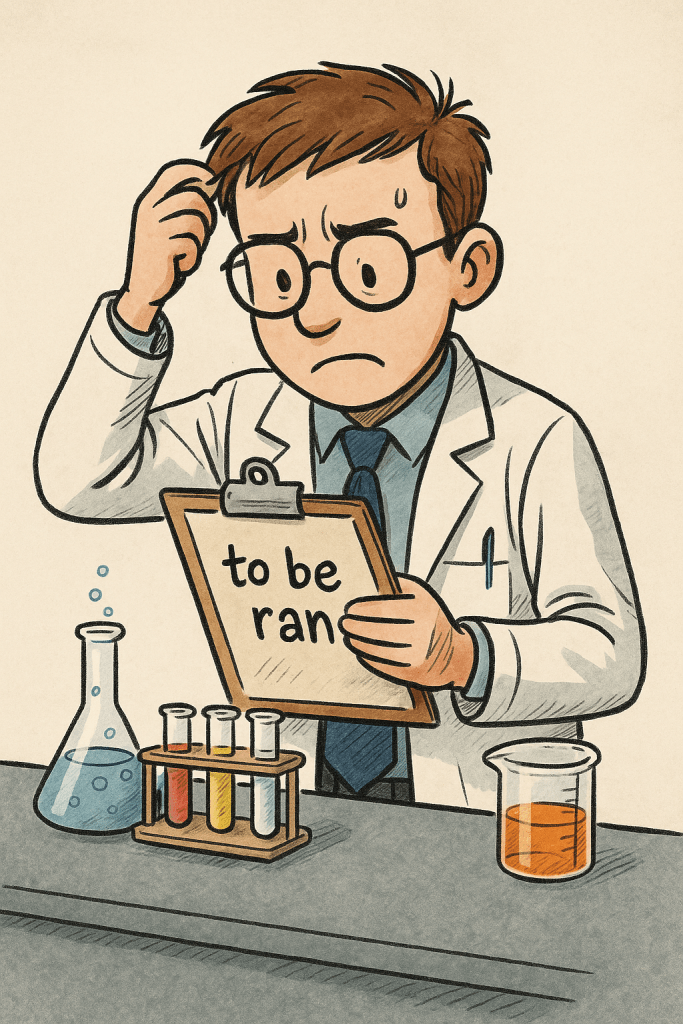
The inspiration for this post came from a lab analyst’s comment I recently saw:
“Carryover did not meet criteria (28% carryover). Plate was stored in AB-123-4567 to be ran on different system.”
Now, this kid’s name is not Wang Xiao Qu or Nikolai Petrov, but your ordinary John J. Smith, native-born, raised on cheeseburgers and baseball. And if you had asked him, out loud, why the plate was stored on a different system, he would have said:
“… to be run on a different system.”
Not “ran.” Zero chance. So what happened?
Here’s my theory.
The writing system of a language is not something “of nature, by nature, in accordance with nature,” as Aristotle might put it. It’s a man-made contraption—unnatural, learned, and often at odds with the grammar of the spoken language it is meant to represent. When our poor lab kid wrote “… to be ran,” it wasn’t because he doesn’t know English. He knows it perfectly well; he’s a native speaker. The error happened because of mindset—specifically, two subconscious factors at play.
1. The Scientist Hat
The moment he sits at the lab bench, he’s no longer just some kid from the neighborhood. He’s a scientist. And scientists are supposed to sound like scientists, right? Something about the phrase “to be…” triggers a little alarm in his head: Don’t write it the way you’d say it at home. Make it sound formal. Make it sound… scientific. So instead of the plain, correct “run,” his brain scrambles to make it more “proper” and lands on “ran.”
2. The School Effect
This is where school comes in. From the first day we learn to write essays, we’re taught—sometimes directly, sometimes by example—that writing is not supposed to sound like speaking. You don’t write “We talked a lot about this.” You write “We had an extended discussion.” You don’t write “In the past, we always did things this way.” You write “Historically…” Over time, you internalize the idea that written words must somehow be different from spoken words—even when they shouldn’t be.
And that’s how you get “to be ran.”
A Story from Kunming
This isn’t just an English problem. Years ago, fresh out of college, I landed a job in the HR office of the provincial Bureau of Geology in Kunming, China. Part of my job was copying promotional materials submitted by cadres applying for promotions.
That was around the time when many of China’s first-generation revolutionary leaders were dying of old age. On the radio, funeral announcements went like this:
“Comrade So-and-so, passed away at the age of 85.”
“Marshal Comrade Such-and-such, passed away at the age of 87.”
“Chairman Comrade This-and-that, passed away at the age of 86.”
“Comrade Surgeon General Whoever, passed away at the age of 84.”
And in Chinese, the same announcements would be phrased like this:
“Comrade So-and-so, zhòngnián 85.”
“Marshal Comrade Such-and-such, zhòngnián 87.”
“Chairman Comrade This-and-that, zhòngnián 86.”
“Comrade Surgeon General Whoever, zhòngnián 84.”
The formal term zhòngnián (终年, literally “final age”) was everywhere. On TV and radio, all you heard was “zhòngnián 85,” “zhòngnián 87,” “zhòngnián 86,” “zhòngnián 84.”
One day, while copying self-statements in promotion applications, I noticed something hilarious. Many of the lower- to mid-level employees used “zhòngnián” for their current age. A typical self-statement read:
“I, so-and-so, zhòngnián 45, worked in the field for 10 years…”
They weren’t saying they were dead at 45. They were just imitating the “formal” way they thought one was supposed to write—just like our lab kid with “to be ran.” After weeks and months of hearing funeral announcements phrased that way, “zhòngnián” had quietly slipped into their mental toolbox of what official writing should sound like.
The Common Thread
Whether it’s a young lab analyst in an American lab or a Chinese cadre hopeful in Kunming, the story is the same:
We all know how to speak our mother tongue. But the moment we have to put on a hat—“I’m a scientist writing a lab note,” “I’m a qualified cadre seeking promotion”—we leave the natural, living language we actually speak and wander into the strange, rule-bound world of “proper writing.”
And that’s when the funny stuff happens.
 Yego’s Chronicles