1
Ah, once upon a time — 从前, autrefois — many years ago — 有一回, il y a bien des années, un jour, in the early summer, I was coming back to Kunming from the geological training school of the Bureau down in Lunan.
I stood by a dusty country road waiting for the long-distance bus — back straight, a book I’d been reading for months clutched in my hand, wearing the same clothes I’d had on for days. The iron horseshoe tacked to the heel of my leather shoe was still the one the Zhejiang woman cobbler on the city street had hammered on during my last trip home. My hair? — who knows what it looked like; I probably hadn’t had it cut for months.
A boy just past twenty, no longer a teenager yet not quite a man. Most of each day I lived up among the clouds of imagination — my head filled with daydreams, heaven and earth, the Middle Kingdom and the foreign lands. Countless thoughts, none of them logical; countless pictures, few connected with the reality before me. Looking back, there was no history — for life had just begun; looking ahead, no future — for I was someone who lived only in the moment. Ah well, so it was.
If I were a woman — even one of today’s bottom-of-the-basket oranges — I’d never have married such a man. I’d wait until I was thirty-seven to find a boyfriend, and he’d have to be older than me — someone surnamed Qin, given name Shihuang, who burns books, buries scholars, and unifies weights and measures — and at that, my poor old mom just lost her mind.
The stop was called Beida Village, right where today’s National Highways G209 and G324 intersect. Back then it was the Eastern Yunnan Road. Buses came from Kunming, passed here, went through Luliang toward Guangxi and Guangdong; you would then board Zheng He’s ships, cross the seas to Singapore, Malaysia, Thailand — speak Hakka and eat curry rice.
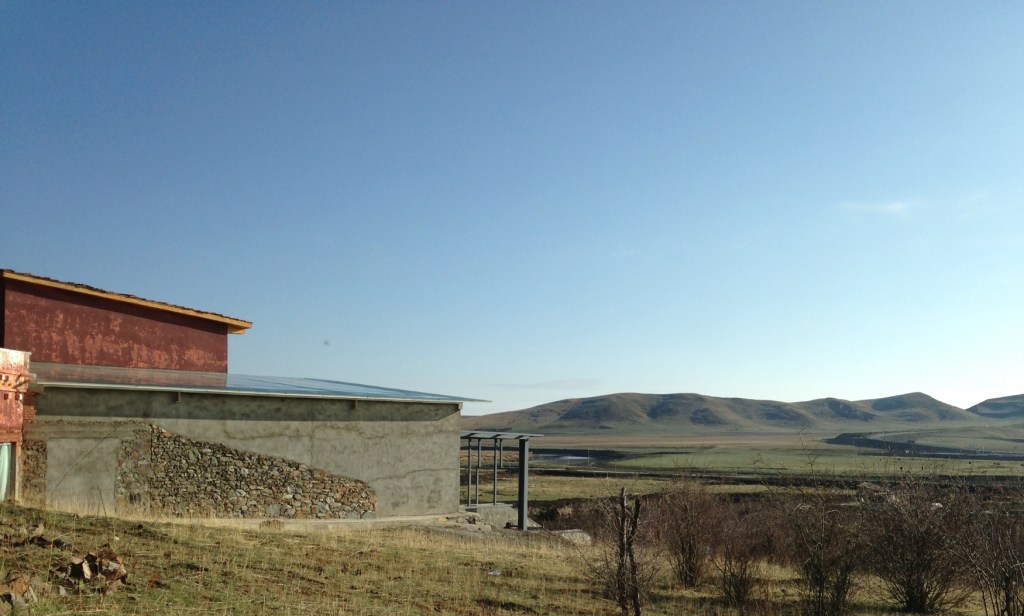
There were no stop signs, no road marks. A few thatched huts stood by the road, a few old eucalyptus trees with trunks smeared red by dried mud. In summer, the people waiting for the bus were spattered with that same red mud. If you followed the Yunnan-West Road to Gejiu, the mud turned purple; go farther down to the Mekong, and every color of mud would coat you — because by then you’d be soaking wet.
While I was waiting, a battered old 1950s Cadillac showed up from nowhere, dragging along someone important perhaps, or maybe a provincial official’s prodigal son. The car turned off the highway onto a dirt track through the fields. A few loafers from the village stood by the road. When the driver stopped to ask directions, I heard them say, “Your chassis is too low — you’ll have trouble.”
I thought, What the hell do these bumpkins know about a chassis?
Just then the long-distance bus arrived — the kind with a luggage rack on top and its body painted that heartbreaking gray-yellow. The kind that tears you away from your loved ones, or carries you to see them after long years apart, or takes you off alone with no idea where you’re headed. The color of sorrow and tears — the color of summer rain, falling for a moment and gone again. But best if it didn’t rain, or the red mud would splash all over you.
I scrambled aboard. The others, fearing the splatter too, hurried up as well, grabbing the railings. If you weren’t quick, there’d be no time left for sadness — you’d be stuck waiting for a freight truck at Beida Village, or walking back to the training school and trying again tomorrow — sad a few more times. And when the sadness was over and you read your book again, everything would be forgotten. Tears and sorrow — worth not a penny.
Ai! A grown man talking of sadness and tears — doesn’t that make your face burn? Why not study like Yang Zhenning, win a Nobel Prize, or like Chen Jingrun, stand tall and climb the peaks of science, score a perfect hundred in every exam? And if you can’t climb high enough — then piss in a puddle and drown yourself in it, spare the nation the shame of seeing your sorry hide. Utter disgrace!
The passengers who got on were all country folk from Lumeiyi — minority villagers, Yi or Sani people. Every one of them looked like a minority, and the women, whichever way you looked, looked like Yang Likun herself. The same kind of faces you see when you visit Shilin, the Stone Forest — they are those people.
The places along the route were all Yi villages I knew well: Zhiguoshi (Fire-Pot Stone), Leidapo (Thunder Hit Slope), Wanyaoshan (Bent-Your-Waist Hill), Bajiang River. It took hours to reach Kunming. And even when we said Kunming, what we really meant was Guandu (Official Ferry), Dabanqiao (Big Wooden Bridge), Xiaobangqiao (Small Wooden Bridge) — long-braid girls, short-braid gals, as the folk song goes.
Among the passengers were a young girl and a middle-aged woman. They got on together and sat near the front; I sat in the back. The older one was short — She must have been the mother, yet something in her bearing made her seem more like the girl’s nanny than her mother. The younger one sat composed and quiet, with a kind of modest grace that’s hard to put into words.
All the way, the mother never took her eyes off the girl, her face filled with admiration — almost worship. The girl, though dressed in Han-style clothes, had a little upturned nose and a pair of shy, blinking eyes. Her long, fine hair was coiled in soft rolls atop her head. She didn’t look Han. She looked Yi — like one of the Lumeiyi people, like Ashima, like the singing girls and boys in those mountain-song films.
And in Yunnan’s Midu mountain songs, they sing:
山对山来崖对崖,
蜜蜂采花顺山来。
蜜蜂本为采花死,
梁山伯为祝英台。
Mountain cliff low, mountain cliff high,
Along the ridges the honeybees fly.
The bee lives — and dies — for flowers;
And Liang Shanbo dies for Zhu Yingtai.
山对山来崖对崖,
小河隔着过不来。
哥抬石头妹兜土,
花桥造起走过来。
Mountain cliff low, mountain cliff high,
Lovers cannot meet, the streams divide.
Brother lifts the stone, sister carries earth,
Build a flower bridge and we can unite.
Midu isn’t Lumeiyi, he mused, but both are Yi country — so really, what difference does it make?
2
By afternoon, the long-distance bus rolled into the Kunming West Coach Station. Passengers began to get off: those without luggage walked straight away; those with luggage stood by the bus, waiting for the driver to hand down their bags from the roof rack.
Back then the West Station, apart from being large, was hardly different from Beida Village, where I’d boarded — the same billowing dust, the same peeling eucalyptus trees by the road, their trunks crusted with sun-baked red mud.
But hey, don’t underestimate this West Station! It was the major gateway from Kunming to western Yunnan — and on to Thailand and Burma. Before the Second World War it was already the hub for both passengers and freight. Don’t believe me? Go dig up an old map.
And what’s more, right next to it stood Hongshan Provincial Middle School — today’s Kunming No. 1 High School — alma mater of the Nobel laureate Yang Zhenning and mathematician Xiong Qinglai, where famed men of letters such as Wen Yiduo and Wu Han once taught. Not to mention that long line of celebrated fliers who came out of there — sparrows, swallows, and Abbie’s mom among them. The cicada and the young dove laughed, saying, “We rise and flutter among the elms and the willows; our flight never reaches far, for we soon fall to the ground — why speak of soaring ninety thousand li to the south?”
When I saw the mother and daughter get off, I hurried down too, hoping to talk with them — or else they’d vanish into the crowd and be lost forever.
Most of the time I spoke to the mother, though she had no confidence at all. Each time she answered, she’d turn to look at her daughter, as if she couldn’t speak a word without permission.
I asked the mother, “A-ma, what’s her name?” She turned toward Axia:
“Axia, you tell this young brother your name.”
I asked, “A-ma, if I come visit Axia tomorrow, where do I go find her?” Again she turned toward Axia:
“Axia, you tell this young brother where we live.”
Her name was Axia Yiruo, and they lived in Hongshan.
When I parted from them, a sweetness came over me — the kind of inexpressible sweetness only a twenty-year-old could feel.
“Axia Yiruo, Axia Yiruo,” I kept repeating the name, afraid I might forget it. Such a lovely name!
I wondered what relation she had to Ashima — was she a little sister of hers, perhaps? People of the Han have always written Ashima wrong. Shi is the family name, and in the Yi tongue Ma simply means “girl.” So Ashima means “the girl of the Shi family.”
Oh-oh-oh! If by that pattern, then Axia Yiruo must mean “the girl of the Xia family.”
Mamma Mia! Or in my local dialect, Méiméi sān! Who would’ve thought of that!
3
From the West Station I walked along Huancheng Road toward the Kunming Bottled Liquor Plant, located in Xiba — literally “West Dyke” — at the far end of People’s East Road.
A high school friend of mine worked there after graduation. I found him in the workshop. It wasn’t quitting time yet, so I just sat there waiting for him. Noise everywhere. The smell of yeast and fermentation everywhere. It smelled like sour bread.
That night I stayed in their dormitory. We hadn’t seen each other for a long time, and once we crawled under the covers, we had endless things to say. I had so much to tell him. We talked half the night and still weren’t done. There were others in the dorm too, all fast asleep.
I told him about waiting for the bus by the roadside at Beida Village. The suitcase I carried had a few books inside — they were for him. One was called Dubliners, one The Rubáiyát, and one Yoknapatawpha. I told him about the trees by the highway, their trunks covered in dried red mud. I told him about the Yi villages the bus passed through: Shaorenchang (Burning Ground), Majianshan (Horse-Sees-the-Mountain), Shinannan (Murmuring Stone).
I told him I’d met a beautiful girl — beautiful and mysterious. Her name was Axia Yiruo, perhaps the younger sister of Ashima. The reason I said that was because one was Axia and the other Ashi — that can’t be coincidence. In the Qing Dynasty scholar Duan Yucai’s Supplementary Annotations to the Shuowen Jiezi, it says: Shi and Xia are phonetic variants — one a tongue sound, the other a dental.
My friend nodded vigorously in agreement.
She had fair skin, a small upturned nose, fine hair braided in coils neatly looped atop her head, and a face like an angel. And I told him that my heart was full of love for her.
Even though it was I who spoke, for the two of us it felt as though it wasn’t me at all, but someone else — someone who had just read a good book and was now telling us the wondrous things it described:
.. the stars winking in the night sky, the meteors fleeting across, the Milky Way that never sets. Lunan. Shilin. Lumeiyi. Ashi Ma, Axia Yiruo. Méi méi sān, mamma mia —the names drifted through the darkness like fireflies.
No wonder we didn’t sleep well that night; in the morning, we both woke up dizzy.
4
Every weekend, when I came back to Kunming from the geological training school in Lunan, I would go to Hongshan by the West Station to see Axia Yiruo.
I never knew what kind of work she did — she seemed only a few years out of middle school. I’d never thought about it, and so I’d never thought to ask.
If I went to her house in the morning, I wouldn’t leave until the afternoon; if I went in the afternoon, I’d stay until evening and have dinner with her family before going.
I guess I’ve always been a little foolish in this life — a few screws loose in the head.
I’d sit there in their home, eating and drinking as if it were my own house, never once wondering whether they actually welcomed me, or whether they found me a bother.
Each time after dinner I’d offer her father a cigarette; he’d hand me a cup of tea, and then we’d talk. What we talked about, I can no longer remember. I was transparent, and he was an adult. Thinking back now, he probably saw me as one might see a three-year-old child.
He wasn’t a man of many words. I still don’t really know him. But what does that matter? Whatever came to my mind came out of my mouth, and whatever came out of my mouth was what was in my heart. I didn’t know what it meant to hide things, and so I had no restraint, no fear. But to be honest, I never thought about any of that —I simply liked Yiruo, and I liked her gentle, harmonious family.
Something about them drew me in completely.
While I was talking with her father, Yiruo and her mother would be off to one side doing something — I forget what exactly — maybe watching TV, maybe crocheting, or something else. Probably knitting. To me, that seemed the most natural thing in the world: I sat with her father, drinking tea and smoking; they, the women of the house — both dear to us — did their own quiet things. Wasn’t that exactly how things ought to be?
One night, it was already late when Yiruo’s father walked me to the West Station to catch the evening bus. There was construction near their house then, and a big trench had been dug across the ground. It was dark; I didn’t see it and fell straight in. Gone in an instant! Hearing the thud, Yiruo’s father turned back, peered down into the pit, and a faint smile crossed his face — he must have found it a little funny. Without a word, he reached out a strong hand, motioning for me to grab hold, and with one pull he lifted me out. I didn’t feel embarrassed — only struck by how steady, how solid, how strong he was.
Ever since that little mishap, whenever I think of it, I think: Axia’s father — now there was a real man.
5
Aside from visiting Axia at their house, where else did I go in those days? On West Dongfeng Road, opposite the Opera House, there was a café. Another one — was it Nan Lai Sheng Café? — stood on some other street; I’d have to think a bit to remember the name of that street. My friend at the Xiba Bottled Liquor Plant knew Kunming inside out — he knew where to find Vietnamese coffee, where to get French pastries. I’d have to ask him one of these days.
Each time I came back to the city, I went to see Yiruo. During the day her parents were never home. She had a younger sister, still in primary school, also away at class. I’d sit on the sofa; she’d sit opposite me, doing embroidery or something like that. I talked to her about the books I’d been reading, about my dreams. She rarely interrupted, just sat there so quietly. The look on her face when she listened reminded me of her father.
My head was full of things from books, and I told her about them. If there was one I particularly liked, I’d lend it to her.
One day I went to see her, and I gave her a book I’d just finished — Hemingway’s A Farewell to Arms. It’s about an American soldier who goes to fight in Europe during the First World War. The cruelty and absurdity of war shatter his idealism, leave him disillusioned, and afterward he and his girlfriend drift through Europe — buying roasted chestnuts in winter on the streets of cities ruined by war.
The next day, when I went again, she said, “I finished the book. But there are things I don’t quite understand. For example, the people in it don’t seem to have any jobs, yet they can move from one city to another. Where do they get their money — how can they just go here and there?”
I froze for a moment. It was a question that had never crossed my mind while reading. In the story, the man and his lover wander everywhere — eating chestnuts, drinking wine — but nowhere does it say where their money comes from. She asked, and I couldn’t answer, because I’d never thought about it.
Axia was a girl; she thought more practically than I did. I was like a kite, ready to fly into the sky —but she was the string that held me, or else the wind would have carried me away.
6
After half a year at the training school, a personnel transfer came through — the provincial bureau wanted me to join a geological team in northwestern Yunnan.
The day before I was to leave, I went to Yiruo’s house to ask her out for a walk in town. Just as we were about to head out, someone knocked on the door. She went to open it — it was her neighbor.
The neighbor didn’t know I was there. I hoped she wouldn’t come in, because it was just the two of us inside; if she came in and started talking later, it might cause trouble for Axia. They chatted for a while at the door, and then the neighbor invited her to go into town to shop together. She declined, but the woman was insistent, almost stubborn about it.
I found it both amusing and a little uncomfortable, worried that Axia might have to invent excuses or say something insincere to get out of it. I didn’t want that — not because it mattered what she said, but because I didn’t want anything to blur or taint the image I held of her in my heart. To my surprise, not a single false note came from her mouth.
Each time I thought, the next line will be the excuse, it never came. She just stood there in the hallway, her voice soft and gentle:
“Not go lah — not go today, another day go lah.”
Here in America, they have a phrase for what Axia did: withholding truth — knowing the facts but choosing not to speak of them. It’s a completely different thing from lying. I felt relieved. Yiruo hadn’t lied — she had simply withheld the truth.
Later, on the way into town, I said, “Your neighbor’s quite persistent!” She smiled. “She’s a good friend.” I teased her, “You withheld the truth.” She only smiled.
As we walked around the shops, she asked how far away my new post would be. I said, “From Kunming, past your hometown in Lunan, toward Shizong. I’ll be teaching for a while — probably only back once a semester.” She said nothing.
Back then, there was a movie theater on Nanping Street that showed films whose run had already ended elsewhere. That day they were showing an old Romanian film at the matinee — I forget the title now. It was about a lineman. One winter, in a snowstorm, the power lines snapped and the city went dark. The man was sent to repair them. He trekked through the mountains, fixing each line one by one.
In the final scene, he was high up on the last pole, reconnecting the final wire. The instant the circuit was restored, the distant city suddenly lit up — tens of thousands of lights blooming out of darkness. And he — his hair, beard, eyebrows, and clothes — was covered in white snow, frozen into the shape of a snowman.
I found the film deeply moving. Sitting there in the dark, my throat tightened again and again. I turned to look at Yiruo, to see whether she too was moved. Her face showed no expression — only a faint, faraway blankness.
7
The next day I set out. I took a bus first to the training school, stayed the night, and the following morning, with my luggage in hand, caught a ride — if I was lucky — to the geological team in northwestern Yunnan.
It was the end of December. When I got off at Beida Village, dusk was already falling, and snowflakes were drifting down from the sky.
I wore my old leather shoes and my grass-green army coat with several buttons missing. The last time those buttons had fallen off, a pretty salesgirl at a shop on Wangfujing in Beijing had noticed, taken pity on me, and handed me a needle and a few strands of thread so I could sew them on right there in the store. Three years had passed; the buttons were gone again.
From the highway to the geological training school was five kilometers, all dirt road. Anyone who’s been to Shilin knows what those roads are like — no big mountains, no flat plains, just red-earth hills. Here and there stood weathered rocks, like mushrooms scattered over the fields. If there were more of them, larger, they’d make another Stone Forest; and then the one you visit today, the one you tell your friends about, wouldn’t earn quite as much money — it would have competition.
Night fell quickly, the snow thickening, dancing in the wind. At first I thought of Axia Yiruo, of the calm in her eyes at the cinema, her slight figure. Then my stomach began to growl, and I thought of her village — not far from here, called something like Shebo, or Zhebai, or Yiweishao. I’d been there once, visited her father’s mother. Her family might have given me a round of rice cake to eat, or roasted corn to chew.
Later, walking on the dirt road, I thought: whoever walks alone through the hills on a snowy night like this must be some kind of hero — like Wang Jinxi, the Iron Man, or Wang Cheng, the battlefield hero. Thinking that, I remembered the Romanian film I’d seen the day before in the city. In my mind I imagined myself as that Romanian lineman — maybe his name was Babu Ceausescu, or Radu Iliescu. As I walked, I kept looking up for power lines snapped by the storm, ready to climb and mend them.
After a while another thought came — Tolstoy’s War and Peace. The Chinese translation has four volumes; I’d finished only the first three. The fourth I’d left half-read, lying open on my desk at the training school. Andrei, Natasha, the Battle of Borodino, the vast Russian plain, the frozen land that buried Napoleon’s army.
I looked up at the night sky — snow everywhere. It seemed what the book said was, indeed, true.
I kept walking, hunger returning. Sometimes I felt cold, though mostly I felt nothing at all. Why had I chosen a snowy day to come back? Why had I taken such a late bus, arriving after dark? It might not even have been a passenger bus, but some truck whose driver kindly gave me a lift.
I walked and walked, wanting to sing a song, yet none came to mind. Instead I remembered James Joyce’s short story “The Dead,” and the final two paragraphs:
“It had begun to snow again. He watched sleepily the flakes, silver and dark, falling obliquely against the lamplight. The time had come for him to set out on his journey westward…
Yes, the newspapers were right: snow was general all over Ireland. It was falling on every part of the dark central plain, on the treeless hills, falling softly upon the Bog of Allen and, farther westward, softly falling into the dark mutinous Shannon waves. It was falling, too, upon every part of the lonely churchyard on the hill where Michael Furey lay buried. It lay thickly drifted on the crooked crosses and headstones, on the spears of the little gate, on the barren thorns. His soul swooned slowly as he heard the snow falling faintly through the universe and faintly falling, like the descent of their last end, upon all the living and the dead.”
As I murmured the words to myself, without realizing it I had reached the top of a small hill. In the blackness ahead, lights flickered in the distance. I realized I was home. A quiet joy rose within me. I was almost there — even if it was only a traveler’s home. I forgot the cold, forgot the hunger, forgot the weariness. In my mind I could already see my room, its warmth, the soft glow of the lamp on the table, and my unfinished War and Peace lying open, waiting for me.
Before I even knew it, my legs began to run.
I ran and ran. Snow fell on my head, on my face. Snow buried the footprints I’d just left, buried the path ahead. In my imagination I was the lineman in that Romanian film, standing stiff atop the pole. Because of me, Yiruo’s home had light; because of me, the world had light. And at that thought my eyes grew wet — tears clung to my lashes. Snow and tears blurred my sight, turning into countless glittering stars in the night sky.
Looking back now, I sigh — how foolish I was when I was young.
 Yego’s Chronicles