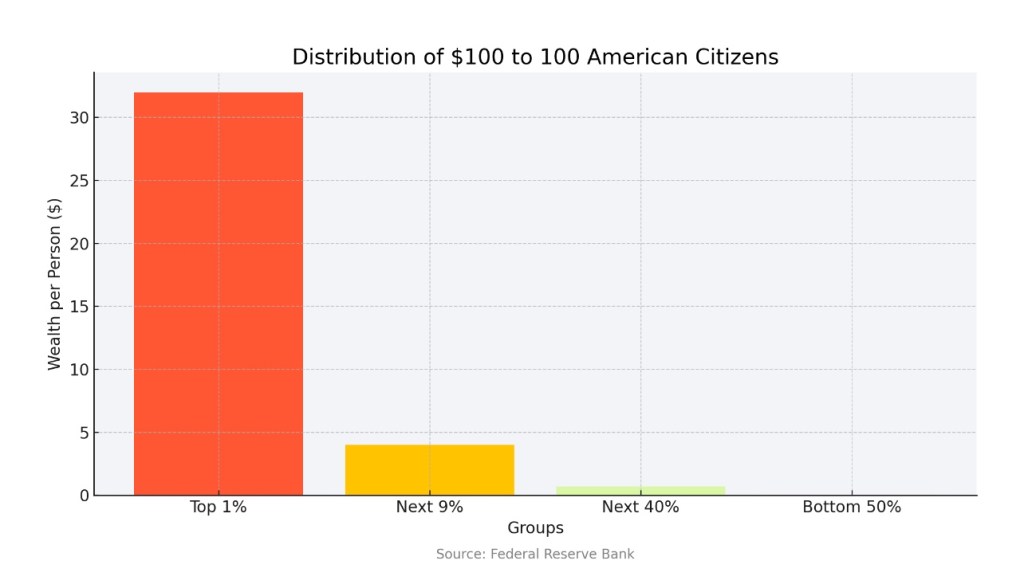
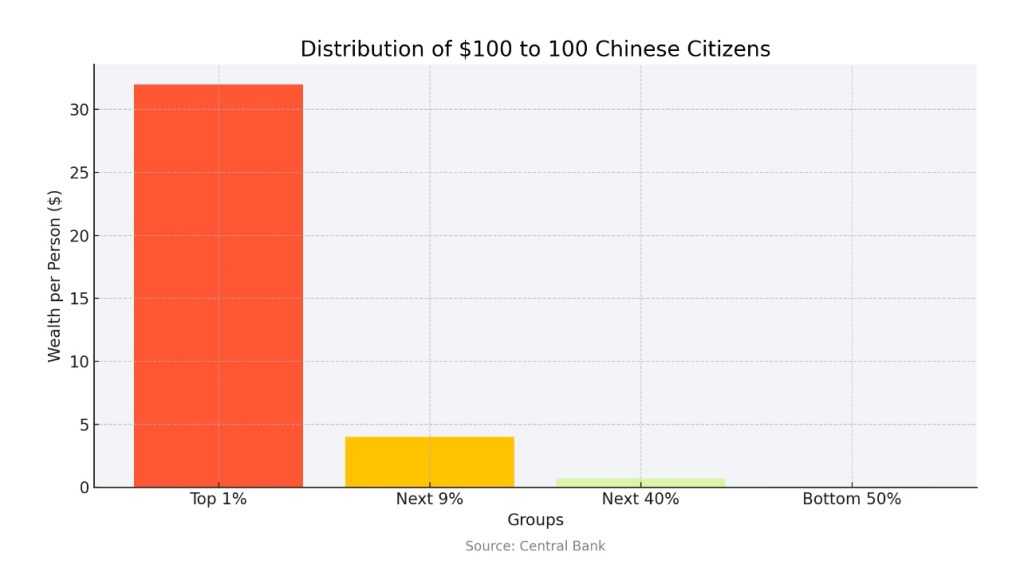
Let’s talk about these two identical charts I have in front of me. Both of them show wealth distribution: one represents the U.S., the other represents China. What do these charts tell us? Well, they show something quite revealing—about both countries. In each, the top 1% holds a lion’s share of wealth, and the bottom 50%? Barely anything. These charts are nearly identical in numbers, but here’s the question: If the wealth distribution is the same, why is the U.S. the U.S., and China, China? Let’s solve this puzzle.
First, let’s look at the U.S. You’ve got your top 1% holding $32 of every $100. The next 9% has $4. The next 40%? Just 70 cents. And the bottom 50% gets, shockingly, only 5 cents. That’s a huge gap. But this chart isn’t just about money—it’s about power too. And here’s where it gets interesting: In the U.S., this wealth also means political power.
Imagine someone from that top 1%—let’s call him Rockefeller. Mr. Rockie decides he wants more than just wealth; he wants influence. So, he uses his fortune to run for office. He buys TV ads, funds his campaign, and guess what? He gets elected to Congress. Now, Rockefeller isn’t just part of the top 1%; he’s part of the government. In the U.S., the government is inside the chart—power and wealth mix. The rich can buy influence, and the government, in many ways, reflects the distribution of wealth we see in that chart.
Now, let’s shift over to China, where the chart looks exactly the same. The top 1% in China holds just as much wealth as in the U.S., the next 9% has their share, and the bottom 50% barely holds anything. So why doesn’t China look like the U.S.? Here’s the twist: In China, the government isn’t part of this chart.
How does that work? Let’s say you’re the richest person in China. You’ve got your millions, maybe billions, but can you use that money to run for office? Nope. In China, government officials aren’t elected—they’re appointed based on merit and performance, not money. The system of governance is entirely separate from wealth. No matter how rich you are, you can’t buy a political office. The government sits outside the chart. Wealth and power are distinct.
So, even though the distribution of wealth looks the same on paper, the relationship between wealth and power is totally different. In the U.S., the government is part of the wealth distribution, influenced by the rich. In China, the government stands apart, not bought by wealth, but rather appointed based on achievement. Two identical charts, but two very different systems.
This raises some deep questions about how wealth shapes societies. If wealth and government are mixed, like in the U.S., does that mean the rich have more say in laws and policies? And if wealth and government are separate, like in China, does that protect the system from the influence of money? These are puzzles that make us think not just about numbers, but about how power is structured in each country.
So, next time you see a chart like this, think about what it really means. It’s not just about who has what—it’s about who controls what, and how that control shapes the entire system. Two charts, one striking similarity—but the differences are what make the U.S., the U.S., and China, China.
The Kanthan2030 chart with which I opened this essay pairs perfectly with this classic cartoon:

You don’t see such “bosses of the Senate,” aka the 1%, in the Chinese system, which is designed to separate money from political power. This design is rooted in Confucian political philosophy, and has been at the very foundation of China’s politcal system for the past two thousand years. Little wonder China’s 1% hate their own country, and hate the people’s party. “Had it not for the government and the Communist Party, our money would not just talk, it would scream! Damn you, China! Unlucky for you, there is the great America, where money talks, where we can safe keep our wealth, which we amassed on the sweat and toil of those yellow people on the other side of the ocean.”
 Yego’s Chronicles