Oxymorons: When Words Get Funny
Ah, the oxymoron! A delightful concoction of contradictions, like when two words that really shouldn’t hang out together somehow make a perfect pair. We’ve all encountered these little linguistic quirks. Take “jumbo shrimp,” for instance. Shrimp, by definition, are small, but slap a “jumbo” in front, and suddenly you’re picturing a shrimp that hits the gym five days a week. Or “clearly confused”—because nothing says clarity like a head-scratching mental fog, right?
Then there’s “pretty ugly,” which makes you wonder, how exactly does someone look both attractive and not-so-much at the same time? Maybe they’re rocking that perfectly disheveled, artfully chaotic look that only runway models can pull off. And who can forget “living dead”? Zombies, of course. Lurching around, proving that you can indeed be alive and dead—just not particularly pleasant to invite to dinner.
But perhaps the crème de la crème of oxymorons, and one that hits particularly close to home, is the term “original copy.” The idea of having more than one “original” makes my brain do a double-take. What, do we make copies of authenticity now? It’s these paradoxical phrases that twist language into playful knots. And let me tell you, when it comes to oxymorons, few can compete with the granddaddy of them all: “large democracy.”
Athenian Democracy: The Classic Party
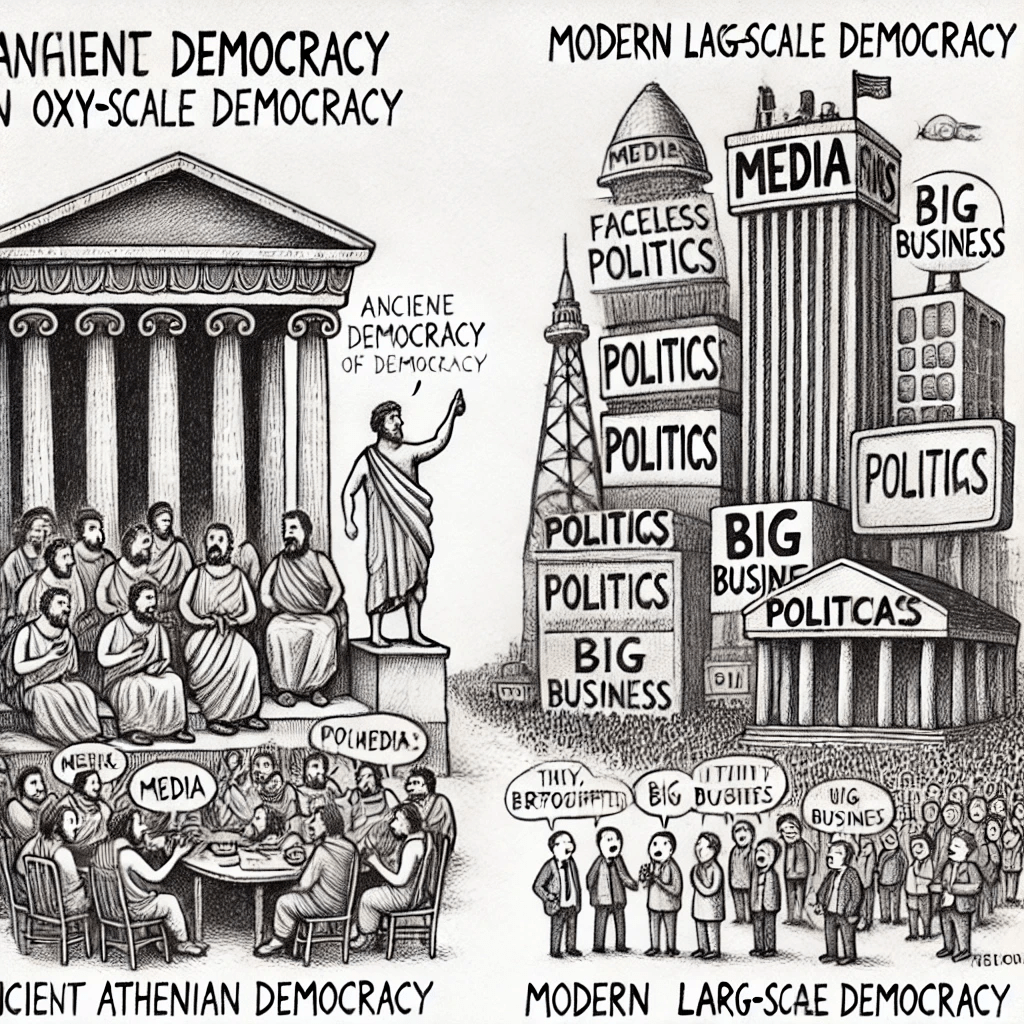
Once upon a time, in a land far, far away (okay, it was Athens), democracy was born, and it looked nothing like what we think of today. This was participatory democracy—none of that ‘representative’ stuff we have now. No, the Athenians went all in. If you were a citizen (and, yes, let’s just glide past the fact that “citizen” excluded women, slaves, and foreigners), you were the government. Every eligible Athenian had the opportunity to debate, vote on issues, and even propose new laws. You could walk down to the Agora, grab a snack, and then participate in making decisions that shaped the city. Talk about getting your steps in while also deciding whether to go to war or not!
This was democracy in its purest form: direct, unfiltered, hands-on. It wasn’t about voting for someone else to make decisions for you; it was about showing up and doing it yourself. Can you imagine the town meetings? It must have been like reality TV with a dash of philosophy and civic duty—except instead of voting people off the island, you were voting on treaties and public works projects.
Now, here’s where things get interesting: this system was small. I mean, it worked because Athens wasn’t exactly sprawling, and only a fraction of the population could participate. In other words, it was manageable. You couldn’t exactly get millions of people to gather in one place and have a sensible conversation about, say, tax policy. The sheer logistics would make even Zeus throw in the towel.
Representative Democracy: When Democracy Goes Large
Fast forward a couple of thousand years, and democracy has gone jumbo. Enter the United States, where democracy means electing representatives to do the democratic work for you. But here’s the kicker: once things got super-sized, we started bumping into some serious problems, like trying to fit a sofa into a compact car.
First, there’s the whole issue of representation itself. On paper, it sounds great—elect someone to represent your views in the halls of power. But in reality, the system isn’t as squeaky clean as it sounds. We’ve got politicians more interested in pleasing donors than the average Joe (or Jane) and institutions carefully set up to keep the general population… well, a little bit in the dark. Let’s not pretend that the goal is always to inform voters so they can make educated decisions. No, the game is more about how to make sure people think they’re making an educated decision, while various powers behind the scenes push their own agenda.
Take the media. Not exactly the unbiased town criers of democracy’s golden days, right? Instead, it’s a never-ending firehose of information (and disinformation) designed to steer public opinion one way or another. Complex issues get distilled into catchy soundbites that play into your emotions, while nuanced policy debates get reduced to a good old-fashioned shouting match. And don’t even get me started on social media, where algorithms gleefully serve up content that feeds into whatever bubble you already live in. In a way, we’re more “connected” than ever, but less informed.
Then there’s gerrymandering, voter suppression, and all the nifty tricks designed to keep the game rigged. It’s not so much a democracy as a dance of manipulation, where a few play chess while the rest of us are handed checkers. The sheer scale of the thing makes it easy to lose sight of what democracy is supposed to be about: the people. Instead, we’ve ended up with a kind of democratic jumbo shrimp—a massive system that looks democratic on the outside but is weighed down by so many contradictions on the inside, it starts to feel like an oxymoron itself.
Wrapping It Up, Shrimp-Style
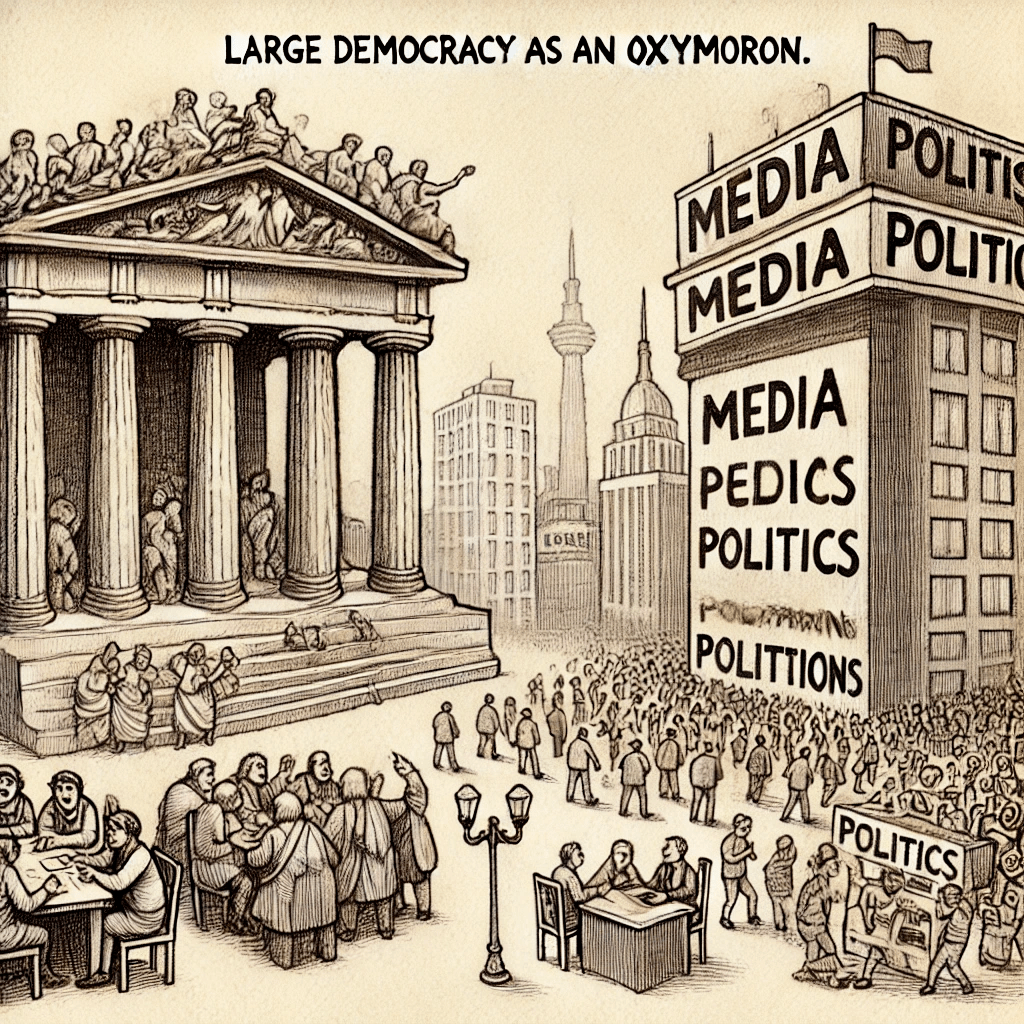
So, is “large democracy” an oxymoron? You bet it is. Just like “jumbo shrimp” or “original copy,” it’s a contradiction that forces you to take a second look. When democracy grows beyond a certain point, it stops being participatory, stops being about the people, and starts being about keeping up the appearance of democracy while all sorts of shenanigans go on behind the curtain.
At the end of the day, it’s like trying to stretch a small-town meeting to fit a country of millions. Sure, we call it democracy, but it might just be the biggest oxymoron of them all.
Over the years, I’ve had more than one person from India telling me, with great pride, that India is “the world’s largest democracy.” I always wondered what the size of a government for a country India’s size would have to be if “people in charge” were to have any meaning at all. In a “democracy” where one elected central government official “represents” one million voters, in what sense such a system can still be called “democracy”?
 Yego’s Chronicles