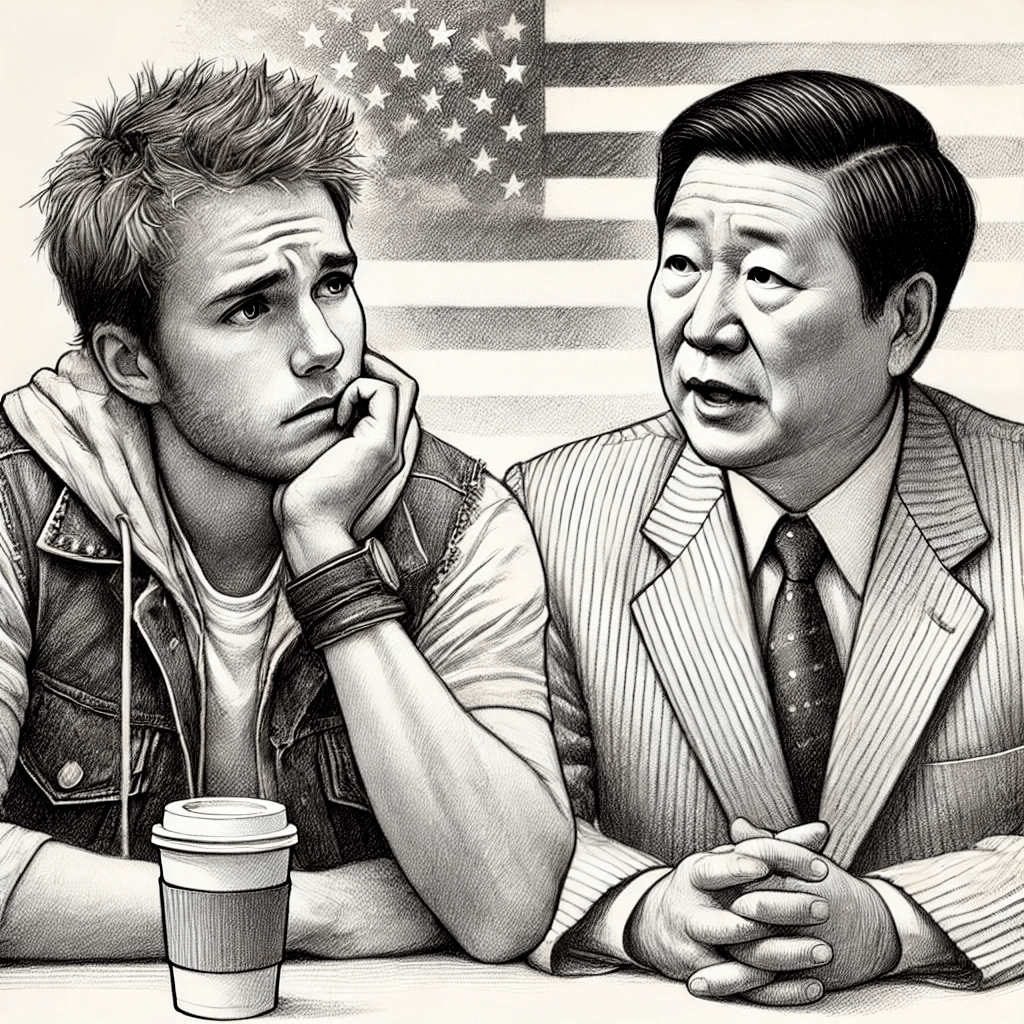
One time during a lunch break at work, I remarked to an American colleague of mine that Americans are the most brainwashed people. He was taken aback. Several days after that, we ran into each other again. He said to me, “On the matter of Americans being the most brainwashed people, I have to agree with you.”
There are two ways to brainwash a people.
The Crude, Patriarchal Way
Imagine a father telling his teenage daughter that she cannot go out after 7 p.m. She asks why, and he responds, “Shut up, or else.” No reasoning, no dialogue—just brute authority. This heavy-handed, oppressive style of control mirrors how propaganda was executed in places like former Soviet Russia or China in its earlier days. The government would assert power and obedience through force or fear, leaving no room for questioning or dissent. The state’s authority was absolute, like the patriarch who doesn’t feel the need to justify his rules. The result? Compliance through intimidation, shaping a population that, though subdued, was deeply resentful and aware of its subjugation.
This method is crude but effective in the short term. The control is overt and based on fear, and the immediate results can be profound. People fall in line because the cost of disobedience is too high. But this kind of brainwashing, while useful for ensuring compliance, also tends to generate resistance over time. The more people are denied the ability to ask “why,” the more they begin to rebel—either quietly through non-conformity or actively through revolt. The control is unsustainable in the long run, as the resentment that builds eventually erupts.
The Scientific Way, aka the American Way
In contrast, the scientific approach to brainwashing—let’s call it the American way—takes the form of slow, subtle manipulation. Imagine that same daughter, but instead of forbidding her outright, the father begins to subtly introduce reasons why going out after 7 might not be the best idea. He might bring up a news report about crime in the area or suggest that staying in is better for her studies. Over time, she internalizes these ideas, and eventually, she decides for herself that staying in after 7 is what she wants. She doesn’t feel controlled; she feels empowered by her “decision.”
This is how brainwashing is done in a more scientific, calculated manner. Instead of brute force, it relies on shaping perceptions, thoughts, and desires over time. The population is fed narratives and information in such a way that they begin to believe the ideas presented are their own. They accept them willingly, even enthusiastically, thanking those who have manipulated them for providing “guidance.”
Two examples illustrate how this works in practice. The first is the working-class people in America. If you ask them why they have lost their jobs, they often answer: “China took our jobs.” They say this because they hear it on TV all the time. But if you think about it, American jobs got shipped overseas because businesses moved their operations there. And why do American businesses move their operations overseas? For profit, which is what investors—the rich people in America—want. But the rich also own the media: TV, newspapers, and more. So, the narrative that blames China is carefully constructed to hide the real reason behind the job loss: corporate greed. The working-class people never direct their anger at the true source, and they accept the message fed to them.
The second example comes from a simple trip to the supermarket. Have you ever thought about why the merchandise is placed where it is? Toilet paper is always located way in the back of the store, whereas junk food is always placed at the cashier. There is a lot of science, e.g., psychological research, behind this. The same scientific principles are used in propaganda: guiding people to make certain choices without them realizing they are being guided. The American public has been subject to this kind of manipulation for decades, which is why they are some of the most brainwashed people on earth—being brainwashed without knowing it.
Which Is More Effective and More Detrimental?
The scientific way is undoubtedly more effective, long-lasting, and detrimental. While the patriarchal method might seem more immediate, it ultimately invites rebellion. People subjected to overt control will eventually resist once they realize the extent of their subjugation. The scientific approach, however, is insidious. The brainwashed individuals do not realize they are under control, and so they don’t fight back. They spread the ideas themselves, becoming unwitting agents of the very system that manipulates them.
This method can shape entire societies in ways that persist long after the original manipulators are gone, creating a self-perpetuating system of control. In the end, the scientific method is more dangerous, precisely because it is harder to detect and harder to undo. The people, having thanked their oppressors for “helping” them, may never realize the extent of their manipulation.
Which Society Has a Greater Need for Brainwashing, a Democratic Society, or a Non-Democratic One?
In a system where the government is elected, there is a far greater need to manipulate voters through misinformation and disinformation. Democratic societies rely on the will of the people, and those in power must convince the electorate to support them in each cycle. This leads to constant efforts to shape public opinion, not always through truth, but often through distortions that serve political ends. Propaganda, in this context, becomes a tool to secure votes, with various media channels, campaigns, and narratives designed to influence voter behavior.
In contrast, a society like China, where government officials are appointed or rise through meritocratic processes, does not face this same need. Since there are no elections in the Western sense, there is less urgency to manipulate the masses with false or misleading information to secure power. The government doesn’t need the public’s vote, so information control, while present, is not as crucial for maintaining authority. The system functions without needing to sway the opinions of millions in the same cyclical, high-stakes way as democracies do.
Government and Private Enterprise
The Chinese system of government is structured in a way that mirrors the organization of a private enterprise in America. In both cases, there is a clear hierarchy, and officials or managers are not elected but appointed based on job performance—essentially, meritocratic standards. Those who excel in their roles rise through the ranks. This is no different from how corporate leadership in America is chosen: executives are appointed based on their ability to increase profits, meet targets, and contribute to the overall success of the company.
Now, imagine suggesting to Americans—whether rich or poor—that they run their companies the same way they run their government, with elections for corporate leadership. They would likely think you’re out of your mind. To Americans, the way private corporations are structured is the only way to do business. There is no alternative in their view. And yet, they are so deeply brainwashed and ignorant that they fail to recognize the parallels between the Chinese government and the very corporations they hold as models of success.
It’s not like Americans are not familiar with the way American businesses and industries work. After all, approximately 85% of American workers employed in the private sector work for corporations. In other words, most American jobs are in the private sector, where corporations, including large and small businesses, account for a significant majority of employment. To put it bluntly, the majority of Americans live and work in a China-like system, and yet they’re blind to this very fact. They’re like the fish in the joke: “One fish asks another fish, ‘What’s water?’ ‘No idea, indeed, what is water?’”
The Chinese political system operates exactly like American private corporations, with individuals being promoted based on merit and performance rather than popular vote. But here’s the irony: many Americans hate their own government and simultaneously declare their disdain for China, labeling its system as a dictatorship. They don’t see that the very structure they praise in business is mirrored in the Chinese government. This disconnect is a testament to the power of brainwashing—where people are blind to contradictions in their beliefs and quick to condemn what they don’t fully understand.

The only part of American society that’s “democratic” is the government – the conglomerate known as “the deep state,” aka the three letter agencies, aka “what money can buy.” If that’s democracy, butter my butt and call me a biscuit! Irony doesn’t get any better than this!
 Yego’s Chronicles