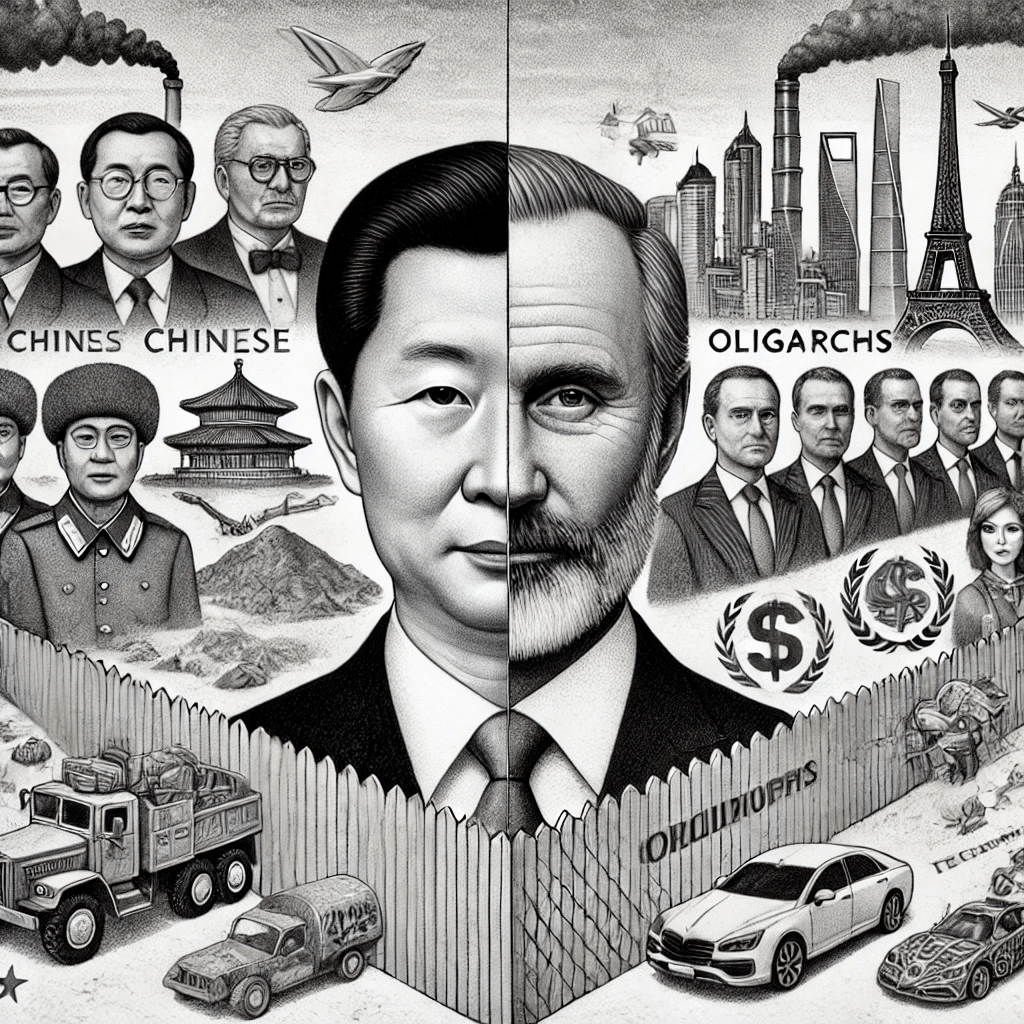
The Rise of the Superrich and Their Impact on China and Russia
The latter half of the 20th century and the early 21st century saw the emergence of a powerful class of superrich individuals in both China and Russia, who amassed wealth at an extraordinary pace. In China, these individuals, known colloquially as 土豪 (nouveau riche), leveraged the rapid growth of sectors like housing, coal mining, and e-commerce. In Russia, oligarchs arose following the dismantling of the Soviet Union, taking control of state-owned assets, primarily in natural resource industries. Although the means through which they gained their wealth varied, the consequences for their respective nations have been strikingly similar. This essay explores how this class of superrich emerged, the business models they employed, and the broader consequences for their countries and global power dynamics.
I. The Emergence of the Chinese 土豪
- Historical Context: China’s Economic Reforms China’s shift from a centrally planned economy to a market-oriented one, initiated by Deng Xiaoping in the late 1970s, laid the foundation for the rise of a new business class. However, it wasn’t until the mid-1990s, during the housing boom and the rapid expansion of the coal and e-commerce industries, that this class truly emerged.
- Key Figures in China
- 许家印 (Xu Jiayin): The tycoon behind China Evergrande Group, Xu amassed immense wealth through the property development sector. With little emphasis on innovation, the model relied on speculation, mass construction, and cheap labor.
- 马云 (Jack Ma): Through Alibaba, Ma revolutionized e-commerce in China. Although technologically savvy, Alibaba’s reliance on a vast underpaid workforce and third-party suppliers became a staple of this business model.
- The Characteristics of the Chinese 土豪 Business Model The industries that gave rise to China’s nouveau riche were marked by several key characteristics:
- Low-tech sectors: These industries, such as real estate and e-commerce, often relied on pre-existing technologies rather than fostering cutting-edge innovations.
- High externalities: Environmental degradation from coal mining, deforestation, and pollution became prominent as a result of the boom.
- Cheap labor: Much of China’s economic growth was fueled by low-wage labor, which was abundant as the country transitioned from an agrarian society to an urban one.
II. The Rise of Russian Oligarchs
- Privatization After the Soviet Collapse After the fall of the Soviet Union, the Russian government embarked on rapid privatization. State-owned enterprises, particularly in industries like oil, natural gas, and mining, were sold off at a fraction of their value, often to politically connected individuals.
- Key Figures in Russia
- Roman Abramovich: Known in the West primarily for his ownership of Chelsea Football Club, Abramovich made his fortune by acquiring vast oil assets in the early 1990s through the controversial loans-for-shares program.
- Mikhail Khodorkovsky: Khodorkovsky gained control of Yukos, a major oil company, during Russia’s privatization wave by acquiring shares in state-owned enterprises at low costs, often by outmaneuvering ordinary shareholders. Yukos became highly profitable under his leadership, solidifying his status as one of Russia’s wealthiest men. However, as he moved assets to Western countries to protect his wealth, he encountered difficulties due to sanctions imposed after the conflict in Ukraine, which complicated his ability to control these assets from abroad.
- The Russian Oligarchic Model Much like in China, the industries that created Russian oligarchs were:
- Resource-dependent: Russia’s vast reserves of natural gas, oil, and minerals were quickly monopolized by a handful of individuals, allowing them to build monopolies.
- Low innovation: Russia’s oligarchs did little to invest in technological innovation, preferring to focus on resource extraction.
- Extraction over development: Environmental concerns were secondary to profit, as the oligarchs focused on extracting raw materials for export rather than reinvesting in long-term sustainable industries.
III. The Global Dimension: Beneficial to the West, Costly for China and Russia
- Economic Models That Serve the West The economic models of both China’s 土豪 and Russia’s oligarchs were highly advantageous for Western economies. Both countries exported cheap goods (China) or raw materials (Russia) to the West, fueling the consumption-driven economies of Europe and the United States. At the same time, they imported high-end technology, luxury goods, and services from the West, creating an imbalanced economic relationship. A revealing remark made by former U.S. President Barack Obama in 2009 highlighted this attitude from the West. Speaking on the global impact of rising living standards, Obama remarked, “Countries like China and India, with their vast populations, are aspiring to achieve the same living standards that we enjoy in the West. However, if they were to reach our level of consumption, the strain on the world’s natural resources would be unsustainable.” On the surface, this appears to be a comment about the strain that larger populations would place on global resources. Yet, it subtly underscores a deeper message: the U.S. and other Western powers expect developing nations to remain in high-polluting, labor-intensive, low-tech industries. In other words, developing countries should “know their place”—that is, keep producing cheap goods for the West while the U.S. retains dominance over high-tech innovation and capital-intensive industries. “We produce high-tech, we trademark designs, we print money, we take 95% of the profit margin, and you don’t get to play here, got it?!” That’s the true message Obama’s words convey. “Your job is to make shoes and Happy Meal toys for us.”
- Export of Wealth: Moving Assets Overseas Once wealthy, many of these superrich individuals moved their assets to more stable financial environments. In the case of Russia’s oligarchs, billions of dollars in wealth were transferred to European tax havens or invested in Western real estate and football clubs. Similarly, Chinese 土豪 began buying properties abroad, sending their children to Western universities, and diversifying their investments to protect their wealth from potential political backlash.
- The Lack of Domestic Investment in Innovation Both China and Russia struggled for years to incentivize their superrich to invest in advanced technological industries that could propel their nations into the future. Instead, these individuals continued to focus on industries that yielded immediate, short-term profits. This lack of investment in domestic R&D left both nations technologically dependent on the West for innovation and expertise.
IV. Irony
Despite the fact that the business practices and economic models adopted by China’s 土豪 and Russia’s early oligarchs have directly benefited Western economies, there is a deep-seated irony in how these figures are perceived—and labeled—in the West. The products and resources they supply—cheap goods from China, raw materials from Russia—fuel the consumption-based economies of Europe and the United States, reinforcing an economic structure that advantages the West. Yet, even as the West profits from this arrangement, it simultaneously stigmatizes the very individuals who uphold it.
This irony is perhaps best reflected in the terminology applied to business figures from these regions. In the West, successful business people who accumulate wealth and influence are often celebrated as “entrepreneurs,” symbols of ambition, innovation, and hard work. However, when a business person is from Russia or China, terms like “oligarch” and “土豪” are used—labels that carry distinctly negative connotations of corruption, vulgar wealth, and unchecked power. This linguistic distinction implies that while Western wealth is legitimate and deserved, wealth from non-Western regions is inherently suspect, regardless of how it was obtained.
For instance, Russian-born entrepreneurs who have built their fortunes in industries unrelated to the extractive models of the early oligarchs, such as Vlad Doronin in luxury hotels, are still frequently referred to as “oligarchs” in Western media. The label persists, even when there is no evidence of corruption or political influence, simply because of nationality and origin. Similarly, in China, successful business people are often painted as greedy 土豪 regardless of their contribution to the economy or their level of sophistication.
This prejudice reflects a broader Western narrative that not only undermines the legitimacy of non-Western success but also reinforces a stereotype of “knowing one’s place.” While China and Russia are expected to supply cheap labor and resources, their business elites are simultaneously discouraged from being viewed as legitimate players in the global market. As such, the 土豪 and oligarchs become both the backbone of a system that benefits the West and the targets of a racialized and nationalistic double standard that delegitimizes their success.
V. The Future: Shifting Dynamics?
- A New Era of Tech Investment? Recently, both China and Russia have started shifting their economic strategies. China, under the leadership of Xi Jinping, has pushed for greater investment in high-tech sectors such as AI, green energy, and semiconductors. Similarly, Russia has begun exploring new technologies, though with less success.
- The Role of the West Moving Forward The West’s relationship with China and Russia continues to evolve, particularly as both countries seek to reduce their dependency on Western economies. However, the structural advantages that allowed the West to benefit from the 土豪 and oligarchic systems are increasingly being challenged, particularly as the geopolitical landscape shifts.
Pour résumer
The rise of the 土豪 and oligarchs represents a pivotal moment in the economic histories of China and Russia. While these individuals accumulated immense personal wealth, the broader impact on their nations was often detrimental, leading to environmental degradation, social inequality, and technological stagnation. Meanwhile, Western economies benefited from the flow of cheap goods and raw materials. The challenge for both China and Russia moving forward is whether they can break free from this extractive model and build more sustainable, innovation-driven economies.
 Yego’s Chronicles