
The Cold War divided the world into two camps: the communist bloc, led by the Soviet Union, and the so-called “free world,” championed by the United States. This bipolar struggle was ideological at its core, with communism and capitalism vying not just for economic and political dominance, but for the soul of humanity. Militarily, this division was crystallized in the form of the Warsaw Pact on one side and NATO on the other. The world was deeply entrenched in an ideological battle that shaped every aspect of international relations throughout much of the 20th century.
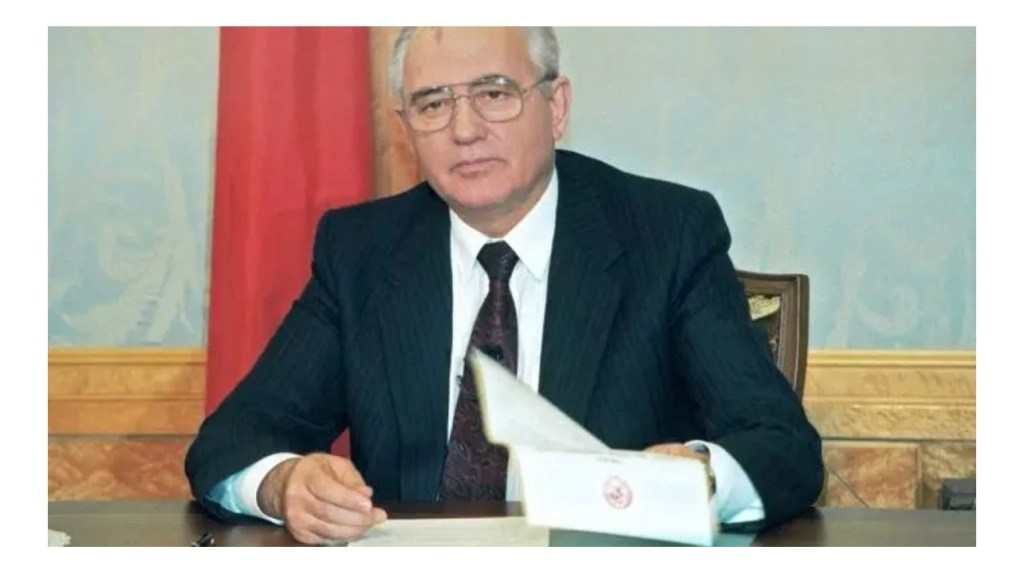
The dissolution of the Soviet Union in 1991, formally announced by the Supreme Soviet and symbolized by Mikhail Gorbachev’s resignation as president on December 25, marked the end of the Cold War. More profoundly, it signaled the conclusion of the ideological century. For decades, ideologies had driven nations, inspired revolutions, and justified wars. By the time the Soviet Union breathed its last, however, it had become clear that ideologies—whether Marxism-Leninism or free-market fundamentalism—were no longer the engines of global history. The world was entering a new millennium, one less concerned with grand ideologies and more preoccupied with pragmatic concerns like globalization, technological advancement, and economic survival.
Gorbachev played a deeply symbolic role in this transition. His resignation underscored the futility of clinging to an ideological construct that no longer had the power to sustain a unified state. His departure marked the final gasp of a world order defined by communist ideals, acknowledging that the ideological experiment of the Soviet Union had reached its end. Yet, while the East came to terms with the death of its ideology in the early 1990s, the West remained unwilling to confront the same reality.
It took the so-called “free world,” led by the United States, three more decades to acknowledge the demise of ideology. This was not due to any inherent strength of Western ideals, but rather to the inertia of power. The United States, unchallenged on the world stage after 1991, continued to propagate its own ideological rhetoric—individualism, liberal democracy, and free markets—even as these principles began to erode under the pressures of inequality, social fragmentation, and global discontent. The triumphalist narrative of the “end of history” masked the fact that the ideological fever gripping the West had long since cooled.
From this historical perspective, Donald Trump’s victory in the 2024 presidential election serves as a counterpart to Gorbachev’s resignation in 1991. Just as Gorbachev’s departure symbolized the death of ideology in the communist bloc, Trump’s return to the presidency marks the end of the ideological era in the West. His rise reflects a world no longer animated by grand visions of democracy or the “American Dream,” but by a fragmented, post-ideological reality where pragmatism, populism, and power politics dominate. In this sense, Trump and Gorbachev are historical twins, each representing the last breath of ideological fervor in their respective halves of the world.
The difference between the two is insignificant when viewed through the lens of history. For Gorbachev, the death of ideology was symbolized by his resignation as the leader of a crumbling Soviet Union. For Trump, it is embodied in his victory—a moment that marks not the resurgence of an ideology, but its final dissolution. In Trump, we see the collapse of Western ideals just as clearly as Gorbachev’s resignation highlighted the collapse of Eastern ones. Trump is the Gorbachev of the West, and Gorbachev, in turn, is the Trump of the other half of the world. Each stands as a monument to the end of an era, signaling the world’s readiness to move beyond ideology into a new, uncertain age.
In this light, both figures are not architects of transformation, but rather its symbols. Gorbachev resigned to mark the end of the Soviet dream; Trump rises to confirm the end of the American one. The historical parallels between these two men remind us that the world, East or West, has moved beyond the illusions of ideology, leaving behind a global stage where pragmatism reigns and the future remains unwritten.
 Yego’s Chronicles