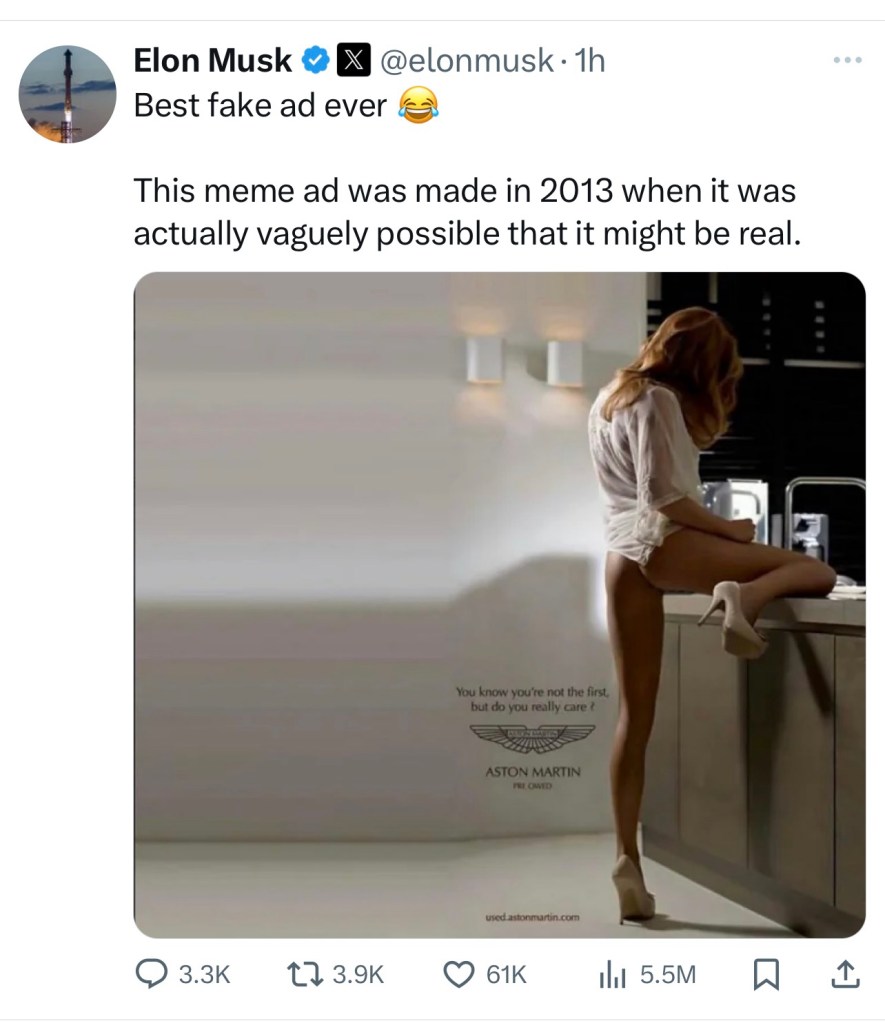
The other day, Elon Musk posted a tweet that’s both hilarious and oddly revealing. Alongside a fake Aston Martin ad featuring a suggestive photo, Musk wrote: “This meme ad was made in 2013 when it was actually vaguely possible that it might be real.” Now, let’s pause for a second. What does “actually vaguely possible that it might be real” even mean? It’s a sentence so drenched in uncertainty, it practically loops back on itself.
Let’s be honest—Musk didn’t really want to comment on the ad’s realism. He wanted to share a cheeky photo of a woman’s barely-covered backside while adding a touch of tongue-in-cheek irony. The unnecessarily layered language was just his way of deflecting focus. And in doing so, he gives us a great example of how people use language—not necessarily to say what’s true, but to express an attitude or feeling. This brings us to an age-old debate in philosophy: What do words like might, must, and possibly really mean? Are they about truth, or are they just ways for us to hedge, joke, or save face?
What’s the Deal With Words Like “Might” and “Possible”?
There’s a group of philosophers known as realists who think these words (called epistemic modals) are all about truth. According to them, when someone says, “It might rain tomorrow,” they’re talking about other worlds—possible worlds, compatible with what the speaker knows to be exact—where it rains. If rain happens in at least one of those worlds, then the statement is true. If not, it’s false. Or take Musk’s convoluted sentence: “… it was actually vaguely possible that it might be real.” According to the realist, this translates to something like this: “There is a possible world w1, reachable from the world in which this sentence is uttered, there is at least one possible world w2, compatible with what is known in w1, such that this Ashton Martin ad exists in w2.” It’s like math: clean, precise, and universal.
But let’s be real—language isn’t that simple. Think about Musk’s tweet. Was he seriously weighing all the possible worlds where the ad could’ve been real? Of course not. He was using fancy, over-complicated language to make a joke and keep things playful. Words like might and possible weren’t about truth; they were about tone and attitude.
That’s where another school of thought, expressivism, comes in. Expressivists argue that modal terms like might and could are more about expressing how we feel or what we think at the moment, rather than describing some deep truth about the universe. Musk’s tweet wasn’t about the ad’s authenticity—it was about being funny, ironic, and maybe a little evasive.
How We Use Modal Words in Real Life
If you look at how people actually talk, it’s clear modal words aren’t just about truth—they’re about how we present ourselves. For example, studies have shown that men and women use these words differently. Women tend to use more modal terms like might, could, or possibly to soften their claims and sound polite. Men, on the other hand, often avoid them, favoring direct statements. It’s not about truth; it’s about communication styles.
You can also see this in different professions. Think about a police officer writing a report: “The suspect entered through the window.” That’s a clear, no-nonsense statement. Now imagine an academic in the humanities: “It might be possible to argue that the suspect could have conceivably entered through the window.” Same idea, wildly different approach. One’s about certainty; the other’s about exploring possibilities. Again, this isn’t about truth—it’s about context.
And let’s not forget how people react when someone overuses these terms in conversation. If your friend says, “It’s necessarily might be possibly true that I could come to your party,” you’d probably roll your eyes and think, Just say yes or no! Overusing modal words often makes people sound insincere or evasive. It’s not about truth—it’s about how people feel when they hear you talk.
Why Expressivism Wins
This is why the realist idea of modal words—tying them to truth and possible worlds—just doesn’t cut it. In real life, words like might and possible are tools we use to express uncertainty, humor, politeness, or even sarcasm. They’re not about some grand metaphysical truth; they’re about how we want to come across in the moment. Elon Musk’s tweet is a perfect example. His over-the-top, hedged language wasn’t about seriously evaluating the ad’s realism. It was a way to share a risqué photo while keeping it lighthearted and ironic.
So the next time someone uses a million modal terms to answer a simple question, don’t think about truth or possible worlds. Think about what they’re trying to express—humor, hesitation, or maybe just an elaborate way to dodge the question. And if you ever catch yourself saying something like “It might be vaguely possible that I could probably come to your wedding,” just know you’re in good company. After all, even Elon Musk does it.
 Yego’s Chronicles