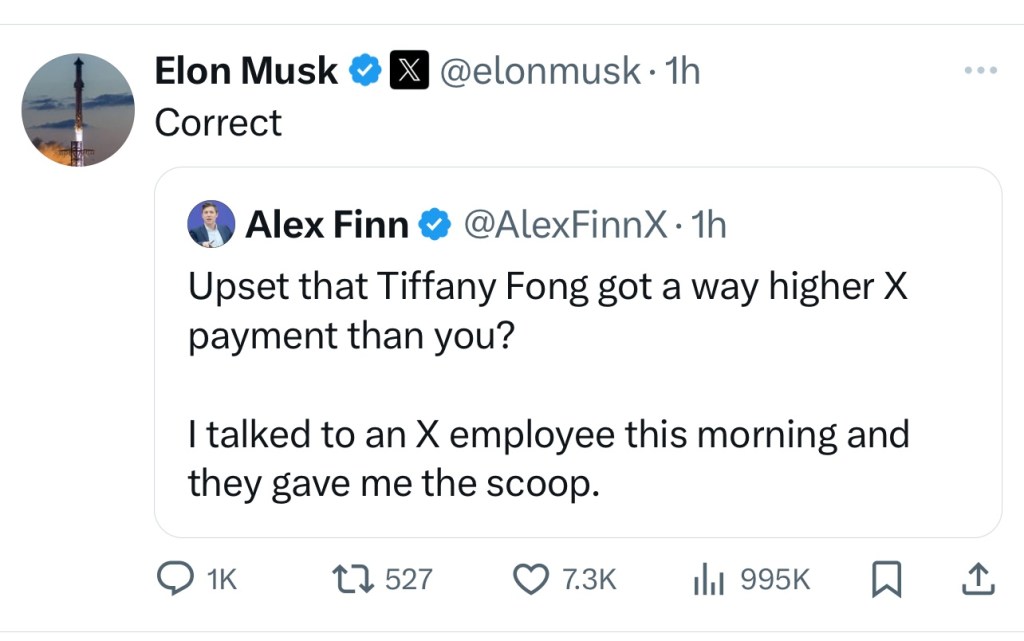
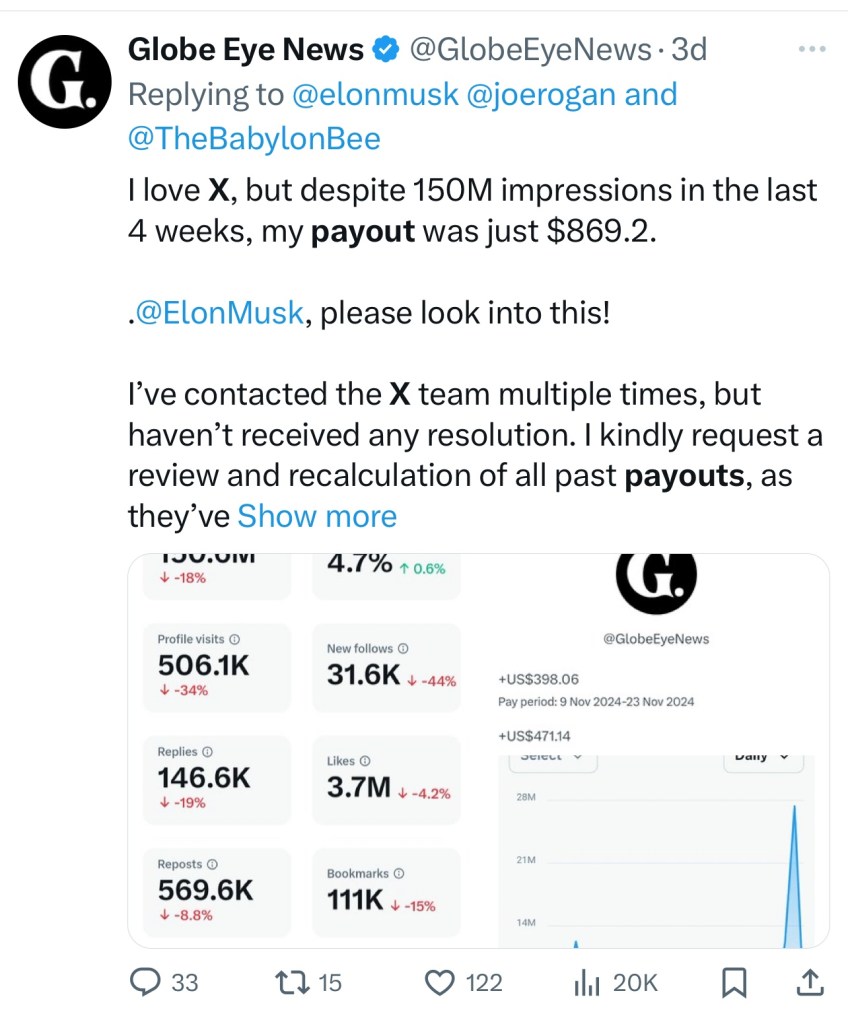
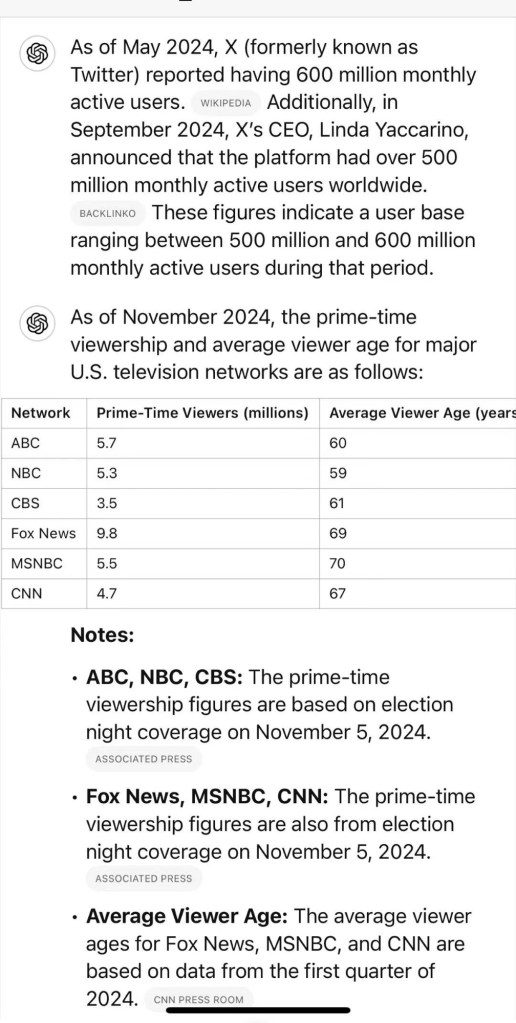
Recently, some X users have taken to X (where else!) to complain about what they perceive as an unfair payment scheme, prompting Elon Musk to send one of his deputies to clarify the situation. Users like Globe Eye News and Leonarda Jonie have raised concerns about low payouts despite achieving significant metrics on the platform. (see the attached images). Elon’s clarification deserves some careful thought—not so much about X’s pay scheme, but rather what the implications of the payment system at X mean regarding the much hyped “You are the media now!”?
The Business Model: Incentivizing Certified Interactions
At the heart of this model lies a straightforward business logic: X is optimizing for profitability and influence by creating a tiered ecosystem that prioritizes engagement among its verified users. Verified accounts represent paying customers, whether they are brands, influencers, or individuals seeking increased visibility. By rewarding engagement among these accounts, X incentivizes the creation of a self-reinforcing network of content production and consumption that benefits the platform in several ways:
1. Increased Revenue: Verified accounts are motivated to maintain their subscription status and to drive interactions with other verified users, ensuring a consistent stream of income for X.
2. Control Over Content Flow: By creating a hierarchy of engagement, X can curate which voices dominate the platform, steering the flow of conversations and narratives.
3. Reinforced Network Effects: The model amplifies the interactions of verified users, making these accounts the focal points of attention and encouraging uncertified users to join the verified ecosystem to gain relevance.
Logical Implications for the Information Landscape
This pay structure has far-reaching implications, particularly when viewed in the context of social media’s ongoing replacement of legacy media. If platforms like X become the primary arenas for news, debate, and public discourse, the structural dynamics of their ecosystems will fundamentally shape the map of the information space.
1. The Concentration of Influence
The pay structure inherently rewards accounts that attract engagement from other verified users, creating a feedback loop that consolidates influence among a small group of high-performing verified accounts. These “super accounts” are likely to dominate the platform’s information ecosystem, much like major news networks once dominated legacy media.
The resulting information map would resemble a hierarchical network, with a small number of nodes (the dominant verified accounts) controlling a disproportionate share of attention and influence. Lesser-known accounts, whether verified or not, would struggle to gain visibility, leading to a more centralized and homogenized flow of information.
2. The Narrowing of Content Diversity
This model incentivizes verified accounts to focus on topics that drive high engagement within their certified network. Over time, this could lead to the prioritization of sensational or viral topics over substantive, nuanced discussions. In the hypothetical scenario where the most influential verified accounts focus on just 10 out of 50 globally important issues, the remaining 40 topics risk marginalization. The pay structure thus encourages a narrowing of public discourse, where the range of topics discussed is determined not by their importance but by their potential to generate interactions within the verified ecosystem.
3. The Decline of Grassroots Information
Traditionally, social media platforms have been celebrated for their ability to amplify grassroots movements and diverse voices. However, the X pay structure shifts the balance of power toward verified accounts, diminishing the visibility of uncertified users. This creates an information map where grassroots voices are relegated to the fringes, unable to compete with the centralized influence of verified networks. The platform ceases to be a level playing field and instead mirrors the top-down information flow of traditional media.
4. The Fragmentation of Attention
The economic incentives of the model encourage verified accounts to form tightly interconnected networks, where attention and engagement are recycled among a specific subset of users. While this benefits the platform’s profitability, it fragments the broader attention of the user base. Instead of fostering cross-network discussions, the model risks creating isolated silos where the most prominent verified accounts dominate distinct segments of the information space. This fragmentation could limit the platform’s ability to function as a cohesive public square.
The Future of the Information Map
If this pay structure becomes the norm across social media platforms, the map of the information space will likely be characterized by:
1. Centralized Influence: A small number of dominant accounts will act as gatekeepers, shaping the narratives that reach the broader public.
2. Selective Attention: Engagement-driven algorithms and economic incentives will prioritize specific topics, leading to an uneven distribution of attention across globally significant issues.
3. Marginalized Voices: Grassroots movements, independent creators, and uncertified accounts will find it increasingly difficult to break into the mainstream conversation, reducing the diversity of perspectives in public discourse.
4. Algorithmic Governance: The flow of information will be governed by the economic and algorithmic priorities of the platform, rather than by editorial judgment or journalistic standards.
Examples Illustrating the Perils of the Model
First Example: On X, Tiffany Fong runs a hugely popular certified account, discussing topics that resonate with specific segments of the U.S. population. However, her account receives disproportionately higher compensation compared to accounts like Scott Ritter or Jeffrey Sachs, whose content focuses on dire global issues such as the risk of nuclear war. Despite the critical nature of their warnings, their voices are overshadowed in this engagement-driven model, highlighting the platform’s skewed priorities.
Second Example: Similarly, high-traffic certified accounts discussing celebrity gossip or sensational cultural debates may dominate engagement metrics, while accounts addressing systemic crises like climate change or economic inequality struggle to gain traction. The pay structure effectively incentivizes entertainment over enlightenment, distorting the balance of the information ecosystem.
A New Era of Information Hierarchies?
The pay structure of X represents more than just a business model—it is a blueprint for how information will be valued, distributed, and consumed in the post-legacy media era. By incentivizing certified interactions, X is creating a centralized, engagement-driven information ecosystem that mirrors some of the flaws of traditional media while introducing new challenges.
As this transition unfolds, the logical implications of this model will shape not only the nature of public discourse but also the very fabric of society’s understanding of critical issues. The resulting map of the information space will be one where attention is commodified, influence is concentrated, and the diversity of voices is constrained by the economic logic of the platform. Whether this new landscape will serve the public good or merely amplify the interests of a privileged few remains an open question—but it is clear that the era of decentralized, democratized information is increasingly under threat.
 Yego’s Chronicles