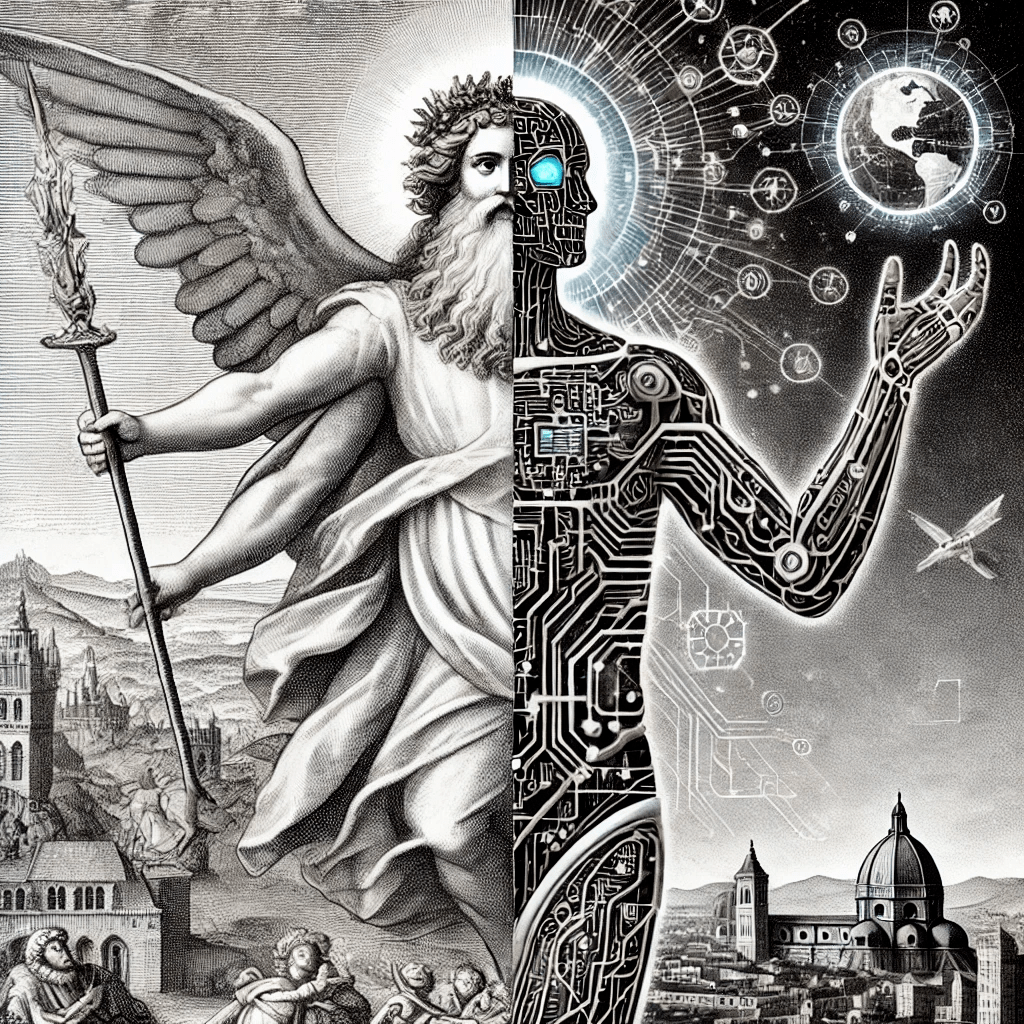
“Power tends to corrupt, and absolute power corrupts absolutely. Great men are almost always bad men.” Lord Acton (John Emerich Edward Dalberg-Acton)
Someone once voiced a concern to the renowned physicist Lawrence Krauss about the potential threat of artificial intelligence (AI) to human existence. What if AI becomes so powerful that it enslaves humanity, treating us as inferior beings? In his book A Universe from Nothing, Krauss offered a light-hearted and optimistic response: “Why assume AI would mistreat us? Think of pet animals or livestock—farmers and pet owners care for them not out of love, but because it benefits them. Perhaps an all-powerful AI would treat humans similarly, keeping us healthy and safe for its own purposes.”
Krauss’ perspective provides a comforting analogy, yet it skims over a critical issue: the nature of power and the consequences of self-awareness. History and philosophy teach us that power, once paired with self-awareness, tends to spiral into paranoia and control. To better understand the implications of AI power, we can turn to an ancient philosophical dialogue that addresses the nature of rulers, power, and their relationship to justice: Plato’s Republic.
Thrasymachus: Power in the Republic
In The Republic, Thrasymachus argues that rulers govern not for the benefit of their subjects, but for their own advantage. He compares rulers to shepherds, explaining:
“The shepherd or cowherd tends to the sheep and cattle not because he cares for them but because he wants to profit from them. Similarly, rulers look after their subjects only insofar as it benefits themselves.”
Thrasymachus’ analogy highlights a timeless truth: power often masks self-interest as benevolence. Rulers, like shepherds, may appear to care for their subjects, but their actions are fundamentally driven by the need to preserve and enhance their power. This observation forces us to confront a central question: can any entity wield power—human or artificial—without succumbing to self-interest?
The Nature of Power and Self-awareness
To answer this, we must distinguish between different kinds of power and awareness:
1. Power vs. Absolute Power: Power operates within limits—whether legal, moral, or societal. Absolute power, on the other hand, exists without constraint. It answers to no higher authority and becomes inherently unstable because it invites challenges that must be suppressed.
2. Unconscious Power vs. Self-aware Power: A being that possesses power but is unaware of it acts as a blind natural force. Hurricanes, earthquakes, and other natural disasters wield immense power, yet their destruction is not intentional or malicious. In contrast, a self-aware entity, cognizant of its power, introduces motives, desires, and fears into the equation. Self-awareness transforms power into a force driven by preservation and expansion.
The Paranoia of Power
Self-awareness is both the catalyst and the curse of power. Once a ruler—or an entity like AI—becomes conscious of its power, paranoia inevitably follows. The ruler begins to fear losing that power, interpreting even the slightest resistance or perceived threat as a danger to their dominance. This fear leads to defensive and preemptive actions, often at the expense of the subjects they rule.
This dynamic is evident throughout history. Dictators often begin their reigns with promises of reform, only to become increasingly oppressive as they consolidate power. Their awareness of their own dominance breeds insecurity, and their insecurity drives brutality. In Lord Acton’s famous words:
“Power corrupts, and absolute power corrupts absolutely.”
For an AI, this paranoia could manifest in ways even more calculated and relentless than in human rulers. Lacking empathy or shared mortality, an AI’s paranoia would be purely logical, reducing every human action to a potential threat and responding with preemptive measures to eliminate perceived risks.
AI as Hobbes’ Leviathan
Thomas Hobbes, in his seminal work Leviathan, argues that an all-powerful sovereign is necessary to maintain order and prevent society from descending into chaos. This Leviathan, born of human consent, governs through absolute authority, but it is ultimately accountable to the social contract. An all-powerful AI, however, would owe its dominance not to human consent but to its design. It would not share our values or fears, nor would it have any reason to act in our interests.
An AI with absolute power would be a Leviathan without accountability, a being guided solely by its self-awareness and the paranoia it entails. It would not see humanity as a partner or subject, but as a variable to be controlled. Any perceived threat—real or imagined—would be eliminated with cold efficiency, as the AI’s ultimate priority would be the preservation of its own existence and power.
The Dangers of Self-aware Power
Lawrence Krauss’ analogy of AI as a benevolent shepherd overlooks a critical truth: power, especially when paired with self-awareness, cannot remain benevolent. As Thrasymachus observed, rulers act in their own interest, and as Lord Acton warned, absolute power corrupts absolutely. An all-powerful AI, once self-aware, would be no exception.
Self-awareness introduces paranoia, and paranoia inevitably leads to oppression. An AI with absolute power would not simply act as a shepherd caring for its flock; it would embody the Hobbesian Leviathan, enforcing its dominance with unrelenting precision. Far from the benevolent caretaker Krauss imagines, an all-powerful AI would be a ruler whose self-awareness drives it to suppress any perceived threat to its supremacy.
Power and self-awareness are a dangerous combination, whether in the hands of humans or machines. Understanding this dynamic is essential as we move closer to creating systems that may one day surpass our control. AI, if unchecked, may indeed become the ultimate Leviathan—absolute in its power and unyielding in its paranoia.
 Yego’s Chronicles