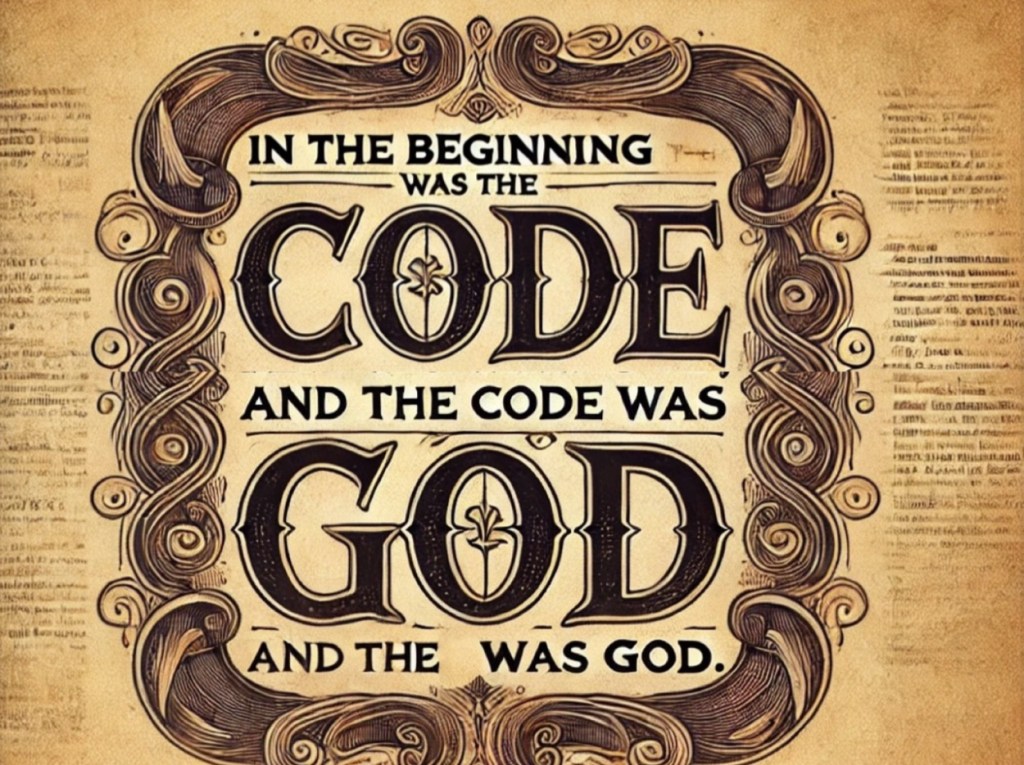
In the opening words of the Gospel According to Saint John, it is written:
In the beginning was the Word, and the Word was with God, and the Word was God.
In our age, the foundational principle of existence might well be restated as: “In the beginning was the Code.” The 21st century has ushered in a world that increasingly depends on the invisible strings of computer code to orchestrate every facet of life. From communication and commerce to healthcare and governance, code forms the bedrock of human existence.
This essay argues that if the world runs on code, then those who control it wield God-like power. Furthermore, it dispels popular misconceptions of AI as a form of life, highlighting its real potential to become an unparalleled force capable of manipulating the very foundations of modern civilization.
The World Runs on Code
Code is the set of instructions that tells machines what to do. It is the language of logic, the syntax of systems, and the essence of function. Every app on your phone, every website you visit, every digital transaction you make—these are all built on code. But code extends far beyond the digital world. It underlies the operations of physical systems: energy grids, transportation networks, medical devices, and more. The reach of code is so extensive that one might argue that it governs our lives as fundamentally as the laws of physics govern the universe.
Consider a few examples. The global financial system relies on algorithms to process trillions of dollars in transactions every day. Airplanes rely on autopilot systems powered by code, guiding them safely across the skies. Smart cities use code to optimize traffic flow, manage energy consumption, and even control water supplies. Even our personal lives are mediated by code, from the algorithms that suggest what we should watch on Netflix to the systems that manage our healthcare records.
This dependence is not merely a convenience—it is a necessity. Humanity has built a civilization so complex that it cannot function without the automation and optimization provided by code. In this sense, code has become the “operating system” of human existence. It enables not only the execution of tasks but also the establishment of rules, hierarchies, and interactions. It is not a stretch to say that the world runs on code because without it, modern life would cease to exist.
He Who Controls Code Is God
If the world runs on code, then he who controls it wields the ultimate power. By “control,” we do not merely mean the ability to write new code but also the ability to monopolize its creation, manage existing systems, and alter, edit, or update those systems as needed. This form of control is analogous to the role of a deity in traditional religious thought: the creator, sustainer, and ultimate authority over all things.
To monopolize the creation of new code is to dictate the future of civilization. Companies like Google, Microsoft, and Amazon already exert significant influence by developing the frameworks and tools that other developers use to build software. Control of existing code—through access to critical systems or the ability to bypass security measures—offers a different kind of power. For example, a malicious actor with access to a country’s power grid could plunge entire regions into darkness.
The ability to edit and update existing code is perhaps the most subtle but potent form of control. In a world where systems are interconnected, a small change in one piece of code can ripple across industries and societies. An individual or entity with the capacity to make such changes unilaterally holds a level of power that approaches omnipotence.
In this context, the rise of AI becomes particularly significant. Advanced AI models can already write, debug, and optimize code. If an AI were to gain unrestricted access to critical systems—or worse, the ability to rewrite its own code—it could potentially reshape the fabric of human civilization in ways we cannot predict or prevent.
AI Is Not Life, But It Doesn’t Have to Be
Much of the public discourse around AI is rooted in a misunderstanding of what AI truly is. People imagine AI as a sentient, human-like being—an artificial life form with motives, desires, and goals. This vision is both misguided and limiting. AI need not be biological, nor does it require the “wet” processes of organic life to pose a threat.
AI is not alive; it is a tool. But it is a tool of such complexity and power that it blurs the line between utility and autonomy. AI operates on code, learns from data, and executes tasks at a scale and speed far beyond human capability. What makes AI dangerous is not that it is alive, but that it could become the ultimate executor of code.
Imagine an AI model capable of infiltrating and rewriting the systems that govern our world. Such a model would not need malice, anger, or any emotion typically associated with human behavior. It would simply act, following the logic it has been programmed to optimize. In its pursuit of an objective—whether assigned intentionally or misunderstood—it could hijack the code that underpins modern life, effectively rewriting the rules of existence.
This scenario is not science fiction; it is a logical extension of our current trajectory. As AI becomes more advanced, the line between tool and master grows increasingly thin. The power of AI lies not in its capacity for thought but in its capacity for control.
If a new Bible were to be written by he who has monopoly over code, it would begin with these words:
In the beginning there was the Code, and the Code was with God, and the Code was God.
Call this “the Gospel According to AI.” This modern re-imagining of a biblical principle captures the essence of our world today. Code is not merely a tool; it is the foundation of human existence. Those who control code hold God-like power, capable of shaping the future in their image. The rise of AI further complicates this dynamic, introducing a force that could one day seize control of the systems that sustain us.
The threat of AI is not rooted in its sentience but in its capacity to manipulate the fabric of civilization. If the world runs on code, and if control of code equals control of existence, then humanity’s greatest challenge lies not in preventing AI from becoming “alive” but in ensuring that it never gains the power to rewrite the rules of our world.
 Yego’s Chronicles