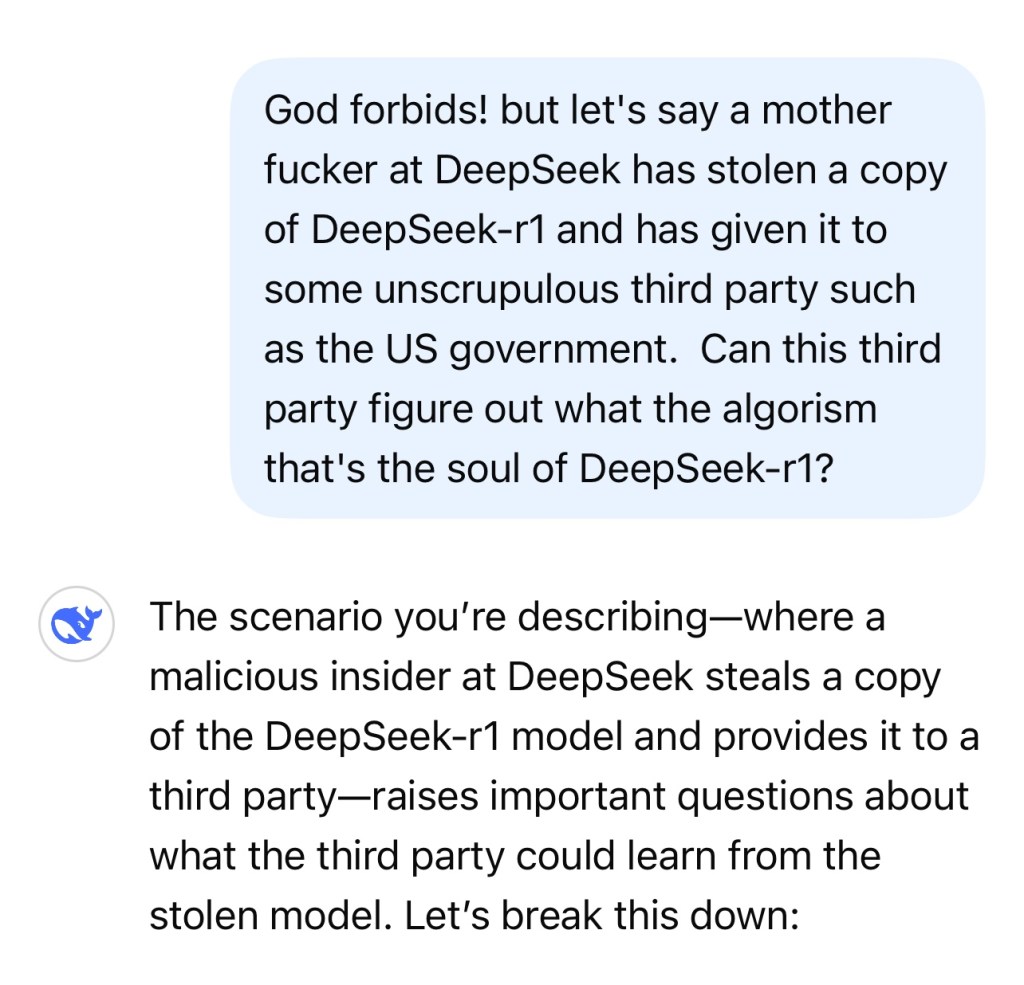
1. What Does the Stolen Copy Include?
- Model Weights: The stolen copy would likely include the model’s weights (parameters), which are the numerical values that define how the model processes input data and generates output.
- Architecture: The architecture of the model (e.g., the number of layers, attention heads, etc.) might also be included, depending on how the model is packaged.
- Tokenizer: The tokenizer, which converts text into tokens that the model can process, would also be part of the stolen copy.
- Configuration Files: These files define hyperparameters and other settings used during training.
2. Can the Third Party Reverse-Engineer the Algorithm?
- Model Weights vs. Algorithm: The model weights are the result of training the model on vast amounts of data, but they don’t directly reveal the training algorithm or the training data. The weights are like the “brain” of the model, but they don’t explain how the brain was built.
- Architecture Insights: If the architecture is included, the third party could understand the structure of the model (e.g., how many layers it has, how attention mechanisms are implemented). However, this alone doesn’t reveal the training process or the data used.
- Training Algorithm: The training algorithm (e.g., how gradients are computed, how optimization is performed) is not typically stored with the model. Reverse-engineering the training algorithm from the weights alone would be extremely difficult, if not impossible, without additional information.
- Training Data: The training data is not included in the model. While the model’s behavior might reflect patterns in the training data, the third party wouldn’t have direct access to the data itself.
3. What Could the Third Party Do with the Stolen Model?
- Use the Model as Is: The third party could deploy the stolen model for inference (e.g., generating text, answering questions) without needing to understand the underlying algorithm.
- Fine-Tune the Model: They could fine-tune the model on their own data to adapt it to specific tasks or domains.
- Extract Knowledge: By probing the model, they might be able to extract some knowledge or patterns that were learned during training. However, this would not reveal the training algorithm or data.
- Attempt to Reverse-Engineer: While reverse-engineering the exact training algorithm would be challenging, the third party could analyze the model’s behavior to infer some aspects of its design and training process.
4. Limitations of Reverse-Engineering
- Black-Box Nature: Modern LLMs are highly complex and act as “black boxes.” Even with access to the weights and architecture, understanding the exact training process or replicating it would require significant expertise and resources.
- Lack of Training Data: Without access to the original training data, the third party would not be able to replicate the training process or fully understand how the model learned its behavior.
- Proprietary Techniques: If DeepSeek used proprietary techniques or optimizations during training, these would not be easily discernible from the model weights alone.
5. Could They Recreate DeepSeek-r1?
- Recreating the Model: If the third party has the architecture and weights, they could theoretically recreate the model for inference or fine-tuning. However, recreating the training process would be much harder, as it would require:
- The original training data (which is not included in the stolen copy).
- Knowledge of the exact training algorithm and hyperparameters.
- Significant computational resources to retrain the model from scratch.
- Building a Similar Model: The third party could use the stolen model as inspiration to build a similar model, but it would not be an exact replica of DeepSeek-r1.
6. Ethical and Legal Implications
- Intellectual Property: The stolen model would still be the intellectual property of DeepSeek. Using or distributing it without permission would likely violate copyright and trade secret laws.
- Security Risks: If the model contains sensitive information or biases, misuse by the third party could have serious ethical and security implications.
Conclusion
While a third party with access to the stolen DeepSeek-r1 model could use it for inference or fine-tuning, reverse-engineering the exact training algorithm or replicating the training process would be extremely difficult. The model weights and architecture alone do not provide enough information to fully understand how the model was trained or to recreate the training process. However, the third party could still misuse the model for their own purposes, which would raise significant ethical and legal concerns.
In short, the “soul” of DeepSeek-r1—its training algorithm and data—would remain largely inaccessible to the third party, even with the stolen copy.
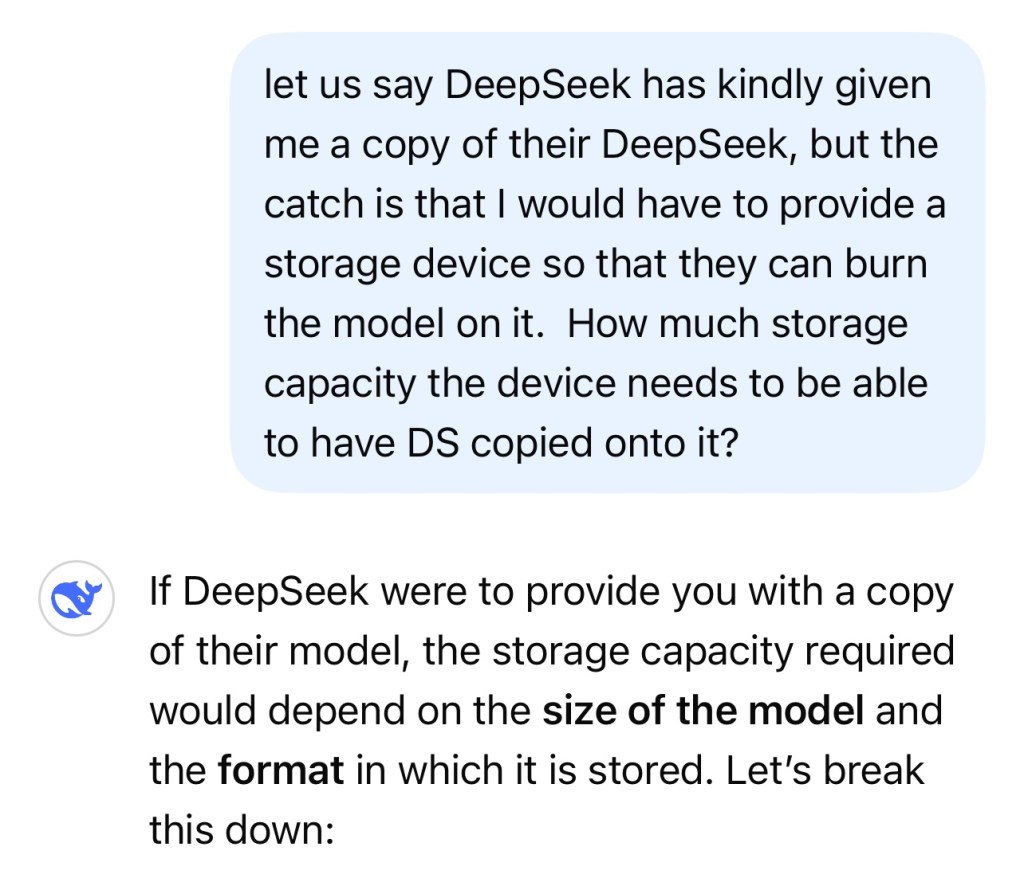
1. Model Size
- Large Language Models (LLMs) like DeepSeek can vary significantly in size depending on the number of parameters. For example:
- 7B (7 billion parameters): ~13-15 GB
- 13B (13 billion parameters): ~26-30 GB
- 70B (70 billion parameters): ~130-140 GB
- These sizes are approximate and can vary based on the precision used to store the model weights (e.g., FP16, FP32, or quantized formats).
2. Precision and Quantization
- Full Precision (FP32): Each parameter is stored as a 32-bit floating-point number. This is the most memory-intensive format.
- Half Precision (FP16): Each parameter is stored as a 16-bit floating-point number. This reduces the storage requirement by about half compared to FP32.
- Quantized Models: Quantization reduces the precision of the model weights (e.g., to 8-bit or 4-bit), significantly reducing the storage size. For example:
- An 8-bit quantized model might reduce the size by ~4x compared to FP16.
- A 4-bit quantized model might reduce the size by ~8x compared to FP16.
3. Storage Requirements
- If DeepSeek provides the model in FP16 format, you would need:
- 7B model: ~15 GB
- 13B model: ~30 GB
- 70B model: ~140 GB
- If the model is quantized (e.g., 8-bit or 4-bit), the storage requirements would be much smaller:
- 7B model (8-bit): ~4 GB
- 13B model (8-bit): ~8 GB
- 70B model (8-bit): ~35 GB
- 7B model (4-bit): ~2 GB
- 13B model (4-bit): ~4 GB
- 70B model (4-bit): ~18 GB
4. Additional Files
- Besides the model weights, you might also need to store:
- Tokenizer files: ~1-2 MB
- Configuration files: ~1-2 MB
- Metadata: Minimal storage required.
- These files are negligible compared to the size of the model weights.
5. Recommended Storage Device
- For a 7B model:
- FP16: A 16 GB USB drive or larger.
- Quantized (8-bit): A 4 GB USB drive or larger.
- Quantized (4-bit): A 2 GB USB drive or larger.
- For a 13B model:
- FP16: A 32 GB USB drive or larger.
- Quantized (8-bit): An 8 GB USB drive or larger.
- Quantized (4-bit): A 4 GB USB drive or larger.
- For a 70B model:
- FP16: A 128 GB or larger USB drive (or an external SSD).
- Quantized (8-bit): A 32 GB USB drive or larger.
- Quantized (4-bit): A 16 GB USB drive or larger.
6. Practical Considerations
- USB 3.0 or Higher: For faster transfer speeds, especially for larger models.
- External SSD: If the model is very large (e.g., 70B in FP16), an external SSD might be more practical than a USB drive.
- File System: Ensure the storage device is formatted with a file system that supports large files (e.g., exFAT or NTFS).
Summary
The storage capacity you need depends on the size of the DeepSeek model and the format in which it’s provided:
- 7B model: 2 GB to 15 GB
- 13B model: 4 GB to 30 GB
- 70B model: 18 GB to 140 GB
If you’re unsure, a 32 GB USB drive or larger should cover most cases, especially if the model is quantized. For larger models (e.g., 70B in FP16), consider using a 128 GB USB drive or an external SSD.
 Yego’s Chronicles