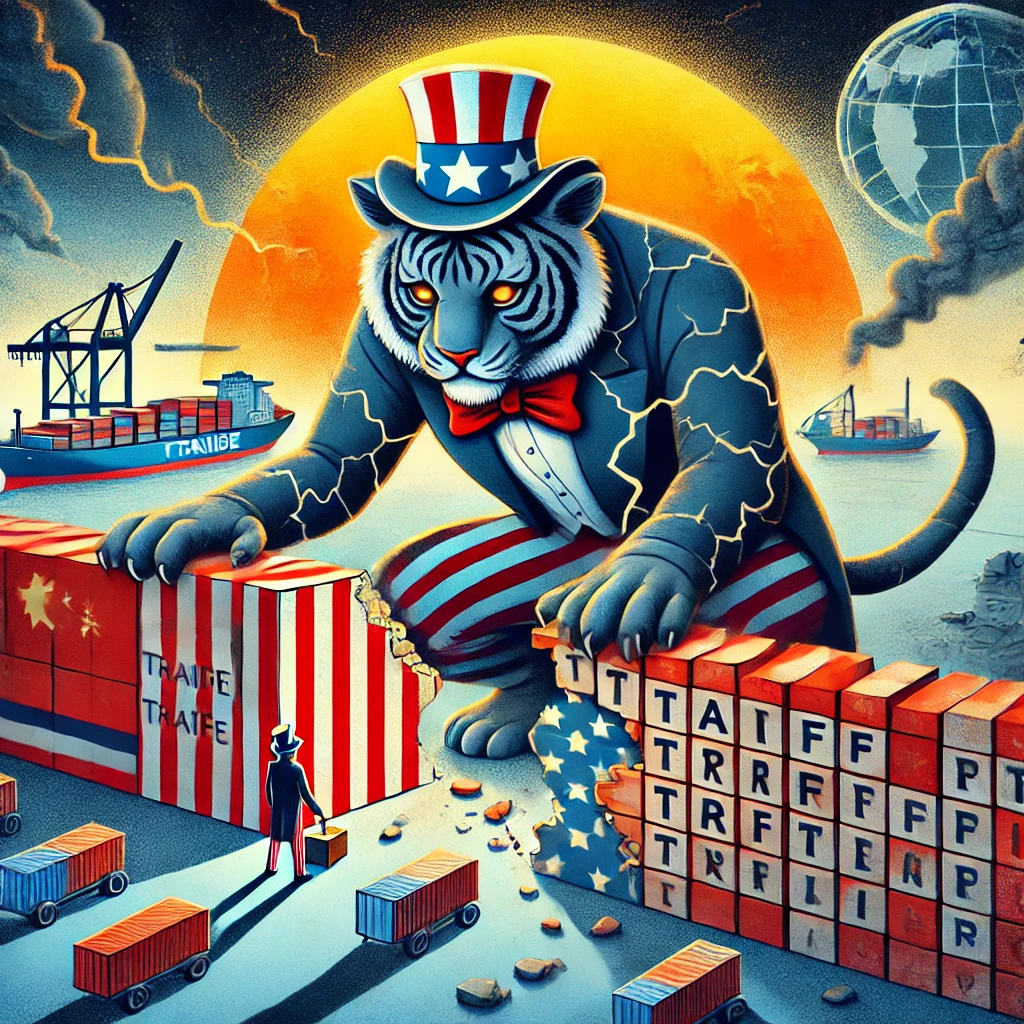
History has a way of marking the fall of great powers before they even realize they have fallen. The most telling sign is not military defeat or economic stagnation but something far more subtle—tariffs. When an alleged empire begins implementing tariffs, you know it is no longer an empire. Tariffs are barriers, walls erected to shield oneself from danger, whether real or imagined. They are the policy of the insecure, the fearful, and the declining. A confident power, an empire in its prime, needs no tariff. The very idea would be laughable. But when tariffs become a necessity, they reveal the fundamental truth: the empire is already in retreat.
The Nature of Tariff: Walls Built Out of Fear
At its core, a tariff is an act of self-defense. It is an economic barrier designed to protect domestic industries from foreign competition. But this protection is always rooted in fear—a fear that without these barriers, the empire’s own industries cannot compete, that its economic foundation is weaker than it appears. This is why truly dominant empires, at the height of their power, do not rely on tariffs. The Romans did not tax goods coming into the heart of their empire—they absorbed, consumed, and dictated the terms of trade. The British Empire, at its height, did not need tariffs; the entire world was its market. The United States, when it was an unchallenged hegemon, policed the global trade system, ensuring goods and capital flowed freely, enforcing its rules without question.
But an empire that resorts to tariffs is an empire that is afraid. It fears competition, it fears exposure, it fears losing control. And an empire that fears is no longer an empire—it is a power in retreat, a shadow of its former self, desperately trying to hold back the tide of history.
Historical Precedents: The Qing Dynasty and Britain’s Decline
Trump’s America is not the first empire to resort to tariffs in its twilight. Two historical examples stand out: the Qing Dynasty in the 19th century and the British Empire in the late 19th and early 20th centuries.
The Qing Dynasty: The Paper Tiger of the East
The Qing Dynasty, once the master of East Asia, began implementing tariffs not as a sign of strength but as an act of desperation. By the time the Western powers came knocking in the 19th century, China, though vast, was inward-looking and fragile. It imposed tariffs on foreign goods, attempting to shield its economy from the forces of global trade. But tariffs did not save the Qing. Instead, they became a tool of humiliation. The Western powers, through a series of unequal treaties, stripped China of its ability to set its own tariffs, reducing it to an economic colony in its own land. The Qing had sought to protect itself with barriers, but all they revealed was its own weakness.
The British Empire: From Global Hegemon to Tariff-Wielding State
The British Empire provides another cautionary tale. For much of the 19th century, Britain was the world’s economic powerhouse. It championed free trade not out of ideology but out of confidence—because free trade was good for Britain. The empire had no need for tariffs; it dictated the rules of global commerce.
But as the 20th century dawned, cracks in Britain’s supremacy began to show. The rise of Germany and the United States as industrial powers put Britain’s economic dominance under strain. Enter Joseph Chamberlain, who in the late 19th and early 20th centuries became one of the most vocal advocates for tariffs under the banner of “Imperial Preference.” He argued that Britain needed to protect itself from foreign competition, particularly from Germany and the United States. His calls for tariffs were a stark admission that Britain was no longer confident in its global economic position. The empire that had once ruled the world through free trade was now retreating behind economic barriers. It was a signal that Britain’s imperial supremacy was fading.
Tariffs and the America of Today
Now look at America. Once the unchallenged global hegemon, it dictated the terms of trade, ensuring the free flow of capital, resources, and goods across the world. But today, what do we hear? Tariffs. Marco Rubio, Donald Trump, and others speak of imposing tariffs as a solution to America’s economic woes. They frame it as a way to “protect American jobs,” but in reality, it is a symptom of decline. Just like the Qing Dynasty and the British Empire before it, America is erecting barriers not out of strength but out of fear. It no longer dictates the rules of trade with confidence; it hides behind economic walls, hoping to keep the world at bay.
Even more telling is the rhetoric about “spheres of influence.” Once, America did not speak in such limited terms—because when you are an empire, you do not need to. Everything under the sun belongs to you. The British Empire at its height did not talk about “spheres of influence” in India or Africa—it simply ruled them. The United States, when it was at its most powerful, did not talk about a “sphere of influence” in Latin America—it declared the entire Western Hemisphere off-limits to European powers through the Monroe Doctrine.
But now, America no longer talks as a global hegemon. Instead, it speaks like a regional power, concerned with carving out a sphere of influence to defend against rising challengers. To speak of “spheres of influence” is to admit weakness—to admit that the empire no longer sees itself as master of the world but as a mere competitor among equals. This is the language of decline.
The Empire That No Longer Acts Like One
An empire does not need tariffs. An empire does not speak of spheres of influence. An empire does not fear competition—it welcomes it because it knows it will win. The moment an alleged empire begins to resort to tariffs and to carve out defensive zones of influence, it is no longer an empire—it is a paper tiger, clinging to the illusion of power while the world moves on.
This is what America has become. It is no longer the confident hegemon that shaped the global order. It is no longer the unchallenged master of world trade. It is a power in retreat, hiding behind tariffs, drawing lines in the sand, and hoping to hold onto what little it can.
But history has seen this before. The Qing Dynasty erected tariffs, and its empire crumbled. The British Empire turned to protectionism, and its dominance faded. Now, America walks the same path. The paper tiger roars, but history does not listen.
 Yego’s Chronicles