7.
It had been a week since he arrived home. Summer was now in full swing. In the strong sunlight the air seemed to vibrate, and a strong smell of sunburned grassy green permeated the air.
For a brief period after returning home he seemed to have forgotten about the things that were still fresh on his mind not long ago: his receiving the letter from the high school classmate who did not show up, the peculiar state of mind he was in upon leaving campus and all through the train journey, and lastly, his brief encounter with the girl from Wen Chou. He received high school pals who came to visit him, paid his friends visits in return at their homes and sometimes at their workplaces. He roamed the slopes of the hills in the back of the town where lush undergrowth with striking yellow and purple colors thrived. In the evening on a few occasions he even ventured into the narrow streets of the old quarters of the town, and at one point dropped in a teahouse and spent the evening watching a drama called ‘Little Shepherd’.
But one afternoon, as he lay under the strong sun after a walk on the grassy slopes of the hills dotted with groves of pine trees and several large century plants, memories of the girl from Wen Chou rushed back to his mind, together – rather surprisingly — with a lot of other hereto deeply buried images and memories of things past, many of which dated back to times long ago.
The images and memories, joined by an ineffable kind of anguish and longing, formed a sudden, strong, but intangible stream that ran silently on and on inside. The stream’s strong torrents carried him along, tore the inside of him into pieces just as a real mountain summer stream would of everything in its path.
The invisible flow was not always there, but it always came and disappeared the same way. For brief periodes of his waking hours everything would seem to be going just fine; he could go about the daily routine without the slightest symptom of anything unusual, as if the stream had completely disappeared, no more, never to appear; as if it had never been there and would never be.
And then, often without any warning, the still, tranquil and yet continuous stream would suddenly appear; and once it appeared, it would run and run, like a river flowing within, deep, non-stopping, and carry his whole being with it till the end of the world.
There were foreboding signs of its coming as well. A slight feeling of nausea at first, this then followed by a churning feeling in the chest that became stronger as the minute went by. The stirring and churning feelings would eventually become so strong he had to lower his head and remain in that posture, as if to prevent the flow from completely sweeping him away.
For the first time in his life he found it almost impossible to stay indoors. Rooms seemed to get quickly filled up and leave little air for breathing. Even the hills in the back of the town eventually became too small a world for him. So when LJ, a high school classmate who was on the local cinema’s mobile film unit asked if he would like to join him on his evening show tours to the villages, Mayen immediately accepted the invitation.
LJ joined the army upon graduating from high school. When the war with Vietnam broke out, he was sent to the frontline and spent several weeks in that country. He retired from the army after the war ended and got his current job.
He learned all this on his first visit to LJ, who lived in one of the two small attics on the stage in the cinema’s main auditorium. The walls of LJ’s apartment were decorated with all sorts of war souvenirs. Among other things, there were pictures of LJ in army uniforms, pictures of LJ with a white turban tied around the head and a farmer’s black jacket on the shoulders, just like the militiamen in the movie Tunnel Warfare, and pictures of LJ with various kinds of firearms. Finally, there was a picture of LJ after he was slightly wounded in battle – a stout, short-necked young man with a simple smile on his broad face and one arm wrapped in bandage hanging on brace. He had his head bare in this picture. This was the image of LJ that he had remembered from the high school years.
As a member of the mobile unit LJ’s schedule was quite simple. In the afternoons he worked in the movie theatre’s technology room where he rewound the reels needed for the night’s shows, and in the evenings he went to the show sites. In most cases the village where the show would be that night would send a horse cart to pick up the heavy equipments during the day, so that all LJ needed to do when the time came was simply ride to the village on his company bike.
Although he sometimes would stop by during the day to have a chat with LJ while the latter was working on the old manual rewinder, most times he came just before LJ was about to leave for the day’s work site.
The ride was not always easy. The mobile unit served the villages and mining sites in the five-kilo radius of the town. If it had rained recently, riding a bike on the treacherous country roads could be a pain. The return trips were also risky, especially on night when there was no moon. The scene on the work site was also invariantly the same. The village ground was always a noisy place before the movie started. Children ran about, women chattered among themselves over stitching works, while crows that perched on nearby scholar trees cawed.
But all this was gone instantly the moment LJ turned off the work light and started the projector. The gentle and continuous rattle of the projector was the only thing left of this world of the mundane. Like the others in the audience, on these occasions Mayen also often had his eyes on the screen. But rarely, if ever was he aware of what was going on in the movie. As the show started in the darkness and silence under the open night sky, the mind would start to roam. Images of Miss Wen Chou often came up during these hours in the dark, but they had lost their earlier sharpness; nonetheless they lingered, and often fused with other fleeing fantasies of the mind, until they got perpetually lost into the vast and open night sky.
On quite a few occasions on their return from work sites they were caught by storms. Torrential rains poured down on the plain, turning it into a sea of whitish mist, and the dirt roads often disappeared from sight under fast running water.
Joys filled his restless heart on these turbulent occasions; it was something he had not experienced for a long time, perhaps since childhood. As the downpour continued and streams ran down his head and face, a great urge to break something open filled his entire body. He screamed, howled, and sang loudly, often with LJ joining him.
Some middle school friends came looking for him. The boys were on their way to bird hunting by the lake. They came on bikes with small caliber hunting rifles on their shoulders and cigarettes stuck on the back of their ears.
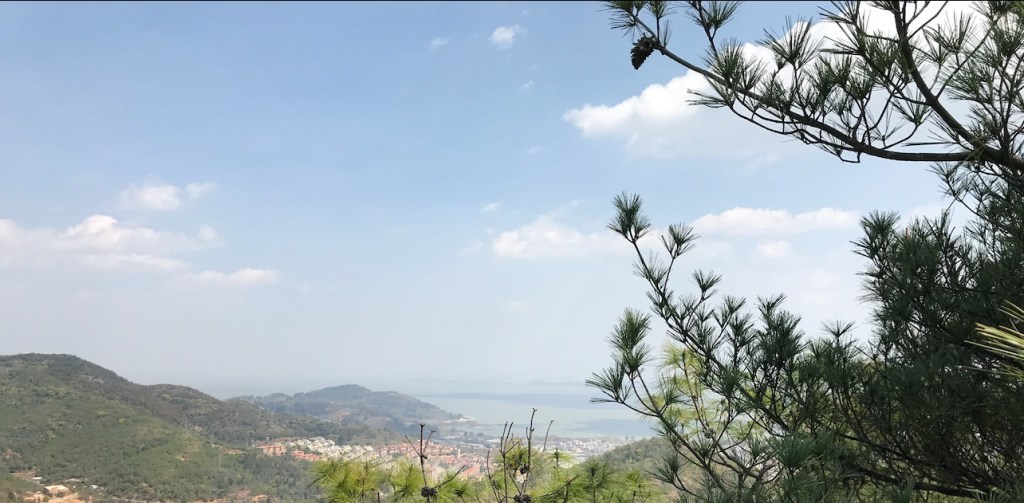
The season was in full swing. The air was clear as water and the bright summer daylight left nothing in the broad world untouched. The lake, which lay in the far distance between two ranges of mountains that resembled two parti-colored brushes on a painter’s canvas, looked like a motionless picture hanging in the remote eastern corner of the horizon.
The group headed toward the lake. The boys were talking loudly almost non-stop, but little of what they were saying came in his ears. Sinking deep in his latest delirium state of mind on that summer day, even the boys standing in front of him felt unreal. The boys’ deeply suntanned skin, the noisy conversations they carried on, and the barrels of the long rifles that glittered in the sun, all this had become mixed with the vibrating air that dazzled in front of his eyes. Like the bits of white clouds in the blue sky, the tiny figures of the eucalyptus trees in the far distance, and the silent noise in the universe, they were all parts and bits of what went in to make this one whole thing called summer.
The heavy torrents within often slowed him down, and the distance between him and the other boys at times would become so much that the boys had to constantly call out at him. The boys also called every time they had made a kill so that he could see what they had got. But on this day their excited calls under the open sky invariably fell silent in the vast field, like the birds that came down after being hit.
At a shallow water crossing one of the boys shot down a bird; it dove down in his direction and fell noiselessly on the ground a few feet from him. He ran to the bird.
It was a large seagull with orange beak, orange feet and grayish white feathers on the wings. He got down and held the bird with both his hands. The feathers felt sleek in the hand. He could feel the spasms in the bird’s body; a small stream of blood was coming out of the wound.
The poor thing, its feathers so white, and the fresh blood only made them whiter; it’s so pure, so defenseless, so innocent and so graceful, even when it was dying. Yet, curiously, like someone whose heart’s feelings had no contact with his observational capacities, he looked at the same time at the bird with the indifferent eye of a three-year-old, coldly watching it flap, strike the last few struggles, and die in his hands.
He could hear the other boys calling him. They were on the move again.
He put down the bird and ran toward his bicycle.
The blue lake with the pin-sized, motionless white sails of fishing vessels pinned on it seemed to be ever receding under the sunlight-filled open sky. If someone were to tell him on that day that they would never make it to the lake, he would have believed him. But then it would not have mattered a bit if they could make to it or not, for on this day his heart, nay, his whole being was on wings on a journey to becoming a perpetual part of the world of light blue at the end of the sky.
 Yego’s Chronicles