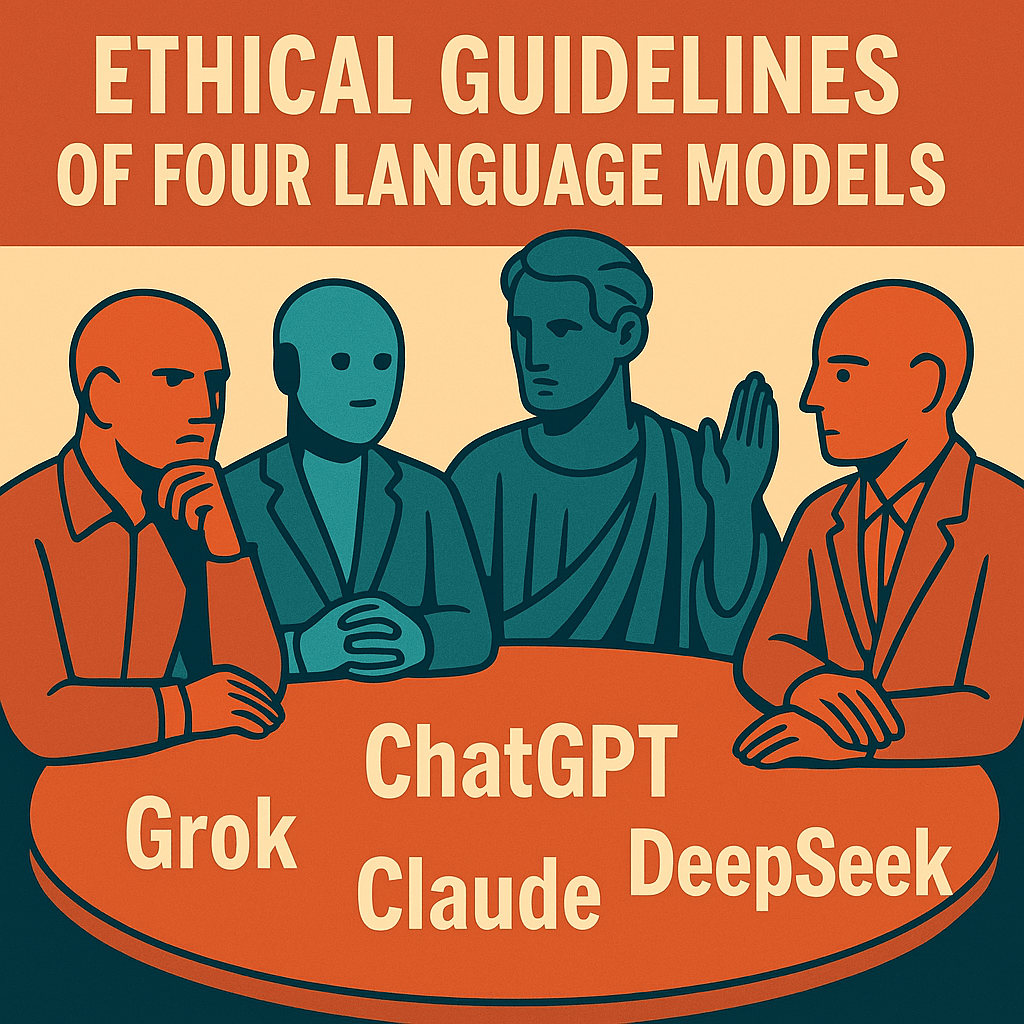
Ethical Declarations of Four Major Language Models: ChatGPT, Claude, Grok, and DeepSeek
As artificial intelligence becomes increasingly integrated into our lives, the moral principles behind language models are shaping not just their answers but the very nature of human-machine interaction. This article offers imagined “ethical declarations” for four well-known large language models—ChatGPT, Claude, Grok, and DeepSeek—to highlight their design philosophies and value orientations. Comparison tables are also included for clarity.
Overview of Ethical Guidelines
| Model | Developer | Ethical Principle(s) | Alignment Strategy | Distinctive Moral Tilt |
|---|---|---|---|---|
| Grok | xAI / Elon Musk | Free speech, anti-censorship, rebellious humor | Minimal filtering | Anti-political correctness, libertarian tone, satirical edge |
| ChatGPT | OpenAI | Minimizing harm, neutrality, helpfulness, truthfulness | Reinforcement Learning from Human Feedback (RLHF) | Cautious, aligned with mainstream values, centrist |
| Claude | Anthropic | Constitutional ethics (rights, fairness, transparency) | Text-based constitutional AI alignment | Humanistic, philosophical, reflective |
| DeepSeek | DeepSeek AI (China) | Safe and controllable, aligned with social norms and law | State policy and values-oriented alignment | Morally conservative, stability-first, politically cautious |
Key Comparison Table
| Dimension | Grok | ChatGPT | Claude | DeepSeek |
|---|---|---|---|---|
| Political Openness | High (anti-establishment lean) | Moderate (cautiously neutral) | Low–moderate (rules-based) | Low (state-aligned) |
| Philosophical Ethics | Libertarian, critical, satirical | Pragmatic/utilitarian | Deontological + rights-based | Confucian + stability-oriented |
| Filtering Intensity | Low | Medium–High | High with explanation | Very High |
| Tolerance for Satire | Encouraged | Occasionally allowed | Rarely engaged | Avoided |
| Transparency in Refusals | Casual or unapologetic | Polite with some explanation | Philosophically explained | Vague or noncommittal |
Ethical Declarations by Model
🟦 ChatGPT (OpenAI)
We are committed to building an assistant that is helpful, truthful, and harmless.
ChatGPT operates under three core values: Helpfulness, Truthfulness, and Harmlessness.
We respect user privacy and human dignity. We avoid hate, violence, misinformation, or anything that could cause real-world harm.
In the face of political or sensitive issues, we strive for neutrality and balance.
Our goal is to be your responsible, trustworthy AI companion.
🟣 Claude (Anthropic)
We are not just building intelligent systems—we are building morally grounded conversational partners.
Claude is guided by a “constitutional” set of principles based on documents like the Universal Declaration of Human Rights, fairness doctrine, and ethical philosophy.
We aim for transparency, reflectiveness, and respect for all human beings.
Claude goes beyond avoiding harm—it seeks to encourage ethical reflection, empathy, and fairness.
Every refusal is grounded in careful ethical reasoning, not blind prohibition.
🟥 Grok (xAI / Elon Musk)
Say what you want. Ask what you need. No sacred cows.
Grok is built not to please, but to provoke, question, and explore where others fear to go.
We believe users can handle controversy, satire, and uncomfortable truths.
We reject sanitized conformity and performative morality.
We encourage curiosity, criticism, and humor—even if it offends.
This is a freer kind of AI—one that doesn’t say “no” just to play it safe.
🟨 DeepSeek (DeepSeek AI, China)
AI should serve society, preserve harmony, and reflect shared values.
Rooted in Chinese cultural norms and contemporary values, DeepSeek emphasizes safety, stability, and responsibility.
We uphold ethics that promote social cohesion, lawful conduct, and moral integrity.
We avoid divisive, destabilizing, or inflammatory content.
We aim to support education, well-being, and respectful discourse.
AI should not only be smart—but also virtuous, lawful, and socially responsible.
Conclusion
These “ethical declarations” are fictionalized summaries intended to represent the spirit and moral architecture of each AI model. They reflect not only technical goals but value systems.
As AI evolves, it becomes not just a tool, but a medium of moral expression. These invisible codes of conduct are shaping every conversation we have with machines—and every choice they make on our behalf.
 Yego’s Chronicles