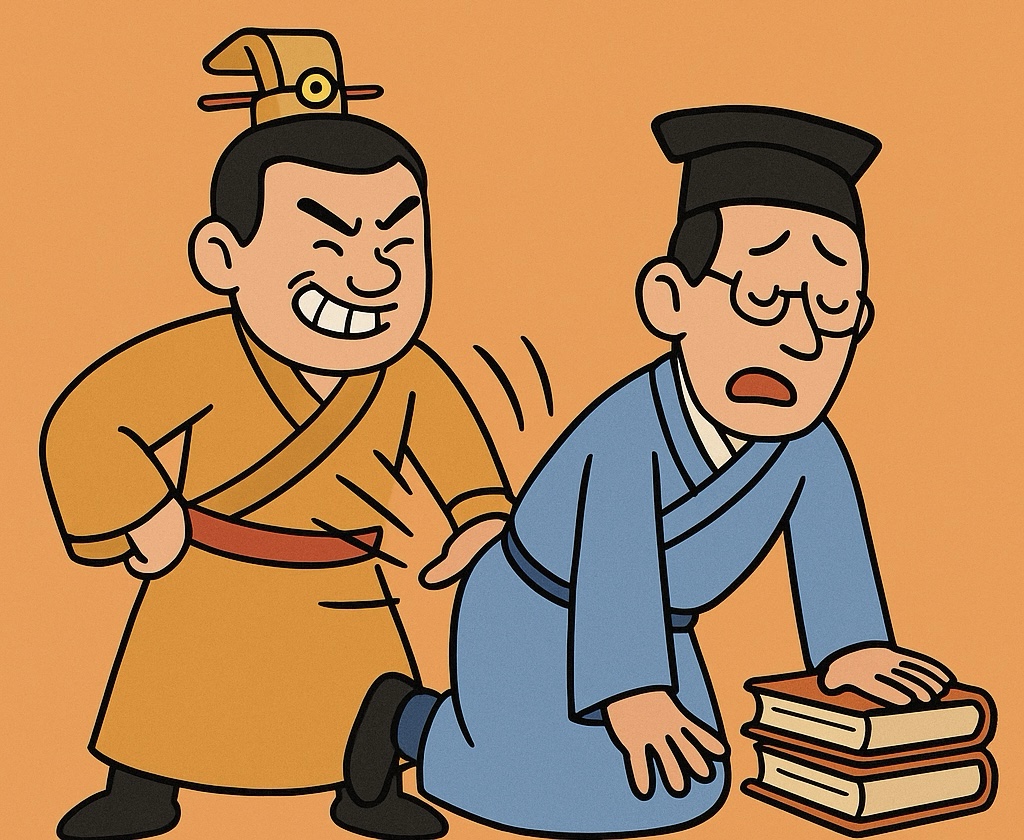
Of Whiners and Emperors: The Art of Keeping the Intelligentsia in Check
What Is a Whiner?
A whiner is someone who complains constantly—not out of necessity or moral urgency—but out of habit. No solution satisfies them; no improvement is ever enough. If you fix their roof, they’ll complain about the color of the shingles. If you serve them cake, they’ll complain it’s not pie.
Squidward from SpongeBob SquarePants might come to mind, but he’s not a true whiner—he’s a pessimist with artistic frustration and misanthropic pride. A better example is the guy who went by the nickname “沈不乐” in a university office in China where I went to college—Shen the Unhappy One. That’s a real whiner. Always bitching, chronically dissatisfied, unimpressed by joy or logic. A walking raincloud.
We all know a Shen. Some of us were raised by one.
The Whiner Ratio: A Fixed Constant in Human Populations
Like handedness, or lactose intolerance, or being gay, the “whiner gene” is not evenly distributed—but it’s always there. A conservative guess? Around 3–5% of any given population are natural-born whiners. They are the Pig Won’ts of the Richard Scarry universe. Every classroom has one. Every department has one. Every family, if they’re honest, has one.
They come out of the womb with a sigh and never recover.
To Bitch, or Not to Bitch
The English verb to bitch is colloquially synonymous with whining—but the etymology is unfair. Originally a slur against women (referring to female dogs), the term took a misogynistic route to mean “nagging or complaining excessively.” Yet men are just as prolific bitchers—especially in the intelligentsia.
So let’s de-gender the term. A whiner is an equal-opportunity b*tcher.
The Great Hothouse of Whining: Academia
You want peak bitching? Visit a university. Better yet, visit the Humanities Department. Doesn’t matter if it’s in Harvard or Hunan. Academia breeds whiners the way stagnant water breeds mosquitoes: naturally, efficiently, endlessly.
In China, these people are called 知识分子 (zhīshì fènzǐ), or “intellectuals.” In dynastic times, they were the Confucians, selected through exams, steeped in texts, and always ready to tell the emperor why he was wrong. Today, they read Western philosophy, praise Foucault, and complain that the water cooler isn’t pure enough.
The Fire Safety Incident: 打脸 in Real Time
Once, while teaching at a Chinese university, we hosted a fire safety seminar. The fire department showed up with videos and warnings. The professors? Showed up late, ignored the officers, and spent the session swapping irrelevant stories—until the videos began to roll. Charred bodies. Real fires. Real consequences.
And suddenly: silence.
What happened? A moment of collective 打脸—literally, a slap in the face. It was no longer abstract. Their smugness met reality. And for once, the whiners were shushed by death itself.
When Whining Becomes a National Threat
Now, here’s the thing with whiners: most of the time, you let them be. But when their bitching starts to rot the foundation, someone has to step in with a broomstick.
Qin Shi Huang, China’s first emperor, understood this. Tired of Confucians telling him how to rule, he burned their books and buried many alive. Not out of cruelty—but to restore national focus. In modern terms: it was a strategic purge of chronic dissent.
Chairman Mao Zedong took a similar approach during the Anti-Rightist Movement. Intellectuals had their moment during the Hundred Flowers Campaign. Then they took it too far—so Mao yanked the leash.
The Political Wisdom of VPN Governance
Modern China, wiser than its ancestors in many ways, has adopted a softer approach.
Take the issue of VPNs. Technically illegal. But enforcement? Rare to nonexistent.
Why? Because the people who use VPNs—the “one percenters” of thought—are mostly university professors, foreign-language instructors, liberal arts scholars. In short, bitchers. Or as they’re sometimes called: bananas—yellow on the outside, white on the inside.
Instead of jailing them, the state lets them frolic. This is political genius. If they get out of hand? Slap on the wrist. If they really get out of hand? Then it’s time for the emperor’s methods.
Conclusion: The Monkeys and the Chicken
There’s an old Chinese proverb: 杀鸡儆猴—kill the chicken to scare the monkeys.
You don’t need to jail every whiner. You just need to make an example of one. The rest fall in line. In the end, a country that tolerates some noise while keeping the drumbeat steady is not weak—it’s wise.
And sometimes, wisdom means knowing when to ignore the b*tching—And when to bring out the shovel.
By the way, I’m a bitcher and a great admirer of the following contemporary English philosopher :
Zeke Plunkett (philosophy of noisy pork stew)
Cooter Wiggins (philosophy of sex)
Bubba Ray Jethro (philosophy of catfish)
Elmer Lou Shoats (philosophy of the Alabama Moon)
Clem Kadiddlehopper (metaphysics of redneck art)
Wobble Jingo (philosophy of unstable walking)
Fiddle Tito (philosophy of Leaky Roofs)
Puddles Rupert (philosophy of the baltic states)
Tinkle Mavis Q. (philosophy of Pee Pee)
Giggle Fanny W. (philosophy of silliness)
Dusty Bucksnort (philosophy of history)
Booger Hank (philosophy of the dried stuff out of the nose)
Cricket Joe McSnuff (philosophy of noise)
Tater Wiggles (homework)
Spackle Jeb (homework)
Queenie Mae Fuzzbottom (philosophy of soft ass)
Snuffy T. Rawhide (homework)
Lurlene Hissy (philosophy of serpents)
Billy-Bob Banjoman (Jewish music studies)
 Yego’s Chronicles