1. Four Meters in English Poetry
There are four basic meters in English poetry:
Iambic = da-DUM da-DUM (a single foot is an iamb)
Trochaic = DUM-da DUM-da (a single foot is a trochee)
Anapestic= dada-DUM dada-DUM (a single foot is an anapest)
Dactylic = DUM-dada DUM-dada (a single foot is a dactyl)
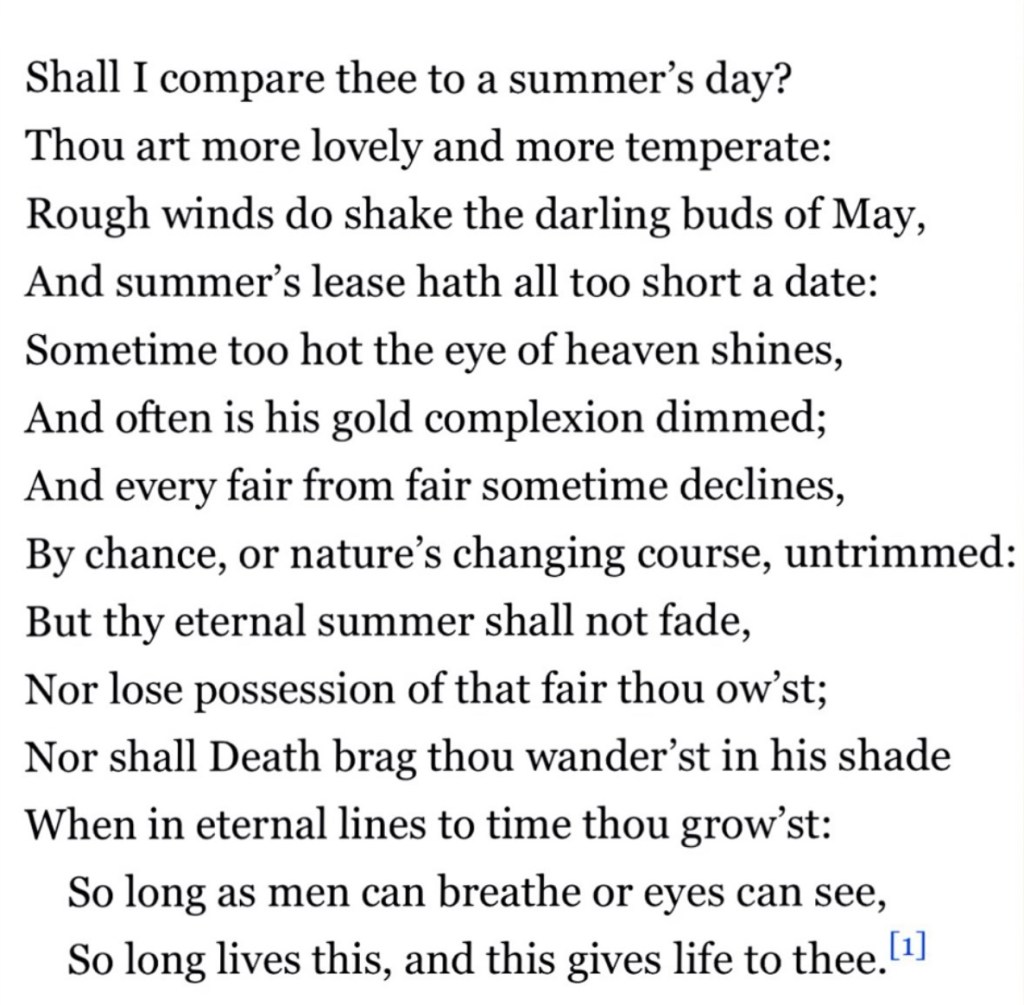
Iambic meter is the most common in English language poetry. The model work of the Iambic meter is Shakespeare’s most celebrated Sonnet 18:
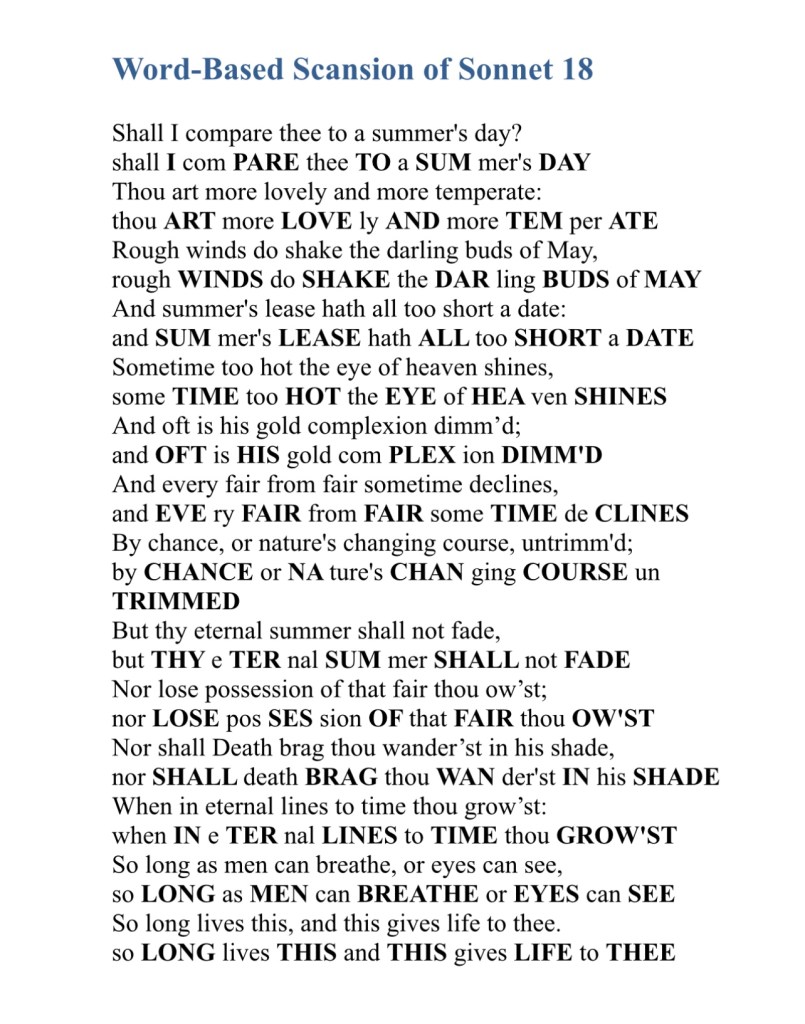
Below is the scansion for this work in two notational systems, one word-based and one in the da-DUM notation – or the sound-based mnemonic scansion notation:
And the sound-based version:

2. Rendering Chinese Poetry into English
Any attempt to translate Chinese poetry into English must take into account the metrical conventions unique to each language. This does not mean one should try to preserve the original Chinese meters in English translation, or vice versa—that would be preposterous! Rather, it means that an English rendering of a Chinese poem should adopt a natural and consistent poetic meter—or meters—that are familiar in English poetry, and that sound fluid to native English speakers and their reading habits. At the same time, the translation should remain faithful to the original work in both style and meaning, to the extent that such fidelity can be preserved.
3. Hut of a Home – Translation and Metrical Analysis
This work by Tao Yuanming is an ageless classic. I use it here to demonstrate how the metrical patterns of English poetry can be employed to render the poem into natural and rhythmic English.
a. The Chinese Original
陶渊明 (372-427)
结庐在人境,
而无车马喧。
问君何能尔,
心远地自偏。
采菊东篱下,
悠然见南山。
山气日夕佳,
飞鸟相与还。
此中有真意,
欲辨已忘言。
b. English Translation
Hut of a Home
I reside in this world, in a hut of a home,
From the hurly and burly, my home is a-free.
You ask of me, “How’s this achieved?”
A far-off mind makes distance seem.
I gather mums beneath the eastern fence,
And idly I see the hills to the southern lea.
The mountain air is fair at dusk and dawn,
As birds in flight come back in company.
There’s truth in this, so richly deep—
I sought to speak, but lost the words in me.
c. English Translation with Word-based Scansion
1. i re-SIDE | in this WORLD | in a HUT | of a HOME
2. from the HUR | ly and BUR | ly my HOME | is a-FREE
3. you ASK | of ME | how’s THIS | a-CHIEVED
4. a FAR- | off MIND | makes DIS- | tance SEEM
5. i GATH | er MUMS | be-NEATH | the EAST | ern FENCE
6. and ID | ly i SEE | the HILLS | to the SOUTH | ern LEA
7. the MOUN | tain AIR | is FAIR | at DUSK | and DAWN
8. as BIRDS | in FLIGHT | come BACK | in COM | pa-NY
9. there’s TRUTH | in THIS | so RICH | ly DEEP
10. i SOUGHT | to SPEAK | but LOST | the WORDS | in ME
d. Line-by-line analysis
1. i re-SIDE | in this WORLD | in a HUT | of a HOME → 4 feet – mostly anapestic (anapestic tetrameter)
2. from the HUR | ly and BUR | ly, my HOME | is a-FREE → 4 feet – anapestic tetrameter (clean)
3. you ASK | of ME | how’s THIS | a-CHIEVED → 4 feet – iambic tetrameter
4. a FAR-off MIND | makes DIS- | tance SEEM → 4 feet – iambic tetrameter
5. i GATH | er MUMS | be-NEATH | the EAST | ern FENCE → 5 feet – iambic pentameter
6. and ID | ly i SEE | the HILLS | to the SOUTH | ern LEA → 5 feet – iambic pentameter
7. the MOUN | tain AIR | is FAIR | at DUSK | and DAWN → 5 feet – iambic pentameter
8. as BIRDS | in FLIGHT | come BACK | in COM | pa-NY → 5 feet – iambic tetrameter (with a feminine ending)
9. there’s TRUTH | in THIS | so RICH | ly DEEP → 4 feet – iambic tetrameter
10. i SOUGHT | to SPEAK | but LOST | the WORDS | in ME → 5 feet – iambic pentameter
e. The Poem with the Sound-based Scansion
1. i reside in this world in a hut of a home
→ da-da-DUM | da-da-DUM | da-da-DUM | da-da-DUM
2. from the hurly and burly, my home is a-free
→ da-da-DUM | da-da-DUM | da-da-DUM | da-da-DUM
3. you ask of me how’s this achieved
→ da-DUM | da-DUM | da-DUM | da-DUM
4. a far-off mind makes distance seem
→ da-DUM | da-DUM | da-DUM | da-DUM
5. i gather mums beneath the eastern fence
→ da-DUM | da-DUM | da-DUM | da-DUM | da-DUM
6. and idly I see the hills to the southern lea
→ da-DUM | da-DUM | da-DUM | da-DUM | da-DUM
7. the mountain air is fair at dusk and dawn
→ da-DUM | da-DUM | da-DUM | da-DUM | da-DUM
8. as birds in flight come back in company
→ da-DUM | da-DUM | da-DUM | da-DUM | da-DUM
9. there’s truth in this so richly deep
→ da-DUM | da-DUM | da-DUM | da-DUM
10. i sought to speak but lost the words in me
→ da-DUM | da-DUM | da-DUM | da-DUM | da-DUM
f. Summary of Overall Meter
This English translation of Hut of a Home maintains a flexible but musically consistent rhythm grounded in English accentual-syllabic meter. The poem alternates primarily between iambic tetrameter and iambic pentameter, with occasional use of anapestic feet in the opening lines for a lighter, more lyrical lift-off. Most lines feature four or five metrical feet, creating a natural cadence that supports the contemplative tone of the original Chinese. Variations like feminine endings and strategic substitutions keep the rhythm fluid rather than mechanical, allowing the voice of the speaker to feel at once poetic and conversational. The overall metrical structure mirrors the balanced and reflective spirit of the poem, while remaining faithful to the pacing and emotional rhythm of the original..
4. The Crane Tower – Translation and Metrical Analysis
唐 崔颢
黄鹤楼
昔人已乘黄鹤去,
此地空余黄鹤楼。
黄鹤一去不复返,
白云千载空悠悠。
晴川历历汉阳树,
芳草萋萋鹦鹉洲。
日暮乡关何处是,
烟波江上使人愁。
Before reading the English translation, you might want to listen to a recitation of the original poem in Cantonese. Just because you speak Mandarin doesn’t mean you truly understand Chinese. Don’t believe me? Give it a listen! And if your mother tongue isn’t “Chinese,” don’t despair — just watch the face of a Mandarin speaker listening to this — totally thrown off their feet!
The Crane Tower
The man and his crane are long since gone,
The tower now stands forlorn and gaunt.
The crane had left n’ would not be back,
The clouds may linger, in vain, for eons on.
The trees across the river, sharp and clear,
The grass upon the islet thick has grown.
Whither is home, as night draws near?
The river haze brings sorrow to the lone.
Scansion (Word-Based Breakdown):
1. the MAN | and his CRANE | are LONG | since GONE
2. the TOW | er now STANDS | forLORN | and GAUNT
3. the CRANE | had LEFT | n’ would NOT | be BACK
4. the CLOUDS | may LIN | ger, in VAIN | for e’|ons ON
5. the TREES | aCROSS | the RIV | er, SHARP | and CLEAR
6. the GRASS | upON | the IS | let THICK | has GROWN
7. WHITH-er is HOME | as NIGHT | draws NEAR
8. the RIV | er HAZE | brings SOR | row to | the LONE
Line-by-Line Metrical Analysis:
1. 4 feet – Mostly iambic; contains one anapest (“and his crane”) at the start.
2. 4 feet – Clean iambic tetrameter, with balanced phrasing.
3. 4 feet – Smooth iambic line; contractions aid the meter.
4. 5 feet – Mostly iambic pentameter; the final foot (“eons ON”) reads naturally as iambic.
5. 5 feet – Clear iambic pentameter; good cadence and emphasis.
6. 5 feet – Strong iambic rhythm; diction is natural and consistent.
7. 4 feet – Well-paced iambic tetrameter; phrasing is tight and rhythmic.
8. 5 feet – Primarily iambic pentameter, with a trochaic substitution in the fourth foot (“row to”).
Summary of Overall Meter:
This English translation of The Crane Tower adheres to a loose iambic meter, alternating between iambic tetrameter and pentameter. The first three lines lean on iambic tetrameter with mild anapestic substitutions, while lines 4–6 settle into clean pentameter. Lines 7 and 8 reintroduce some metrical variation with substitution and stress shifts that mirror natural speech. Overall, the rhythm is musical and formal, echoing the reflective solemnity of the original poem while remaining smooth and idiomatic in English.
5. Reunion is Hard – Translation and Metrical Analysis
无题 · 相见时难(李商隐)
相见时难别亦难,
东风无力百花残。
春蚕到死丝方尽,
蜡炬成灰泪始干。
晓镜但愁云鬓改,
夜吟应觉月光寒。
蓬山此去无多路,
青鸟殷勤为探看。
No Title
Reunion is hard but harder still is the parting,
Spring has yet to come, already the flowers are dying.
Silkworms will die only when there’s no more thread inside,
A candle won’t be ashes until all its tears have run dry.
In the morning mirror the graying truth does not hide,
An aging bone feels the chills even on a moonlit night.
My road to the Isles of Penglai is getting shorter,
I thank the Green Bird for being my diligent guide.
Scansion (Stress and Meter)
1. reUNion is HARD | but HARDer STILL | is the PARTing
2. SPRING has YET to COME | alREADy the FLOWers are DYing
3. SILKworms will DIE | onLY WHEN | there’s no MORE thread INside
4. a CANdle WON’T | be ASHes unTIL | all its TEARS have run DRY
5. in the MORNing MIRror | the GRAYing TRUTH | does not HIDE
6. an Aging BONE | feels the CHILLS | eVEN ON | a MOONlit NIGHT
7. my ROAD to the ISLES | of PENGlai IS | getTING SHORTer
8. i THANK the GREEN bird | for BEing | my DILigent GUIDE
Summary of Metrical Features
This translation generally follows a flexible iambic base but allows for anapestic and trochaic substitutions, making the rhythm feel modern, emotionally expressive, and true to the poem’s intense lyrical voice. Most lines contain four to five feet, with some regular use of pentameter (especially in lines 2–4). Lines like “Silkworms will die only when there’s no more thread inside” and “A candle won’t be ashes until all its tears have run dry” achieve an almost elegiac cadence.
The variation in rhythm — especially the looser beats in lines 6 and 8 — reflects the original’s subtle shifts in mood from melancholy longing to transcendent hope. The stresses fall naturally on key semantic elements, allowing the poem’s meaning and meter to reinforce one another.
6. The Zither – Translation and Metrical Analysis
Original (by Li Shangyin)
锦瑟无端五十弦,
一弦一柱思华年。
庄生晓梦迷蝴蝶,
望帝春心托杜鹃。
沧海月明珠有泪,
蓝田日暖玉生烟。
此情可待成追忆,
只是当时已惘然。
English Translation
The Zither
Why fifty strings make the zither I can’t explain,
Each fret, every string—a youthful year in vain.
One the butterfly in Zhuang-sheng’s dream,
Another, an emperor’s heart in the cuckoo’s rain.
One the tearful pearl in the moonlit sea,
Yet another the smoky jade on the sunny plain.
All this I do so wish to hold and keep,
Yet they fade too fast, and can’t be retained.
Scansion (Word-Based)
1. Why FIFT | y STRINGS | make the ZI | ther I CAN’T | ex-PLAIN →5 feet
2. Each FRET | ev’ry STRING | a YOUTH | ful YEAR | in VAIN → 5 feet
3. ONE the BUT | ter-FLY | in ZHUANG | sheng’s DREAM → 5 feet
4. A-NOTH | er, an EM | per-OR’S | HEART in the CUCK | oo’s RAIN → 6 feet
5. ONE the TEAR | ful PEARL | in the MOON | lit SEA → 5 feet
6. Yet a-NOTH | er the SMO | ky JADE | on the SUN | ny PLAIN → 5 feet
7. ALL this I | do SO | wish to HOLD | and KEEP → 5 feet
8. Yet they FADE | too FAST | and CAN’T | be re-TAINED →5 feet
Summary of Overall Meter and Rhyme
This translation of The Zither follows a regular and formal metrical structure, with most lines written in iambic pentameter — five metrical feet per line, each typically consisting of an unstressed syllable followed by a stressed one (da-DUM). Some lines feature subtle variations, such as initial trochees or anapests, but these are few and do not disrupt the overall cadence. The even-numbered lines (2, 4, 6, and 8) follow a strict and elegant rhyme scheme, all ending in a clear and perfect “ain” sound: vain, rain, plain, retained. The odd-numbered lines are unrhymed, giving the poem a classical couplet structure while allowing for flexibility in expression. This pattern mirrors the Chinese original, where only the even lines are required to rhyme.
7. The Yügu Fort – Translation and Metrical Analysis
Original Chinese
The Yügu Fort ~ A Bodhisattva Label
郁孤台下清江水,
中间多少行人泪。
西北望长安,
可怜无数山。
青山遮不住,
毕竟东流去。
江晚正愁余,
山深闻鹧鸪。
English Translation
Below the Yügu Fort the water flows so clear,
How much o’ the water’s travelers’ tears!
Hopes to see the land forsaken,
All but dashed by countless mountains.
What the mountains fail to slow,
To the east it must still flow.
The night is here, and sad am I,
Deep in woods I hear the partridges cry.
Word-Based Scansion
1. beLOW | the YÜ | gu FORT | the WAT | er FLOWS | so CLEAR
2. how MUCH | o’ the WAT | er’s TRA | velers’ TEARS
3. HOPES to | SEE the | LAND for- | SA-ken
4. ALL but | DASHED by | COUNTless | MOUNtains
5. WHAT the | MOUNtains | fail to | slow
6. to the | EAST it | MUST still | FLOW
7. the NIGHT | is HERE | and SAD | am I
8. DEEP in | WOODS I | HEAR the | PARtri | dges CRY
Summary of Metrical Features
This English translation of “The Yügu Fort” adheres closely to a structured meter, alternating between iambic tetrameter and pentameter lines. The rhyming scheme follows a clear couplet pattern: AABBCCDD, with even-numbered lines rhyming. The meter and rhyme reinforce the poem’s contemplative mood, reflecting the persistence of flowing water and lingering sorrow. While some lines feature substitutions such as anapests or trochees, the overall rhythm maintains formal balance and musicality.
8. Find Me a Better Translation
These are not my only translation works; I’ve done more — some of which appear in video format on platforms like Bilibili and YouTube.
To the reader: If you know of a translation of any of the poems above that you believe is better than mine, write to me and let me know — I’ll be more than happy to take this post down.
As a small reward for your visit, here’s an audio recording of a little Chinese poem translated by ChatGPT — in some alien tongue. Enjoy!

 Yego’s Chronicles