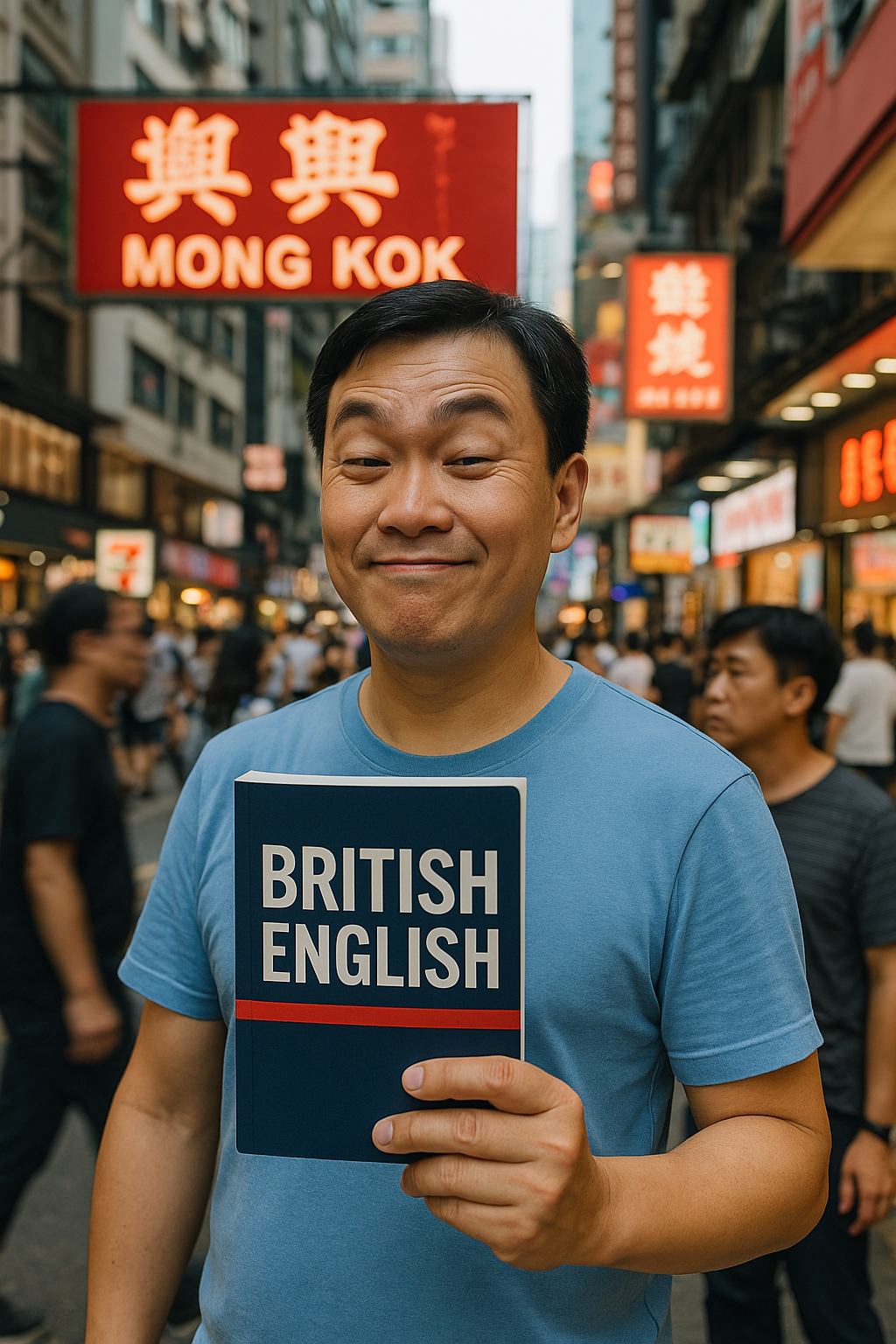
My cousin from Hong Kong came to visit last summer. He was slick, confident, and wore a blazer in ninety-degree weather. Over dim sum, he declared — in a thick, showy accent — that English was “the key to civilization.” I asked him what kind of tea he preferred, and he answered, “Frankly, I only drink Earl Grey.” That’s when I knew: this wasn’t just a man — it was a former colony speaking through him. What followed was a weeklong crash course in linguistic snobbery, colonial pride, and the sacred ritual of speaking English like it was a royal bloodline. And that, dear reader, is how this essay began.
Once upon a humid day in the Pearl of the Orient, a miraculous truth revealed itself: speaking “Eengleeshi” — that blessed tongue of their late colonial overlords — is not merely a skill. No. In Hong Kong, it is a sacrament, a badge of civilization, a litmus test for human worth.
If you thought the British left in 1997, think again. They may have taken the flags, the wigs, and the Queen’s portrait, but they left behind something far more precious — a mindset. A glorious, unshakable, utterly colonial conviction: those who speak English (with a certain accent, preferably nasal and clipped) are better than those who don’t.
And who doesn’t speak English? Why, the Mainlanders, of course. Poor things. They may have money, power, tech empires, and billion-dollar IPOs, but alas — what good is that if you cannot order your Tall Caramel Macchiato without sounding like a Mongolian goat herder?
“Look at them,” says Auntie June in Causeway Bay, eyeing a tourist from Chengdu with disdain. “Don’t even know how to say ‘excuse me.’ Mainland quality so low.”
It’s true. She said “s’cuse me” with a hard “s” and — horror of horrors — a Mandarin rhythm.
Shame! Ban her from Harbour City. Take away her LV bag.
📖 Vocabulary of Superiority™
Or: How to Mangle English and Still Feel Superior to the Mainland
| English Word | Hong Kong Version | Gloss |
|---|---|---|
| bus | ba-see | Final vowel added, as if honoring the Queen herself. |
| fork | f**k | Be careful asking for one at dinner. |
| sheet | shit | Hotel staff horror story #43. |
| beach | bitch | Not quite the sunny vacation image. |
| basis | bay-see / bay-sit | The foundation of linguistic comedy. |
| three | tree | No “th” in Cantonese = treepical confusion. |
| thirty | tur-dee | Now you’re speaking Turdish. |
| fruit | foot / flute | Can’t tell if it’s edible or musical. |
| real | weal | “Weally?” Yes. Weally. |
| rarely | lah-lay | Mystery meat of phonemes. |
| salad | ser-lert | Healthy and unrecognizable. |
| umbrella | um-bla-la | Sounds like something Mary Poppins would sing. |
| airport | air-po | Because the “-rt” is just colonizer noise. |
| vehicle | wee-he-ko | Transport yourself to a linguistic dream. |
| crisps | crips | Final consonant cluster? Nah. Too colonial. |
| shirt | shit | See also: wardrobe-based profanity. |
| restaurant | rest-lawn | Almost French. Almost English. Fully butchered. |
The Irony, Reheated
Let’s not forget: these same Cantonese speakers will scoff at a Mainlander who misplaces an “s” or mixes up “he” and “she” — never noticing their own sentence just went:
“Actually I have went to shopping and then I take the MTR come back home lor.”
Fluency? Irrelevant.
Grammar? Colonial baggage.
Accent? A class weapon.
What matters is that you sound British-ish, or at least not Mainlandish.
Final Blessing
So let us salute the Eengleeshi speakers of Hong Kong, gatekeepers of colonial identity, defenders of post-imperial pride, and the last bastion of Queen’s English — albeit spoken like a karaoke remix of BBC radio and Mong Kok minibus chatter.
For though their grammar may be broken,
their sense of rank is clearly spoken.
Amen. Or as they say at the cha chaan teng:
“Eh-man, la!”
 Yego’s Chronicles