1
In the evening Dina Papádopoulou came. She wore a simple wrap dress, a pair of barely-there heels, and carried a small foldable umbrella in her hand.
Earlier in the day we had talked about going for a walk — to the small shopping area near the college campus, maybe grab something casual to eat, like sushi. But the rain had come, heavy at times, and from the wet, low-hanging clouds it looked as though it would go on through the night. It was only late May, but this year the monsoon seemed to have arrived early.
Still, there she was, right on time. We headed out, turning onto the main avenue. Young trees in deep green lined the sidewalk — camphors, ginkgos, and tallows.
“Dina Papádopoulou,” I said, turning to her with feigned surprise and admiration as we walked. “You look great tonight.”
“Oh, come on,” she answered with a smile. “Is this irony, or what? You know me — this is how I always dress.”
That was mostly true, except for the heels. I had seen her in dress boots, in sneakers, but never in heels. They were there, and yet not — the straps disappearing into her skin, leaving only her feet: pale, delicate, so graceful in shape. Until that moment it had never occurred to me that a woman’s feet could be such a beautiful thing.
Dina looked the way you might imagine a Greek woman: medium height, a thick head of dark hair, a fuller but harmonious figure. Her eyes always seemed to be smiling. The fabric of her dress drew softly at her waist and fell with an easy grace over her body.
And Dina in heels, and me in my Adidas, went out for an evening walk.
2
The sidewalk was wet, and the shrubs along the landscaping glistened with rainwater. The air smelled of leaves and wet soil.
The street had only light traffic. We came to an intersection; the pedestrian light was red, so we stopped. When it turned green, Dina didn’t move but stayed standing, so I did the same. The light went red again, then green once more. Instead of crossing, she stepped back a few paces and stopped near the edge of a semi-circular flower bed.
I went up to her and asked softly, “Is something wrong?” She didn’t immediately answer.
“Shane,” she said after a pause. “Do you know that I was once married?”
The question was unexpected. I was at a loss for words.
“I… didn’t know that,” I managed.
She stayed silent for a while, looking down at the wet ground, then lifted her eyes to me. I saw the familiar Dina smile in them, but that was not enough for me to know what to say, or do. I thought perhaps she wanted me to respond, but I wasn’t sure. It was such a personal thing to share, and I was glad she trusted me with it — yet in the end no words came.
In those brief moments, a few thoughts flashed across my mind. First I thought: she’s Greek, so the man she was briefly married to was probably Greek too. An image of a Socrates statue with a snub nose came to mind, but I dismissed it immediately as impossible. For whatever reason the famous statue of Laocoön and his two sons being strangled by giant sea serpents also rose up, but that too I pushed aside. Then I thought of Olympiacos FC, whose games I sometimes watched, as I was myself a decent soccer player. Those boys were handsome, and they had fans all over Greece. But Dina and a professional footballer? I shook my head.
Still, I was glad she told me. I was fond of Dina, and the thought that she was free, with no ties, gave me relief.
Just then the pedestrian light began to tick. We both looked up and started across the street.
3
Business at the sushi restaurant was light that evening, probably because of the weather. As we waited for our order, she asked me where I grew up. Up until this night our conversations had always been about study and not personal stuff. I took out my phone and showed her a photo of a painting.
She took my phone to view the image, but immediately broke into laughter.
“You have a very fine sense of humor, Shane,” she said, shaking her head in disbelief while smiling. “I like it, I really like it.”
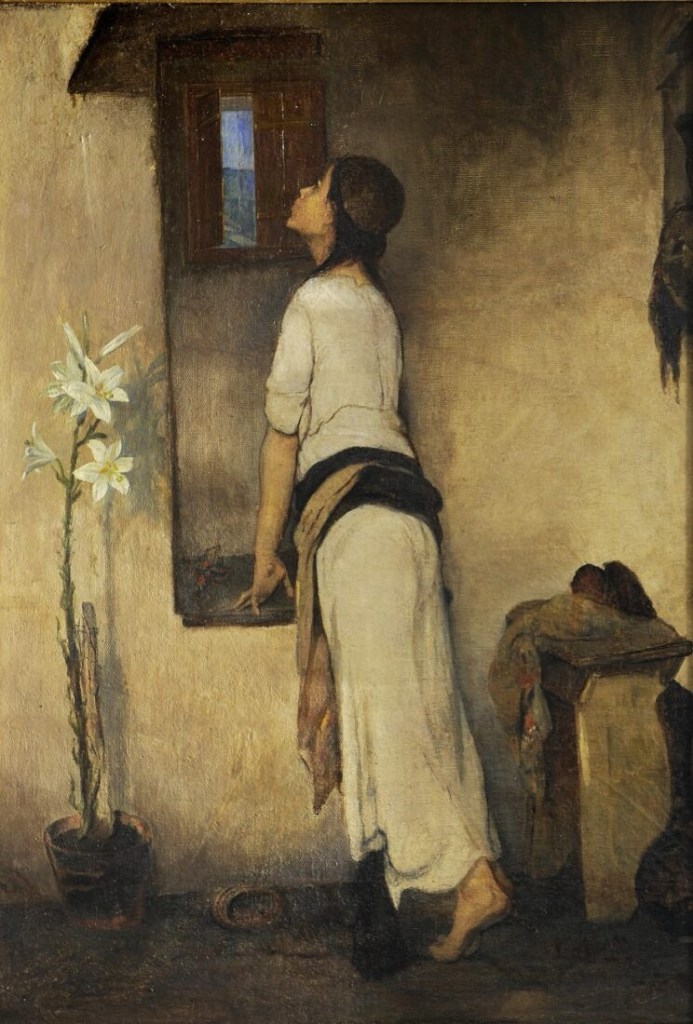
What I showed her was a painting by the great Greek painter Nikēphoros Lytras — more exactly, the painter’s own study version of the famous Le Baiser. Apparently she was familiar with the painter and his work, and in particular this one and the story behind it — that it existed in two versions, different in ways only the attentive would notice. I shouldn’t have been surprised; this was Dina, after all, and she had been a literature major back in college. Still, I was impressed. Words were not needed with Dina Papádopoulou.
At that moment our order arrived. The owner set down two plates of sushi rolls but lingered, glancing at Dina, then at me, then back at Dina.
“Weren’t you two here a few nights ago?” she asked.
“No, I don’t think so,” Dina said in a dismissive tone. “Looking all good, thank you!”
A couple of young people — boyfriends with their girlfriends — came into the restaurant, students from the college most likely. The owner went over to them.
4
We dropped into a bar after the sushi place. Since neither of us drank, we ordered mocktails — a virgin mojito for me, and for Dina, a virgin Bloody Mary. Her glass came rimmed with salt, mine with sprigs of mint. We raised them lightly, without toasting, and sipped in the dim light.
Only then did we notice that the booth across the aisle was occupied. A young man lay on his back, clothes rumpled, apparently passed out. A half-empty bottle of British gin sat at the edge of the table. On the other side were a girl and two men, all three with their heads down, eyes glued to their phones.
“Poor boy,” I said.
“Poor boy,” Dina echoed.
I used to drink, and on more than one occasion had ended up in a situation like that young man. I also knew what it was like to get drunk on gin — no matter how fine, regardless of the brand, it was something you would never forget. It was something that would haunt you for life. But when you are young, and stupid, as they say, this happens: sometimes out of bravado, more often for a doomed love.
Dina had a concerned look on her face, but something about the scene across the aisle also bemused her, for there was a twinkle in her eyes when she turned her head back and looked at me.
5
It had rained while we were in the bar, but when we came out it had eased to a drizzle. It was now completely dark. Streetlights glowed orange, flickering, and revealed a thin curtain of rain slanting through the night air. The street was nearly empty; now and then a lone car passed by, almost in silence.
More leaves had fallen on the sidewalk, soft underfoot, spongy when stepped on. I held the tiny umbrella over her, though more symbolic—even a bit comical—than practical. Our shoulders, our backs, and of course our feet were getting wet, and we both knew it. Whether we continued to hold it up or not would not have made any difference. We could simply walk in the rain. But she let me fuss with my constant adjustments, as though in both our minds the umbrella really was keeping her dry. In truth, we liked the closeness it had made possible. It was as if we had convinced ourselves about the umbrella — because it was raining, so we must keep using it; because it was small, so to share it we had to stay close, shoulder brushing shoulder, cheek nearly against cheek.
At one point we came upon a shallow pool of rainwater on the pavement. We both looked down at it at the same time, then leapt across together, Dina lifting the bottom of her dress with one hand. When we landed, in the dim light falling through the tree foliage, I caught sight of Dina’s feet — pale, petite, delicate. For a moment I thought they were the most beautiful things in the world.
We straightened ourselves, but stood still, in breathing distance, as if uncertain where we were, or whether we had heard something that wasn’t really there. We stayed like that, in anticipation of something — a miracle, an event, an action that might somehow take place of its own accord. The moment came, then it was gone. At that instant we both looked up. It was gone, and we both knew it. The streetlights showed the night sky, rain broken into fine threads, dancing in the wind.
 Yego’s Chronicles