A-Xia, from Volume 3 of Pu Songling’s classic Liaozhai Zhiyi, presented here in a complete English translation.
In Wendeng there lived a man named Jingxing, known from youth for his good reputation. His neighbor was a certain Chen, the two houses separated only by a low wall.
One evening Chen was passing through an abandoned old market village when he heard a young woman weeping among the pines and cypresses. Coming close, he saw a sash hanging from a slanted branch, as though she meant to hang herself.
Chen questioned her. She wiped her tears and replied, “My mother is away on a long journey, and left me in the care of my cousin. Who knew he would reveal a wolf’s heart, trying to force himself on me? Alone and helpless like this, I might as well die!” With that she burst into tears again.
Chen untied the sash and urged her to go seek refuge with someone else. The girl said she had no one to trust. Chen offered, “Then stay at my house for now.” She agreed.
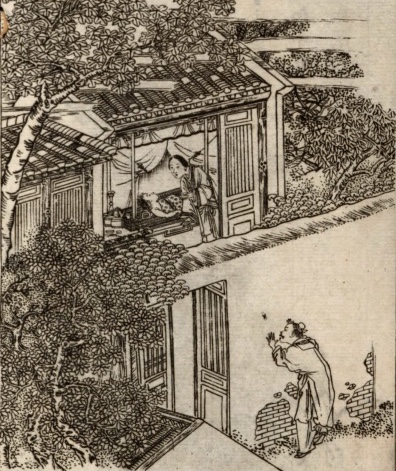
When they returned home, Chen lit a lamp to look at her closely. Seeing her beauty, full of grace and charm, he was delighted and wanted to take advantage of her. The girl cried out loudly in resistance, their struggle so noisy that it reached the neighboring house. Jingxing climbed over the wall to see what was happening, and Chen let her go.
When the girl saw Jingxing, she stared at him fixedly for a long moment, then suddenly ran off. The two men chased her, but she vanished without a trace.
Jingxing returned home, closed the door, and was about to sleep when the girl suddenly appeared in his room, her figure graceful and full. Startled, he asked what she was doing there. She answered, “That one’s virtue is thin and his fortune shallow. I cannot entrust myself to him.”
Jingxing was overjoyed and asked her name. She said, “My ancestors lived in Qi, and so my surname is Qi. My childhood name is A-Xia.” She answered his teasing words with only light laughter, not strongly refusing him, and they slept together.
Jingxing’s studio often had friends coming and going, so the girl always hid in the innermost room. After several days, she said, “I must leave for now. This place is full of visitors and bothersome noise. From now on, let us meet only at night.”
He asked where her home was. She replied, “Not far.” She left early the next morning and indeed returned at night. Their affection grew intense.
A few days later she told him: “Though our attachment is deep, in the end it is still an illicit union. My father is serving as an official in the western frontier. Tomorrow I shall go with my mother to join him. I will find an opportunity to ask their permission, and then come back so that we may be together openly for the rest of our lives.”
Jingxing asked how long she would be gone. She promised to return in ten days.
Once she left, Jingxing felt it improper to keep her in the study. He thought of moving her into the main house but feared his wife’s jealousy. After much deliberation, he decided it would be best to send his wife away. His mind made up, whenever his wife came home he berated her harshly.
Unable to bear the humiliation, she wept and spoke of wanting to die. Jingxing said, “If you die you’ll only drag me down with you. Better that you return to your parents.” He drove her harder and harder until she had no choice but to leave. She sobbed, “I have followed you for ten years without ever failing in virtue. Must you cast me off like this?” But he would not listen, and she finally left the house.
After that, he plastered the walls clean and swept the rooms spotless, every day craning his neck in anticipation. But no message came. A-Xia’s promise floated away like a green luan bird, lost without a trace, like a stone sinking into the sea.
His wife’s family later returned her to him and begged their acquaintances to plead for her restoration, but Jingxing refused them all. She eventually remarried into the Xiahou family. The Xiahou clan lived next to Jingxing, and because of a long-standing dispute over farmland, there had always been bad blood between the families. Hearing she had married into that household only made Jingxing more resentful. Yet he still hoped that A-Xia might return, which gave him a sliver of comfort.
More than a year passed with no sign of her.
During a festival for the Sea God, people crowded into the temple, men and women alike; Jingxing was among them. From afar he saw a woman who looked very much like A-Xia. He approached, but she slipped into the crowd. He followed her outside the gate, but she drifted away lightly and vanished. He could not catch up, and returned full of regret.
Half a year later, while walking along the road, he saw a young lady clad in scarlet, accompanied by servants, riding a black donkey. He took one look and knew it was A-Xia. He asked one of the attendants, “Who is this lady?” The man replied, “She is the second wife of Master Zheng of the southern village.”
Jingxing asked, “When did he marry her?”
“Half a month ago,” the man said.
Jingxing wondered if he might be mistaken. Just then the lady, hearing their exchange, turned and glanced at him. He looked carefully: it was truly A-Xia.
Seeing she had married another, his chest filled with fury. He shouted, “Lady Xia! How could you forget our old vow?”
The attendants, hearing a stranger call their mistress, raised their fists, ready to beat him. The lady hastily stopped them, lifted the thin silk veil covering her face and said coldly to Jingxing:
“You faithless man, how dare you show your face before me?”
Jingxing said, “You betrayed me, not I you.”
She replied, “You wronged your wife far worse than you ever wronged me. Your hair-binding wife you cast off like nothing. With such a heart, how could you be faithful to anyone? Because of the merit of your ancestors you once held a place among the candidates for high honors. But due to your unjust treatment of your wife, the spirits have cut your fortune short. In this year’s examinations, the runner-up, Wang Chang, is the one who has taken your place.
“I now belong to the Zheng family. Do not think of me again.”
Jingxing bowed his head and couldn’t utter a single word. He watched her ride away swiftly, sorrow swallowing his heart.
That year Jingxing indeed failed the examination, and the runner-up was indeed a man named Wang Chang. From this, Jingxing gained the reputation of being a fickle, shallow man.
He remained unmarried into his forties, and his household gradually fell into ruin. He often relied on relatives and friends just to eat.
Once he went to call on Master Zheng, who treated him courteously and invited him to stay the night. A-Xia peered at the guest and, seeing him, felt pity. She asked Zheng, “Isn’t that Jing Xingyun?”
He asked how she knew the man. She said, “Before I married you, I once took refuge in his home and received his care. Though his conduct is base now, the virtue of his forefathers is not yet entirely extinguished. And since he is your old acquaintance, you ought to show him the kindness of a padded fur robe.” Zheng agreed, replaced Jing’s threadbare garments, and kept him for several days.
At midnight before Jing left, a maid brought him over twenty taels of gold as a gift. From outside the window A-Xia said, “This is my private savings. Take it to repay our old affection. Go find yourself a good wife. Your ancestors’ virtue is deep; your line can still flourish. But do not lose your moral restraint again and shorten your remaining years.”
Jing thanked her. Returning home, he used part of the gold to purchase a servant girl from a scholar-official’s household. She was very ugly and fierce, but she bore him a son who later passed two levels of the imperial examinations.
Master Zheng eventually rose to the post of Assistant Minister of Personnel. When he died, A-Xia accompanied the funeral procession back home. But when the carriage was opened at the end of the journey, it was empty — she had vanished. Only then did people realize she had not been a human being.
Alas! When a man lacks conscience and casts off the old in pursuit of the new, the end is like eggs crushed and the fledgling birds flying from the wreckage. Heaven’s retribution is never gentle.
The Chinese Original
聊齋誌異卷三·阿霞
文登景星者,少有重名。與陳生比鄰而居,齋隔一短垣。一日,陳暮過荒落之墟,聞女子啼松柏間,近臨,則樹,橫枝有懸帶,若將自經。陳詰之,揮涕而對曰:「母遠出,託妾於外兄。不圖狼子野心,畜我不卒。伶仃如此,不如死!」言已復泣。陳解帶,勸令適人,女慮無可託者。陳請暫寄其家,女從之。既歸,挑燈審視,豐韻殊絕,大悅,欲亂之,女厲聲抗拒,紛紜之聲達於間壁。景生逾垣來窺,陳乃釋女。女見景生,凝目停睇,久乃奔去。二人共逐之,不知去向。
景歸,闔戶欲寢,則女子盈盈自房中出。驚問之。答曰:「彼德薄福淺,不可終託。」景大喜,詰其姓氏。曰:「妾祖居於齊,以齊爲姓,小字阿霞。」入以遊詞,笑不甚拒,遂與寢處。齋中多友人來往,女恆隱閉深房。過數日,曰:「妾姑去,此處煩雜困人甚。繼今,請以夜卜。」問:「家何所?」曰:「正不遠耳。」遂早去,夜果復來,歡愛綦篤。又數日,謂景曰:「我兩人情好雖佳,終屬苟合。家君宦遊西疆,明日將從母去,容即乘間稟命,而相從以終焉。」問:「幾日別?」約以旬終。既去,景思齋居不可常,移諸內又慮妻妒,計不如出妻。志既決,妻至輒詬厲,妻不堪其辱,涕欲死。景曰:「死恐見累,請早歸。」遂促妻行。妻啼曰:「從子十年未嘗失德,何決絕如此!」景不聽,逐愈急,妻乃出門去。自是堊壁清塵,引領翹待,不意信杳青鸞,如石沉海。妻大歸後,數浼知交請復於景,景不納,遂適夏侯氏。夏侯里居,與景接壤,以田畔之故世有隙。景聞之,益大恚恨。然猶冀阿霞復來,差足自慰。
越年餘,並無蹤緒。會海神壽,祠內外士女雲集,景亦在。遙見一女甚似阿霞,景近之,入於人中;從之,出於門外;又從之,飄然竟去,景追之不及,恨悒而返。後半載,適行於途,見一女郎著朱衣,從蒼頭,鞚黑衛來,望之,霞也。因問從人:「娘子爲誰?」答言:「南村鄭公子繼室。」又問:「娶幾時矣?」曰:「半月耳。」景思:“得毋誤耶?”女郎聞語,回眸一睇,景視,真阿霞也。見其已適他姓,憤填胸臆,大呼:「霞娘!何忘舊約?」從人聞呼主婦,欲奮老拳。女急止之,啓幛紗謂景曰:「負心人何顏相見?」景曰:「卿自負僕,僕何嘗負卿?」女曰:「負夫人甚於負我!結髮者如是,而況其他?向以祖德厚,名列桂籍,故委身相從。今以棄妻故,冥中削爾祿秩,今科亞魁王昌即替汝名者也。我已歸鄭姓,無勞復念。」景俯首帖耳,口不能道一詞。視女子策蹇去如飛,悵恨而已。
是科景落第,亞魁果王氏昌名,景以是得薄幸名。四十無偶,家益替,恆趁食於親友家。偶詣鄭,鄭款之,留宿焉。女窺客,見而憐之,問鄭曰:「堂上客非景慶雲耶?」問所自識,曰:「未適君時,曾避難其家,亦深得其豢養。彼行雖賤而祖德未斬,且與君爲故人,亦宜有綈袍之義。」鄭然之,易其敗絮,留以數日。夜分欲寢,有婢持金二十餘兩贈景。女在窗外言曰:「此私貯,聊酬夙好,可將去,覓一良匹。幸祖德厚,尚足及子孫;無復喪檢,以促餘齡。」景感謝之。既歸,以十餘金買縉紳家婢,甚醜悍。舉一子,後登兩榜。鄭官至吏部郎。既沒,女送葬歸,啓輿則虛無人矣,始知其非人也。噫!人之無良,舍其舊而新是謀,卒之卵覆而鳥亦飛,天之所報亦慘矣!
 Yego’s Chronicles