§1
He set his green army satchel on the counter. The store owner, a woman in her fifties, came out from the back.
“What can I help you with?” she said.
He showed her his work ID.
“I’m so sorry, officer!” she fluttered, then turned her head and shouted toward the back of the store. “Bring a cup of tea!”
“Our local station received a missing persons report a few days ago,” he said. “I assume you’re the one who made that report, correct?”
“Yes, officer, yes, it was me,” she said. She took the tea from the young man who had brought it and offered it to him. “Please, officer, have some tea!”
He took the tea and set it on the counter. From the green satchel, he took out his notebook, a pen, and a black-and-white photograph, placing the photo on the counter for the woman to see.
“Yeeehs—” A startled glare flashed across her eyes as she fluttered again. “That was the photo, and that was them! The two young people!”
“I’d like to go over the missing persons case with you,” he said, putting the photo away.
“I already told everything to the officer who came here a few days ago,” she said, a little nervous. “Everything I said is true.”
“Let’s go over it once again, nonetheless,” he said, taking a sip of the tea.
“About a week ago, in the afternoon,” the woman began, glancing quickly toward the back of the store, “two young people stopped by my store to buy ponchos and ask for advice about going into the mountains. The man was in his late twenties, about twenty-six or twenty-seven I’d say, and the girl was in her early twenties. Very nice people—very polite and well-mannered. At first, I took them for tour guides; they looked just like the tour guides around here. But when they started asking questions, I realized they were here to climb the mountains, and they were worried about the personal belongings they had with them. They asked if they could leave their cash and IDs with me for safekeeping, and that photo was amongst their belongings.
“At first I hesitated, but they were such nice people—very trusting. When they offered to pay me ten yuan as a fee for keeping their valuables, I agreed. I’m an honest person, officer, and they were so nice—I felt for them. I myself would never advise my own children to entrust their valuables to strangers. They told me they planned to spend the night in the mountains and would most likely be back the next day. After that, they headed into the mountains.”
“What about the third person?” he asked when she finished.
“Ah, yes—I almost forgot!” the woman said. “She was a college student. She arrived the night before and stayed at the inn next door. She was on her own. She overheard the two young people talking to me about going into the mountains, so she came over, struck up a conversation with them, and asked if she could join them, since she was afraid to go alone. The two young people didn’t mind, so they went together.”
The woman paused and called toward the back of the store. The same young man returned and refilled his tea.
“That girl came back the next day, toward early evening,” she continued. “But she was with some other tourists, not the two young people she had gone out with. She looked ill and stayed at the inn that night. I don’t know when she left town, but a week passed and the two young people still hadn’t come back to collect their belongings. That’s when I got worried and called the local police station.”
Her account of events matched the one she had given the local police earlier, with no discrepancies.
Across the street, a small group of tourists had gathered in one spot. A man who looked like a tour guide was speaking to them.
“So the three went into the mountains on their own,” he said to the store owner, “and didn’t use a tour guide?”
“They went on their own,” the woman said. “That’s not uncommon, though.”
He took a map out of his satchel and spread it on the counter.
“There are only two routes tourists use when they go into the mountains?” He raised his head after a moment and asked the store owner.
“Yes, officer,” the woman replied. “But one is less traveled than the other, and tour guides are reluctant to use it. When they do, they charge more.”
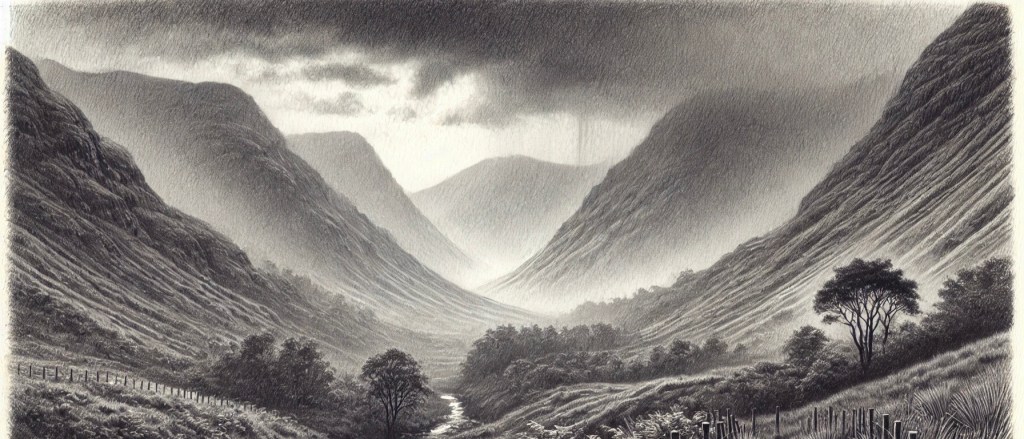
As he listened, he cast a long glance toward the mountains—shrouded in fog and thick rain-saturated gray clouds. If he headed out now, by tomorrow evening he could reach the last point along this route that offered tourist accommodations.
After leaving the store and before setting out, he checked his equipment. The satchel used for this trip was a grass-green military shoulder bag made of cotton fabric, intended for single-shoulder, cross-body carry, with a flap closure and metal buckle. Inside were a flashlight, a notebook, a pen, identification documents, handcuffs, a screwdriver, and eighteen bars of 761 military compressed rations, weighing approximately 2.25 kilograms in total—sufficient to reach the second planned stop. A standard-issue water canteen was clipped to the strap. At the bottom of the bag was a Type-64 pistol with two rounds of ammunition, wrapped in a cotton towel.
§2
The storekeeper had been right. Over the course of a day and a half of travel on foot, he encountered only a tiny trickle of tourists returning along the route. When asked, most appeared to have chosen it out of bravado, misinformation, or some combination of the two. Their frustration was palpable. Not only did the route show clear signs of being little used, but the raw, rugged mountains and valleys demanded constant alertness. The strain was relentless; even for him—someone who had grown up locally and was a twenty-year veteran of the police force—it proved tiring.
Toward late afternoon on the second day, as he rounded a bend, he caught sight of a homestead perched atop a nearby mountain, roughly the size of a typical house in this region. That, he thought, had to be the last stop offering accommodation to tourists, the one the storekeeper back in town had mentioned.
As he entered the premises, he was surprised to see small children both in the yard and inside the house. In a place so high up—a house with children. He also noticed a tiny black-and-white television set in the central hall, with several people seated close around it, their eyes fixed on the screen. He had not known that television broadcasting had reached a place this remote. But where were the relay stations? He had seen none along the way.
The same commotion followed as in the store in town. As soon as he showed his identification, the innkeeper—or more likely the head of the household—became flustered and began issuing instructions. Before long, he was told that dinner was being prepared and that a bed in the guest quarters had been arranged for him.
The dining hall was located at the front of the house, and the panoramic view it offered was striking. The mountain on which the house stood was modest in size, but it lay among far more massive peaks. From the front of the house, the surrounding mountains appeared distant, their outlines smaller and gentler. One had the impression of inhabiting a realm slightly removed from the human one.
The innkeeper returned with tea.
“Please, officer,” he said. “Our homemade tea. Dinner will be ready shortly.”
He gestured for the innkeeper to sit before the man could leave.
“Don’t go just yet,” he said. “There are a few things I’d like to ask you.”
From his army satchel, he took out his notebook and the photograph of the two missing persons.
“Do you recognize the people in this photo?” he asked, placing it on the table so the innkeeper could look more closely.
The innkeeper studied the photograph for a long moment. Finally, he raised his head.
“Yes, I’ve seen them,” he said, visibly uneasy. “They stayed here some time ago, on their way up into the mountains. I don’t recall seeing them again after that. They may have passed through on their way down without staying—I can’t be sure.”
After a brief hesitation, the man added, “On the night they stayed here, the girl left behind a spoon she had brought with her. My daughter found it while clearing the table. I’ll have her bring it to you.”
“That would be good,” he said, nodding. “How long did they stay?”
“They left the next morning.”
Dinner consisted of stir-fried pork with long hot peppers. The meat tasted slightly off; there was probably no refrigerator, and it had likely been kept for some time. As he ate, he kept glancing out at the mountains. Evening was settling in quietly. Above the ridgelines, clouds were rising.
He did not go to bed immediately after returning to his room. The television in the hall remained on late into the night—or perhaps it was always on. After two days of travel, there had been no breakthrough, but the day had not been without value. The innkeeper’s account, and the spoon, were sufficient confirmation that up to this point along the route, nothing about the two missing persons had been out of the ordinary.
§3
Another day of grueling travel on foot. Throughout the day, he encountered no one—not even a local. He had breakfast at the inn, but for lunch he relied on two bars of his military rations.
Sometime in the late evening, he came upon what appeared to be a small settlement. A few huts were scattered along the hillsides beside the bend of a zigzagging creek. The structures were either badly dilapidated or had been overtaken by vegetation and did not appear to be in use.
He walked toward the nearest hut. As he drew closer, he saw a plaque above the entrance bearing the words “Three Purity Hall.” An elderly man, his hair pinned at the back of his head, slowly emerged from the doorway. He realized he had reached a Taoist retreat.
He greeted the old man and stated his official business. The Taoist was calm and composed; there was no visible sign of alarm upon learning his identity or the purpose of his visit.
“We’ll do everything we can to assist you, officer,” the old man said in a thin, slightly shrill but warm voice. “And you are welcome to stay here for the night.”
He was invited in for tea. In front of the Three Purity Hall was a small yard with smooth, packed earth, kept spotlessly clean—reflecting the habits of its resident. As they drank, he took in the surroundings. The hut stood halfway up the hillside, facing a shallow creek. On the opposite side were gently rolling hills. After a day spent in harsh terrain, the landscape here felt unexpectedly mild, almost capable of making one forget the altitude.
Over tea, he showed the Taoist the photograph of the two missing persons. Yes, the man had seen them. They had passed by around noon a few days earlier, stopped briefly for water, and said they were heading farther up into the mountains.
Did they appear ill or distressed? The old man said he could not tell; his eyesight was no longer good.
Was he the only one living here? No—there was another man, residing in a hut farther up the hill.
“I’ll speak with him after tea,” the old man said, gesturing in that direction.
On the way, they passed several abandoned huts, now partially in ruins. Each bore a Taoist inscription above the entrance. One read “Cloud View Temple.” Another, “Encountering Immortals Temple.” A third was called “Keep to Quietude Hall.”
The second Taoist was a middle-aged man with a strong build and few words. During their brief exchange in front of his hut, which bore the name “Embracing Oneness,” he remained focused on the bamboo implement he was shaping, never once raising his eyes. He had seen no strangers in recent months—not since the summer began.
That evening, he shared dinner with the elderly Taoist. By then, roughly a third of his rations had been used, but he nevertheless set aside two bars to share with his host.
He had been troubled by certain thoughts and had considered asking the old man’s opinion. But the Taoist seemed disinclined toward long-winded conversation, and was more concerned with breath, restraint, and the preservation of whatever it was they considered essential. Throughout the evening, the old man kept his gaze lowered, sometimes avoiding eye contact. It was a manner he remembered well. Taoist temples had existed in the region where he grew up, and their residents had always struck him as reserved and self-contained.
Whatever thoughts he had about why people embarked on journeys they did not plan for—or did not understand—the impulse to speak of them did not arise. He wished his host good night and retired to the hut prepared for him.
Sleep did not come easily. In the stillness, he could hear the intermittent dripping of water that had gathered on the roof from the thick mountain fog. He sat up, lit the lamp, and reached into his satchel for the photograph. For what must have been the hundredth time, he studied it.
It was a black-and-white image of two young people standing beside an incense burner of the sort found at temple entrances. In the distance, the tip of a pagoda was visible. There was nothing remarkable about the scene or the figures. The girl wore her hair to her shoulders and had on a knee-length skirt; she leaned slightly toward the young man, who was dressed in a T-shirt and denim shorts. The photograph could have been taken anywhere. They were indistinguishable from the young tourists who had been appearing in increasing numbers back in town.
The storekeeper had remarked that the pair initially struck her as tour guides. He could see nothing to support that impression.
He then thought of the spoon and reached into the bag for it. The young woman in the photograph had left it behind; it was later picked up by the innkeeper’s daughter. It was a plain tablespoon, the sort found in any household. Why bring one’s own spoon while traveling? Perhaps for no reason. Perhaps out of unease with unfamiliar things, or out of distrust—an indication of family background, of social standing.
As he looked at the spoon, a thought briefly crossed his mind. The elderly Taoist had answered without hesitation when he said he had seen the two missing persons. There was no obvious reason to doubt him. Yet the younger man had been equally firm that no strangers had passed by. What accounted for the discrepancy?
The question did not stay with him long. All at once, the fatigue that had built up over the past few days settled in; his eyelids grew heavy. He put the items away, blew out the light, and lay down fully clothed.
They had likely chosen this route out of youthful impulsiveness, he thought dimly, or carelessness—often the same thing. Whatever their reasons, it was now his responsibility to determine what had happened to them. Perhaps they were merely delayed at some remote mountain retreat, safe but out of contact. It was equally possible they had become lost in the mountains, permanently.
§4
The terrain changed after half a day’s walk from the Taoist retreat. There were fewer trees and more exposed rock, dotted with low shrubs and patches of pale green moss—or perhaps lichen.
Early that morning, his foot slipped on a loose pebble while crossing a creek, and he twisted his ankle. He had to stop and use his first-aid kit to ease the discomfort. As the day wore on, walking took more out of him than usual. In addition to the ankle, his stomach began to trouble him intermittently. The journey was starting to take its toll.
Sometime after noon, he reached the crest of a mountain and was startled to see two men seated among what appeared to be crude construction materials—tools, roughly chiseled stone slabs, and mortars. They looked relaxed, as if taking a break from their work.
He greeted them as he approached. Sitting down on one of the slabs, he unhooked his water canteen and was about to take a drink.
“Want some?” he asked, offering it to them.
They shook their heads slightly, the faint trace of a smile remaining on their faces. The two men had the look of peasants from this region—or from anywhere else: deeply lined faces, poor teeth, rough hands. What stood out were their gentle manners and their unforced smiles. He recognized them immediately. These were people who had worked the land all their lives.
“Remote place to be working,” he said.
They did not answer at first. After a pause, one of them replied that they were building a shelter for themselves, not working on anyone else’s project.
“So you’re monks?” he asked, taking another sip from the canteen.
They said they were not. Then added: not Taoist monks, nor Buddhist ones.
He found the answer both puzzling and intriguing. Only then did he realize he had missed lunch. He stood, favoring the injured ankle, moved closer, and sat down again. From his green satchel, he took out a few bars of his rations.
“Please,” he said, offering one to each of them.
They accepted the bars but held them uncertainly, as if unsure what to do with them—or even what they were, beyond the fact that they were edible.
He ate his own bar, taking small sips of water between bites. Gradually, he felt slightly better than when he had reached the summit.
“Lately,” he said after a while—uncertain whether he was speaking to them or to himself—“I’ve been thinking about a few things. A lot of thoughts, not many answers. Since I happened to run into you two today, maybe you could help me out…”
The thought slipped away before it could take shape. The three of them sat in silence, looking toward the fog-shrouded mountains in the distance.
“So you’re not monks?” he said at last. After a pause, he continued. “If you live out here, far from the human world, doesn’t that make you a monk anyway—regardless of what you call yourself? Monk, hermit, whatever.”
They did not answer immediately. Finally, one of them said, “You can be a monk and not live out here. And you can live out here and not be a monk.”
This was not the kind of reasoning he was accustomed to. In his line of work, the logic was straightforward: if you committed crimes, you were a criminal, and if you were a criminal, you committed crimes, and it was his job to see that criminals answered for what they had done. Cause and effect. Identity and action. Simple.
If what he had just heard were true, things became less clear.
Ordinarily, such talk would not have held his attention. But his ankle hurt, his stomach was unsettled, his rations were running low, and the assignment was beginning to feel futile. After days of effort, he had little to show for it. On this day, he no longer cared what made sense and what did not.
Despite his low spirits, his sense of duty remained. Before leaving, he showed the two men the photograph and asked whether they recognized the people in it. Confused and somewhat weary, they shook their heads.
§5
After parting ways with the two men who lived in the mountains, he walked on for several more hours. By evening, he came upon a small Buddhist temple. Or rather, what remained of one: an abandoned site, overgrown with weeds, broken walls and collapsed stonework, long since fallen into ruin.
Night came quickly in the mountains. By the time he settled beneath the eaves of a section of wall still standing, darkness had already closed in on all sides. He sat down on the stone ground, then took his Type-64 pistol from his satchel and placed it beside him on the cold slab, within easy reach, setting his water canteen on the other side. He stretched out his aching legs and leaned his back against the cold stone wall. After resting briefly, he took a bar of compressed rations from his bag and began to chew it mechanically.
A few meters below the broken steps, several pine trees stood, and from time to time he could hear the calls of night birds.
He tried to think, but his mind was blank. Nothing came. The two men he had met during the day, and the riddle-like line they had spoken—living in the mountains does not necessarily make one a monk; being a monk does not require living in the mountains—flickered briefly through his mind. But he no longer had the strength to pursue the thought. His mental sharpness, like his physical strength, had long since been exhausted.
His mind was empty, like the ruins before him—empty of human flesh, and empty of enlightenment. No thought passed through it: neither of what had come before, nor of what the next day might bring.
§6
On the afternoon of the sixth day, he reached the final point of the trail—the highest peak, nicknamed “the Sedan Chair” for its resemblance to the seat of a rickshaw. Beyond it lay nothing but open sky and, beneath the traveler’s feet, an unfathomable abyss at the edge of the cliff.
Reaching the Sedan Chair brought little relief. He was deeply dejected. Physically, he was nearing his limits; mentally, he was weighed down by anguish, disappointment, and guilt. It had been his assignment to follow the trail and determine—if not the fate of the missing persons—then at least to uncover clues that might lead to it. Now he was here, at the end of the route, with nothing to show for it.
The police outpost near the peak was housed in a small shed a few hundred meters below the summit. It was manned by a guard who struck him as slow-witted. A telephone sat on a makeshift wooden desk, its line running through the eaves and out toward some unknown destination; he doubted it was still functional. Supplies for the post came from the other trail, the route preferred by tourists for its easier approach and the many tourist-friendly stops along the way.
Toward evening, he recovered somewhat. He shared a simple meal with the guard and, for a brief time, even found himself taking in the surrounding view. He decided to go for a walk, perhaps to see the famed cliff overlooking the mountain gorges—so deep and wide that even on clear days all one could make out were fast-moving white clouds far below.
Was this what people took such trouble to come for—a place where, if one stood at the edge of the cliff for too long, the sense of boundaries began to dissolve, where it was no longer clear where earth ended and heaven began, where the lower world gave way to a higher realm?
As he stood at the edge and pondered, an allure rose within him—powerful and irresistible, not arriving so much as making itself felt, moving him forward. His feet moved. He had the sensation of lifting, of floating, as if stepping onto an invisible path, something immaterial. The experience was entirely beyond his control, and against his will.
Startled, he pulled himself back—just inches from the edge—breaking contact with whatever had called to him from below, or perhaps above.
 Yego’s Chronicles