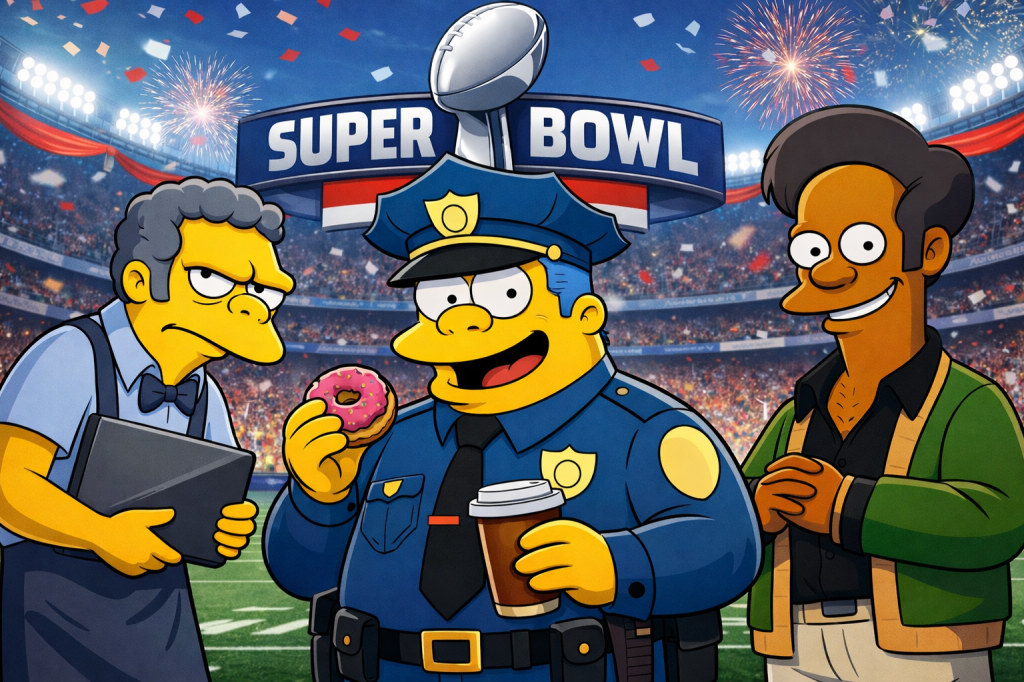
Super Bowl LX is just a week away. Earlier today, an email landed in our inboxes from the company’s event committee announcing this year’s Super Bowl Squares challenge. Two brackets, two winners, no cost, a modest gift card. The twist: instead of employee names, each square is labeled with a cartoon character, randomly assigned.
Within minutes, the office came alive.
My manager, it turns out, is now Stan Smith. My supervisor is Dale Gribble. I myself have been promoted—temporarily—to Chief Wiggum. The IT guy is Moe Szyslak. My neighbor on the right is Apu Nahasapeemapetilon. The metrologist sitting quietly in the corner has drawn Butt-Head. And someone down the hall shouted that he absolutely did not want to be Randall Boggs.
Looking around, I suddenly realized what made the whole thing so amusing: no two names came from the same place. Anglo, German, Polish, Indian, vaguely Eastern European, generically American—the Gribbles, the Wiggums, the Szyslaks, the Nahasapeemapetilons. It was a neat little accidental census.
The names alone brought a rush of nostalgia. They don’t really make cartoons like that anymore. The old ones were crowded, messy, irreverent—packed with voices, accents, and characters who didn’t need to be explained.
And then a thought occurred to me.
No other country seems to have produced so many fictional characters that are instantly recognizable and beloved across the world. That probably isn’t an accident. It likely has something to do with America being a nation of immigrants—different traditions, speech patterns, and sensibilities colliding and recombining into something oddly coherent.
I walked over to my office neighbor and said exactly that.
His immediate response caught me off guard.
“A lot of people are going to have issues with what you just said.”
That surprised me. Why would anyone get upset at hearing America described as a nation of immigrants? Isn’t that just a historical description? In places like Canada or Argentina—countries built through large-scale immigration—people don’t seem particularly bothered by that phrasing. Why does the same sentence provoke unease in the United States?
Americans Really Do React to This Phrase
If you haven’t seen this reaction yet, you probably will at some point. The phrase “nation of immigrants” touches several nerves at once, and for different reasons depending on who is listening.
For Native Americans, the discomfort is obvious. They do not see themselves as immigrants, nor would anyone expect them to. In their understanding, they were already here; their land was taken by others who arrived later. From that perspective, the phrase can sound oddly flattening, as if centuries of displacement were being smoothed into a single neutral label.
Then there are Americans whose families have lived in the country since its earliest days. Among them, one often hears a careful distinction: settlers, not immigrants. Immigrants, in this view, are people who arrived later—and are still arriving.
This distinction isn’t just about chronology; it’s about status. “Settler” suggests permanence and founding; “immigrant” suggests arrival, permission, contingency. The word does different work depending on where one imagines oneself standing in the timeline.
This way of speaking shows up frequently in public rhetoric. Tucker Carlson, for example, often emphasizes ancestry when talking about national belonging. In a speech to a conservative youth audience, he said:
“My ancestors, and I’m sure yours, have been here for so long and fought in all of these wars… once you decide you’re all-in on your country… it changes the way you approach everything. … It’s my country.”
The appeal here is emotional rather than legal. Belonging is grounded not in residence or citizenship, but in lineage—how long one’s people have been here.
Inheritance and Inhabitance
This is where things get interesting.
There are two very different ways of thinking about belonging. One is inheritance: the idea that a place is “yours” because your ancestors were there before others. The other is inhabitance: the idea that belonging comes from living somewhere, participating in its institutions, and sharing its everyday life.
The United States has never fully resolved the tension between these two ideas. Officially, it is a civic nation—membership defined by law and participation. Culturally, however, ancestry still carries symbolic weight, even when it has no formal standing.
When someone stresses inheritance in a civic system, a faint strain becomes audible. Not anger, exactly—more a note of defensiveness. Listeners often pick up on it instinctively, which may explain why such statements can feel a bit awkward rather than persuasive.
Settlers, Newcomers, and an Untidy National Story
Part of the difficulty is that the United States carries several origin stories at once: settlement, revolution, expansion, slavery, immigration. None of them quite cancels the others, and none fully dominates.
Calling America “a nation of immigrants” doesn’t deny these other histories—but it does foreground one strand among many. In countries where immigration is the primary founding narrative, the phrase sounds neutral, even banal. In the United States, it still rubs against competing self-descriptions.
Which may be why a casual comment about cartoons and Super Bowl Squares can suddenly feel like stepping on a conceptual land mine.
Back to the Bracket
By the end of the day, the office had settled back into its routine. Chief Wiggum went back to his desk. Moe rebooted a server. Apu finished a coffee. Someone eventually accepted being Randall Boggs.
The brackets will be filled in next week, the game will be played, and two gift cards will be handed out. Nothing more will come of it.
Still, there was something quietly fitting about that accidental lineup of names—a small, humorous reminder that American culture has long been comfortable juggling many origins at once, even if talking about that fact sometimes makes people uneasy.
And perhaps that tension, too, is part of the story.
 Yego’s Chronicles