1
In the morning, Cheng Yi and I went to the car rental agency next to our hotel. It was called Ruichijie Self-Drive Service. Cheng Yi was the one driving, so she handled the pickup formalities at the counter while I stood off to the side, idle.
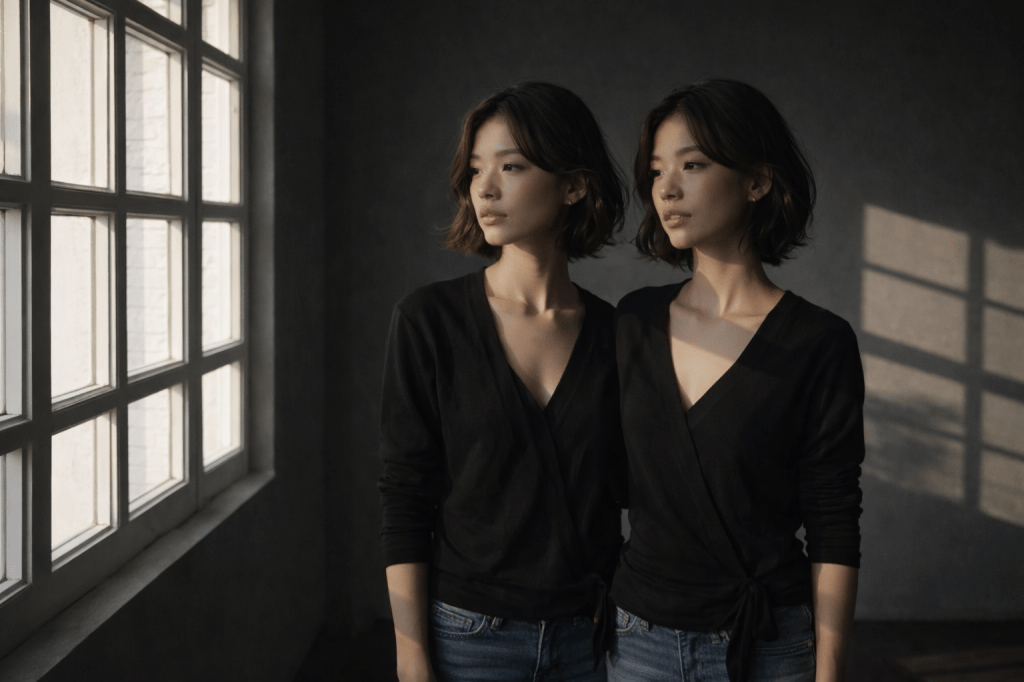
At the counter beside hers was another customer, a girl in her early twenties, also completing rental paperwork. Another girl stood next to her, about the same age. The two looked strikingly alike. I overheard the one signing the papers ask the clerk what to watch out for when driving to Lugu Lake. As the clerk explained, I found myself thinking: they’re going to Lugu Lake too. We’re headed to the same place.
After the paperwork was done, we went to the lot to pick up the car. Ours was a black, new-model Volkswagen Lavida. Cheng Yi had chosen the color. I preferred white, but I knew she didn’t like it. When we booked the day before, I didn’t say anything. Even if I had, she might not have listened.
While we were inspecting the vehicle, I saw another employee leading those two girls toward the lot. It turned out they had rented a Lavida as well—only theirs was white. Their car was parked right beside ours. As Cheng Yi slowly eased our car out of the space, the two girls stepped aside to let us pass. Through the tinted window, I caught a clearer glimpse of their faces. They really did look almost identical—enough to make one wonder whether they might be twin sisters.
2
October in Yunnan is still beautiful. We left Kunming and headed west along the Kunmo Expressway. The sky was a clear blue, mountains stretching endlessly along the road. No wonder Yunnan enjoys such a reputation.
The car was new, carrying that faint scent of a new interior. Cheng Yi doesn’t like listening to music while driving, and I didn’t feel comfortable putting on headphones and retreating into my own world of sound. So I just sat there, eyes on the passing scenery outside.
I felt a quiet sense of guilt about not being able to drive, about having to let Cheng Yi do it. It wasn’t as though I was incompetent. I could handle software, tinker with hardware, manage my own daily life. Yet somehow, when I was with Cheng Yi, I always seemed to get things wrong.
For example, she would have me get out to buy tickets for a scenic area while she waited in the car. I’d return with the tickets, and she’d glance at them and point to the insurance option: “You bought insurance?” Then I’d have to go back and refund it, walking toward the ticket window feeling quietly annoyed with myself.
Sometimes, when we had nothing to do, she would pull me into playing the 24-point card game. My math isn’t bad—I mean, how else would I have made it into grad school for computer science?—but once we started, I’d grow flustered and lose to her every time.
At school, the Party secretary had once been a colleague of my father. Cheng Yi knew this, so whenever something needed taking care of, she would urge me to go see him. I didn’t really want to, but I went anyway. Afterwards, I would regret it. Even so, I still liked Cheng Yi. She was tall, good-looking, two years older than I was, in her third year of graduate study in management, working on her thesis. The things she was good at were precisely the things I wasn’t. Sometimes my classmates would joke that I must be quite capable to have a girlfriend like Cheng Yi. I could never tell whether they were envying me or making fun of me.
Two hours later, we entered Chuxiong Prefecture and stopped at a service area for a break. When we came out of the building, Cheng Yi received a call and walked off to one side, talking as she went. I waited by the car.
A white Volkswagen Lavida turned into the service area and pulled in directly behind us. It took a moment before the passengers stepped out. It was the same two sisters from the rental agency.
They recognized us as well. I greeted them. Cheng Yi, standing a little farther away, raised her free hand and waved. After a brief exchange, the two girls went into the service building. Cheng Yi and I got back on the road, merging onto the Dali–Lijiang Expressway and continuing our journey.
We reached Dali just before four in the afternoon and had lunch at a roadside restaurant. We arrived in Lijiang at seven.
Nothing happened that day.
3
In an age when everyone carries a smartphone, the rarest thing is surprise. There aren’t many people left who can truly catch you off guard. What haven’t we already seen online? Lugu Lake is no exception. There are so many photos of it on the internet they drift across its surface like wayward blossoms.
We left Lijiang around noon, passed Yongsheng County, then Ninglang. By mid-afternoon, we reached the summit of the last mountain. We pulled over at a roadside viewing platform to take photos. Lugu Lake was undeniably beautiful. And yet, within that beauty, something seemed to be missing. I couldn’t quite explain what it was.
The next morning, we went downstairs to the small dining room of the guesthouse for breakfast. We had chosen the place because of its high rating online. Just as we greeted Auntie Dabu, the owner, at the wooden stair landing, we saw the two girls from the road coming down as well. As before, same hair, same clothes, same gestures.
“Never twice without three,” Cheng Yi muttered, almost like a curse. “It’s those two again. How strange.”
“Oh! You’re staying here too?” the older sister said.
The four of us walked into the dining room together, talking as we helped ourselves to food and then sat at the same table. During breakfast, Cheng Yi asked whether they were sisters and how they could look so alike. That was when we learned they were twin sisters. The older one was Axin, the younger Afei. I would look at one, then the other. Just when I thought I had them sorted out, I’d lose track again.
After introductions, we learned the sisters ran an online shop on Pinduoduo. When Axin heard that Cheng Yi was studying business management, she lit up and said how lucky she was to finally meet an “expert” she could consult.
Cheng Yi and Axin were both talkative. Though they had just met, they fell into animated conversation. Afei and I found it hard to get a word in. Not knowing what to say, we stepped outside and sat in the courtyard.
Almost immediately, a cat appeared. Short fur, flat nose, wide bright eyes that stared without blinking—looked like a British Shorthair. It came to Afei’s feet, rubbed against her a few times, then looked up and meowed.
Afei held her phone out to me. “Doesn’t it look like my cat?”
On the screen was another British Shorthair, a silver shaded one, wearing a red little vest and carrying a tiny red crossbody bag. The bag flap was slightly open, revealing the corner of a ten-yuan bill, Chairman Mao’s face peeking out, folded neatly—like it was asking permission to go out and buy something.
“It really does,” I said. “So cute.”
I recognized that the video was from Douyin. The account name was “Afei’s Favorite Finds.”
“Love that name,” I said. “Are you Afei?”
“Yeah,” she smiled. “It’s the name of our shop. If you like it, scan our QR code, follow us, maybe repost in your Moments?”
I scanned the code, thinking to myself: no wonder they do e-commerce—never miss a chance to drive traffic and grow followers. After I followed the account, I pointed back toward the dining room. “No wonder those two hit it off so fast.”
“That’s just how my sister is,” Afei said. “She can talk to anyone.”
I thought about it. The same could be said of Cheng Yi.
While Afei continued playing with the cat, I scrolled through “Afei’s Favorite Finds.” Their brand bio was just two lines: “Handcrafted pet goods. Warmhearted sister duo.” Below were livestream clips and short product videos: cat hanfu outfits, vests, capes, lightweight summer shirts, matching bows and ties, birthday sets, anniversary cards. Travel cat carriers. Skewers of chicken hearts, bright red and glossy, as if they had been freshly yanked out of the chests of chickens and were now fed straight to Afei’s own cat for the camera.
Soon Cheng Yi and Axin came out, still deep in conversation—clearly about business.
We had originally planned to take a boat to Liwubi Island that morning. Now the four of us decided to go together. It was off-season; Daluoshui Pier was quiet. The wooden “pig-trough boats” needed eight passengers before they would depart, but finding four more wasn’t difficult. A few tourists from Hong Kong were also headed to the island, so before long we were underway.
Axin and Afei sat at the bow, facing the boatman and the other passengers. Same slim faces, chin-length hair, black tops. As the boat rocked, they rose and fell gently with it, almost like a pair of celestial sisters who had wandered down to earth.
Behind them stretched the early-autumn waters of Lugu Lake. In the distance, Liwubi Island appeared faintly through a thin veil of mist.
4
After lunch, when we returned to the guesthouse, the sisters saw the British Shorthair again and went over to play with it. The owner, a Mosuo woman everyone called Auntie Dabu, happened to be at the front desk.
Afei asked whether they could let the cat try on one of the “cute pet pieces” they had brought with them—a festive little red vest. Auntie Dabu smiled and didn’t say no.
Afei ran upstairs and came back with it. Once the vest was on, Auntie Dabu was delighted. She stepped out from behind the counter, lifted the cat into her arms, and ran her fingers over the fabric, examining the stitching closely.
Afei’s reflexes were astonishingly quick. In a flash she snapped a photo of Auntie Dabu holding the cat in its red vest.
Auntie Dabu asked Axin what they did for a living.
“We run a pet e-commerce shop,” Axin said. “We design cat fashion and accessories. We have accounts on Red Note and Douyin. Auntie, look—these are some of our videos on Douyin. If you like them, you can scan this QR code and follow us. We post new releases regularly. And if you like the vest, you can keep it. There’s a QR code on the tag too.”
Afei explained that their “Guofeng Cat Vest” line had been their first breakout hit—their first real bestseller. It had sold extremely well. From concept and design, sourcing primary fabric, linings, and trims, to production and promotional copy—they had done everything themselves. They were proud of it.
The small hands that appeared in their videos—dressing the cat, adjusting the straps, slipping money into the tiny bag, fastening the buttons, smoothing the fabric—those were Afei’s. The traditional knot buttons and embroidered details were outsourced to a local embroidery cooperative.
While Axin was talking with Auntie Dabu, Cheng Yi went upstairs to retrieve her laptop. After Axin finished at the counter, she and Cheng Yi settled in the sitting area with milk tea and began discussing work.
Cheng Yi asked questions and typed notes on her laptop while Axin provided figures. Cheng Yi’s graduate thesis required a case study. It seemed they had already discussed the idea while walking on Liwubi Island—Afei’s shop, “Afei’s Favorite Finds,” would serve as the case, and Cheng Yi would offer business guidance in return.
Afei and I sat nearby. From where we were, we could hear a steady stream of terms: 1688, Idling Fish, Taobao, factory overstock, clearance fabric, private resale.
Earlier on the island, the four of us had each bought a small souvenir at the lama temple. Axin chose a sandalwood prayer bead bracelet. Afei bought a red string bracelet. Cheng Yi picked an agate pendant. I got a bodhi seed bracelet. We paid extra to have them blessed by the lama.
Afei liked her new bracelet. She took it out to look at it again, slipped it onto her wrist, shook her arm slightly, and asked whether I liked it. Then she took my bodhi bracelet and held it next to hers, as if comparing them. After a moment, she handed it back.
Cheng Yi and Axin were still deep in discussion. The milk tea sat mostly untouched. It felt as though they had endless things to say.
Afei and I looked through the photos she had taken earlier—on the boat, on the island. As she scrolled, she deleted constantly. Sometimes she paused on one, hesitated, and deleted it anyway. Occasionally she laughed, covering her mouth. “Oh no, I look terrible in this one!”
While we were looking at the photos, notifications from the Pinduoduo seller dashboard kept popping up on her phone—new orders, order confirmations, customer messages. When her phone chimed, her sister’s often did too. Sometimes the sound was WeChat instead.
At those moments, I would turn my head away and let her reply. She held the phone in both hands, thumbs flying across the screen with astonishing speed. I was one of the fastest typists in my class at school, but watching her, she almost matched me.
If there was one thing I was better at than Cheng Yi, it was typing on a phone.
But Cheng Yi was competitive. She used to say I typed fast because I didn’t think. “You’re like that centipede,” she once told me. “You can move a hundred legs at once only because you’re not using your brain.”
5
The next day we drove along Provincial Highway 307 toward Lige Peninsula. We took our black Lavida. Cheng Yi drove and talked with Axin in the front; Afei and I sat in the back.
Up front, the two of them were deep in conversation the entire way—one moment about influencer seeding and livestream sales, the next about customer service and returns, then about cash flow.
At first I helped Afei adjust the settings on her phone—cleaned up storage, reorganized permissions. She used it constantly but never cleared anything out. It had plenty of memory, but also plenty of digital clutter—one-time-use apps still sitting there, photo access granted to everything. I optimized it a bit for her.
After that, we switched to music. We connected to the car through Afei’s Bluetooth, each of us sharing one earbud. She liked Shan Yichun—What Then, What Can Be Done, Better to Meet Once, Not Worth It. She also liked Chen Hua—The Only One, Missed Lover, I Want to Watch May’s Evening Glow With You.
I usually listen to music with headphones. Whether I wear them or not, Cheng Yi knows my taste and my musical ambitions, and she doesn’t think much of them. She doesn’t consider it “real music.” When I get stubborn and ask her, “Then what counts as real music?” she frowns and can’t quite give an example.
We stopped briefly at Lover’s Beach.
Afei and I walked up to the sign at the entrance. She raised her phone and took a picture. The sign read:
Legend has it that the Goddess Gemu and the Mountain God of Houlong were once lovers. Their love angered the heavenly gods, who turned them into Gemu Mountain and Houlong Mountain. From then on, they could only gaze at each other across the lake. The gods allowed them to meet only once a year, on the fifteenth day of the seventh lunar month. The place they chose for their reunion was this stretch of beach along Lugu Lake. Over time, it came to be known as “Lover’s Beach.”
Maybe the story was invented by tourism promoters. Or maybe the Mosuo people truly have such a legend. It seems every ethnic minority has a similar story.
I once read a book about the Comanche, long ago in Texas. They had a similar tale explaining why the moon refuses to see the sun, and the sun refuses to see the moon. In the story, a brother unknowingly took his sister as his lover in the dark of night. At dawn, when she realized the truth, she fled. He chased her. She reached the edge of a canyon and leapt. He followed. She became the moon. He became the sun. Since then, the moon rises only after the sun sets; the sun appears only after the moon disappears.
Near the midpoint up the mountain before Lige Peninsula, there was a viewing platform where tourists were taking photos. We stopped there briefly, then drove down the road to reach the lakeshores. The peninsula was accessible only on foot. The buildings that once stood there had long been deserted, lending it an eerie stillness.
6
On the third night, the four of us returned to the guesthouse after dinner. Axin and Afei were leaving the next day. They had originally planned to stay three or four days, but once you settle into Lugu Lake—this supposed paradise removed from the world—three days can feel like forever. Back home, work had begun piling up. It was the season for clearance sales. Prices needed adjusting. Pinduoduo had strict rules for sellers—customer service response times, shipping deadlines. Late shipments meant penalties.
Cheng Yi’s case study was almost complete, but she still needed Axin’s help. There were a few things she had promised Axin, and Axin hoped they could finalize them before leaving. The two of them decided to spend their last evening at the guesthouse getting everything sorted out.
Supply chain was Cheng Yi’s area of expertise. Axin wanted her guidance. I watched Cheng Yi gesturing at the laptop screen on the tea table.
“For this hanfu piece, the embroidered trim costs five yuan per meter from Store A,” she said, pointing at a spreadsheet. “But Store B offers similar quality at 3.8 per meter, though the minimum order quantity is higher. If you consolidate purchases with other materials, you can hit the threshold. Also, these three accessory suppliers you’re using—on-time shipping is only seventy percent. That’s going to affect your production schedule. I evaluated a new supplier. Better metrics. I’ll send you the comparison sheet. And your main fabric supplier—there’s only one. That’s a risk. I’ve sourced two backups. Here’s the breakdown.”
After a while, Afei and I stopped listening. She asked her sister whether we should go see the bonfire gathering in Daluoshui Village that night. Axin and Cheng Yi said they would stay and finish working. So Afei and I went.
The bonfire was held on Lakeside Drive, across from the Aishang Hotel, not far from our guesthouse. It was off-season, so the crowd was thin. A man named Tashi welcomed everyone with a microphone. Later, young Mosuo men and women sang and danced, and a few tourists joined in.
After a while, Afei said maybe we should head back. We walked along the lakeshore. When we were almost at the guesthouse, she said she didn’t want to return yet. She wanted to keep walking toward the pier.
A bright moon hung in the sky. The lake water lapped against the shore. In the distance, lights flickered from Sanjia Village and Lüjiawan.
Afei took out her phone, slipped one earbud into my ear, and kept the other for herself. Music started playing—The Only One by Accusefive.
She slipped both hands into her coat pockets and swayed her head slightly as she walked, as if listening to the music—or thinking about something else. Under her feet, gravel made a soft scraping sound.
After a while, she turned off the music and said she wanted to race me to the pig-trough boat ahead.
“Fine,” I said. “I’ll give you a head start to that boat.”
She didn’t answer. She just took off running.
In the moonlight, her small dark figure darted forward like some quick woodland spirit. I immediately regretted my bravado and sprinted after her. I ran harder and harder, gasping for breath, thinking that I must have looked like Forrest Gump in the movie.
Just as I was about to catch up, Afei slowed down. She didn’t look at me. She didn’t say anything. She simply returned to the same quiet pace as before, head lowered, walking as she had when we first set out.
After a moment, she said, “Let’s go back.”
7
The next morning, after saying goodbye to them at the entrance of the guesthouse, Cheng Yi and I returned inside. Cheng Yi said maybe we should reconsider our plans—skip the final night, drive back to Lijiang at noon, and return to Kunming the next day.
I agreed immediately.
After the sisters left, a strange emptiness settled over both of us. Sitting in the guesthouse living room with tea, the space felt larger than usual. When we walked down to the pier, it felt unfamiliar. Whether we were eating in Daluoshui Village, strolling along the lakeside road, or looking at the same mountains and the same water, everything had somehow lost its earlier charm.
We couldn’t just sit around the guesthouse. The hotel rented bikes. Lüjiawan was only two or three kilometers away. Why not ride there? So we did.
Sometimes I would open my phone and check Afei’s WeChat Moments. Or scroll through “Afei’s Favorite Finds.” I knew they had only just left. There wouldn’t be any updates. Still, I couldn’t resist refreshing the page.
Sometimes I would open one of her older promotional videos—over a year old now—and listen to her voice. It would feel as if she were downstairs in the courtyard.
Of all their videos, I kept returning to the very first one I had seen. It was well made. There was something about it. The world Axin and Afei had built felt composed of small, loving details. Every detail mattered. Time seemed irrelevant. Their gestures were gentle, their movements unhurried, their focus calm and attentive. One small detail leading into the next. Between these soft motions, life’s time slipped quietly away.
It was only a product video meant to inspire purchases. And yet it lingered.
On the day we left, before getting into the car, I took one last look around the courtyard.
Later, when we reached the overlook, Cheng Yi didn’t stop the car. I looked out at the blue lake, the green mountains circling it, and thought: when we first arrived, I felt that something was missing from the landscape. Now that I was leaving, it seemed the thing missing was inside me.
Goodbye, beautiful Lugu Lake.

 Yego’s Chronicles