1
Me and Kangyao are best friends, even though he’s one grade higher than me in junior high and I’m still in the fifth grade. Our classes are in two different locations too—mine’s in the Temple of Confucius at the foot of the hills and his is at the top of the hills in the Pavilion of the Jade Emperor. Most of the time I get out of school long before he does, I figure that’s because he’s in junior high and those big boys are given more schoolwork and the teachers keep them in school longer than they do with us fifth graders.
In any case, when I get out of school, I take the side door at the back of the Temple and head up the hills to wait for Kangyao so we can do stuff together.
Going up the hill, the first spot I stop by is a gazebo kids call Cool Air Gazebo. I don’t know why we call it that, for it sits in a spot surrounded by tall cypress trees and it’s got plenty of shade all the time. It’s not like you get to cool off if you sit on the benches in it—around here it never gets hot, so what’s the point of trying to cool yourself off when you often shiver if you stay under those big old cypress trees for too long? And besides, there’s just no wind that blows through the gazebo.
I think people just like to make things up—they think because it’s a gazebo, and a gazebo is something open on all sides, that when the wind blows—like there’s ever such a time!—it keeps you cool on a hot day.
But I do like those big old cypress trees a lot!
At the feet of those big trees you can find tiny swirls made of very fine dirt, like the flour Mother uses to make cakes we call baba. Me and Kangyao would come to these trees and mess around with the little swirls with a twig, because when you do, little sleepy bugs dark as beans fall out of them. And they don’t get up and scuttle, they just stay motionless, pretending to be dead to fool us kids I reckon. But we don’t get fooled, and we don’t do anything particular to them either, you know! We don’t harm them or squash them with our feet and stuff.
Speaking of squashing things with our feet, we only get one pair of shoes and it’s always the Liberation brand on New Year’s Day, so if we break our shoes then we’ll have nothing to wear and Mother will be mad.
Anyways, after you destroy several homes of these bugs under those tall trees, you head to a hollow flat stretch of a small field that sits just next to the gazebo, like it became what it is because in some old time the townsfolk had nothing better to do and just decided to dig up the earth in this spot and remove it, so now instead of a hillside you get a flat field, at the head of which stand two old tombstones with lichens and weeds all around them. I don’t know why me and Kangyao always come here even though we both think this is a creepy place and always get freaked out a bit. But I guess we keep coming here because we’re not supposed to, but also because the dirt here is damp and you can find several kinds of wild berries here.
We particularly like the wild strawberries, the plants grow close to the ground, and if you get down on your knees and look closely you can always find a few of those white tiny fruits, and they taste really great when you’re hungry—and we’re always hungry as everyone only eats two meals a day, one at 11 and the other at 5.
Besides wild strawberries we also find plenty of what we kids call “ground pomegranate”—they are bigger than the strawberries, and they have the shape of a gourd, only they’re super tiny compared to a gourd, and they have a color that makes them suspicious—dull crimson, or reddish brown. Anyways, the ground pomegranates make me and Kangyao think of toads, those nasty creatures that leap out from under the tombstones out of nowhere.
We never once try to eat the ground pomegranates, hungry we may be, though we do break them open for no reason, perhaps just to see the insides—tiny white seeds in a puddle of dull reddish gooey stuff. Yuk!
2
I always take the nearest side door into the Pavilion, that way I can get in without anyone seeing me. It’s always a bother when the side door is closed and you have to take the front entrance. Some teachers or the principal of the junior high might see you, and they might or might not stop you and ask why you’re out here in the courtyard and not in class, when I’m not even in the sixth grade yet and don’t even go to school here. Or if they’re paying attention and notice that I’m not one of those big kids that go to school in the Pavilion, they might stop me and ask why I’m here and not heading home.
I’m not sure if moving up to junior high is a good idea, I’ll have to think about it—whether I really want to come here for school.
Like back down the hills in the Temple, when classes are in and it’s a language class, we all hold up our books and slow-chant the words on the page like bees do their singing. We don’t just sit there, we read aloud by chanting the words: “~~ One ~ ~ day ~~ Un ~~ cle ~~ Lei ~~ Feng ~~ is ~~cross~ing ~~ the ~~ s ~~ treet…” When ten classes are having their language class in the same period, you can hear the chanting even when you’re walking by the school on the other side of the walls. As we chant, some little kids with snot and drool on their faces often fall asleep, and then the teachers have to come around to wake them up.
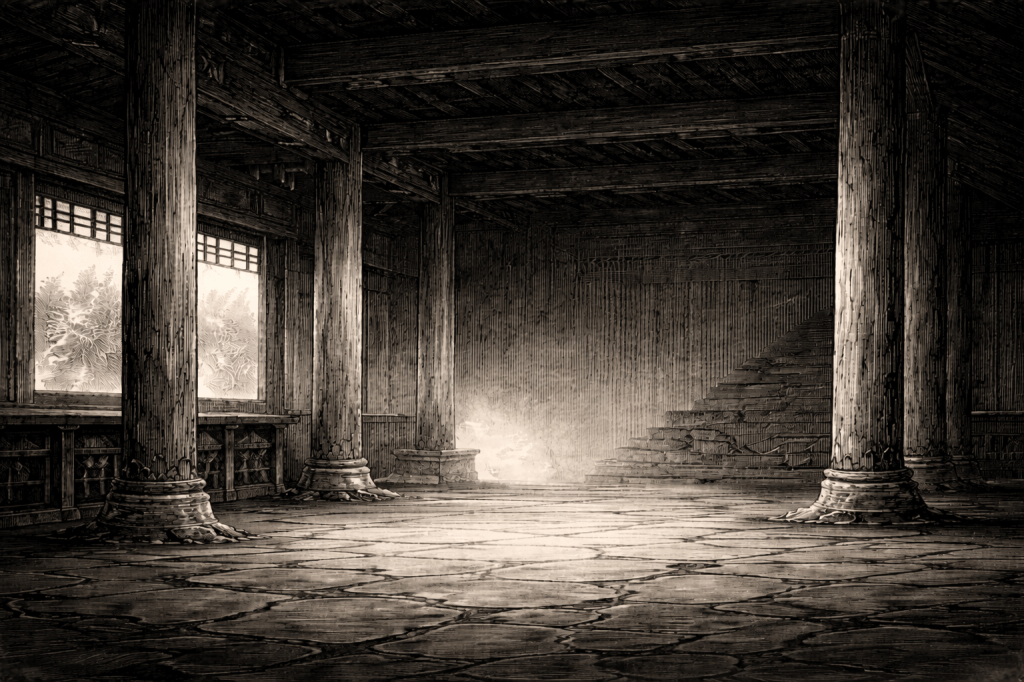
But up here in the Pavilion they do none of that. If I get in and stay in the great hall where those ping-pong tables are, the whole place is just so quiet, like the field where me and Kangyao get freaked out seeing toads leap out of nowhere. I stay in the great hall because it’s the only place that is not used as a classroom. I mean even if they wanted to, they couldn’t make it happen, because the front of the hall has no wall and is wide open, and when it rains people will get wet and they won’t like it.
The two ear-rooms on either side of the great hall are each used by a class, and then the wing houses down the steps on either side of the courtyard are two-story houses, and together they house four more classes, so a total of six classes are housed in the Pavilion. But you can try to listen, and listen hard—you will never hear them chant their books.
How’s that fun, when you only get to look at the characters and you’re never allowed to chant them sing-song style?
3
While waiting for Kangyao to get out of class so we can go do stuff, like climbing the fence into Zheng He’s burial place, or scaling the communications tower the military base has set up at the top of the hill, I try to stay in the great hall, but it’s a pretty boring place. There are ping-pong tables there for sure, but since I don’t own a racket and a ball, and they don’t leave theirs out on the tables for me to play with, the green tables are not much use to me. But even if I had a racket and a ball, it’s not like I could just play there without some teacher coming out at me and shooing me out of the school. Plus, some spots in the great hall are pretty nasty, like the big red columns in the front of the hall—they are often smeared with kids blowing their noses into their hands and wiping them on the columns. Yuk! I only hope Kangyao’s class can finish on time so that I don’t have to stay here long.
When you always stay in the same place, you start to notice things you don’t notice at first, like the bird calls I hear coming from the trees in the courtyard and also from just over the walls. Man, these must be some sad birds, I have to say. They are not like the calls of happy birds, bulbuls, and the like, but intermittent, drawn-out, long, and I just don’t like them very much. But the cypress trees are thick and dense, and no matter how hard I try to spot these sad and annoying birds, I can’t find them.
As annoying as the bird calls are, they’re not as bad as the noises that I sometimes hear coming from the second floor of the great hall. There are times when the whole Pavilion compound is just so quiet, when all classes are in session, like when there’s a storm coming, or when Kangyao has an evening self-study session, or when the classes just keep on going and it feels like the teachers are never going to let anyone out. The great hall has very high ceilings, and it’s always kind of dark up there, and I don’t know why, but when you raise your head to look, you can see some beams for sure, but the rest is just darkness. So sometimes I notice there are footsteps upstairs, as if someone is pacing up and down, and it’s kind of creepy. And I can hear that very clearly. And then for days I don’t hear them again, and then I wonder if I had taken rats or some other critters for human footsteps. Anyways, I’ve never told Kangyao about it.
4
Bro, I tell you, when you’re busy with stuff, like when you’re messing around with the swirl homes of those black bugs, or digging for yams with a homemade stick in the fields on the other side of the hills after harvest, which me and Kangyao do a lot, even when you come up empty-handed after a lot of digging, you never once notice your stomach is rumbling and you feel super hungry, you just keep at the thing you’re doing. But when I’m waiting for Kangyao in the great hall I feel hungry, and when I feel that I get tired. I had my noon meal at 11, and it’s now past 5. I’ll get yelled at by Mother for sure when I get home, if she doesn’t hit me on the head with her knuckles.
There it goes again, the footsteps! As if someone is pacing up and down upstairs. It starts from one end and ends at the other end, then all becomes quiet. Then, after a while, the reverse. And it’s not the kind of footsteps I normally hear—it’s not thuds, it’s not hurried, and the wooden floor does not squeak. It’s just light, flowing, and slow footsteps, much like our teacher’s when he’s pacing at the blackboard thinking something over, chin in hand and brows twisted. But I just don’t like them, because they fall hard on your heart—you know when the next step is going to land, and that makes it all worse.
So I finally told him about it one day when me and Kangyao were digging for yams after he got out of school.
“Man, I really hate those footsteps at your school,” I say.
Kangyao has just found the tender shoots of a plant in the ground—that’s a sure sign that there is a yam there—and he’s getting excited. After he digs up the nice and juicy yam, he comes over to me and asks what I just said. I repeat myself. Me and Kangyao have been buddies for a long time, and he does not usually question what I tell him. But the footsteps thing is a little bit too much even for him.
“Are you sure about that?” he says, the hand holding the fresh yam with leaves on it shaking slightly.
“I’m pretty sure,” I say.
And we decide to go check it out the next day—we’re going to stay behind when his class is over, and we’re going to bring enough pebbles for our slingshots just in case.
5
So I was just on my way to join my Temple school’s recess gymnastics when I was called to the principal’s office. Such a thing had never happened to me before, and bro I tell you I was in a bit of a panic. When I was taken to his office, the broadcasting for the recess gymnastics was just starting. I entered and saw Kangyao was also in there, standing next to the principal’s desk with his head down.
“Can I get an explanation from you two?” the principal said, speaking slowly but deliberately.
We both had our heads down, so we really couldn’t see him, but we sort of sensed he was unhappy with us based on his tone.
“I got this report from the janitor at the Pavilion,” the principal continued. “It says that you two got inside the school after it had been closed. Is this correct?”
Me and Kangyao were so terrified by all this that we just couldn’t speak.
“Look at me when I’m talking to you,” said the principal. Then he turned toward Kangyao. “Since you’re the older one and you go to the Pavilion junior high, tell me what happened.”
And that’s when Kangyao came clean and told the principal the whole thing.
The principal’s face showed no expression, and he did not immediately respond to Kangyao’s confession, as if he was trying to make up his mind.
“Footsteps on the second floor, eh—is that what it is?” he finally said, sitting up in his chair.
“Yes, sir!” Kangyao said, crestfallen.
I thought it was absolutely amazing that the principal did not fly into a rage and rain down scorching words on us, like my teacher sometimes does. My teacher has a habit of scolding my classmates when they make trouble by pointing his finger at the culprit while cursing: “You are a big rotten egg!”—a habit we all quickly learned and applied to each other. As soon as an episode of “you are a big rotten egg” is over and he goes out of the classroom, we all turn around and point a finger at our neighbor and shout, “You are a big rotten egg.”
But the principal wasn’t like this that morning. He remained in his seat, eyes on the report on his desk. He seemed to be pondering something.
Eventually, long after the broadcasting had ended, he waved us away, and as me and Kangyao were trying as quickly and quietly as possible to get out of there, lest the principal changed his mind, we heard him say over the phone:
“Get me the janitor.”
6
The news spread very quickly. A week after me and Kangyao were called to the principal’s office, everyone was talking about it—the teachers at both schools, the bigger kids, the townsfolks. The whole town knew it. Everyone seemed to be saying to everyone else the same thing: “They found it! Have you heard? They found it!” Even when I was back home for the morning meal, I heard my mother repeating the same thing with our neighbors. And when they ran into someone who hadn’t yet heard the news and asked, “What did they find?” everyone tried to be the first to tell him:
“It was a rope!”
It turned out that the reason for the principal’s “eh” after he had heard Kangyao’s confession was that he, like many others in town, knew the story of the person who had hanged himself on the second floor of the great hall in the Pavilion. And just so we would never get called to the principal’s office again, we want to say that me and Kangyao did not make up this story of a hanging, for we did not know, and would not have been able to comprehend such a thing—that a man would hang himself, and do it in the Pavilion where Kangyao went to school every day! For why would a person do such a thing?
The man, they all say, was a cadre at the county government. He was deposed when the Cultural Revolution started, and his wife disowned him, and she also forbade their children from visiting him, and he killed himself out of despair. That was kind of bad for him, though, for many say that he was wronged and shouldn’t have suffered such a fate.
I’m telling you all this not because we want to brag, not because me and Kangyao want to take the credit—we just want to tell it like it is, to make it clear that what we did really helped solve the mystery.
So it is said that after the principal talked to the janitor, our schools got permission, and also assistance from the local police, to reopen the stairs that had been boarded up ever since the incident. The search did not yield anything new, but they did make an unexpected finding: when the man was found hanging from a rope in 1969, the people involved in that discovery and the recovery of the body had forgotten to retrieve the rope, which had been tied to a hidden beam in a small opening in the ceiling. The rope had sprung back up when the body was lowered and had stayed hanging up there ever since—until, of course, me and Kangyao got into trouble for sneaking into the school after dark.
7
Ever since the day the rope was found and taken down, I have not once heard any footsteps while waiting for Kangyao in the great hall. Nothing—just all quiet. No footsteps from east to west, and from west to east.
In less than a year, I’ll be in junior high, and be in the same Pavilion school as my buddy Kangyao. When that happens, instead of waiting for him in the great hall, I’ll be in one of the classrooms—hopefully in one of the wing-house rooms and not in the ear-rooms, for they are separated from the great hall by only one wall. Plus, in junior high classes folks don’t get to chant their lessons, they only read them in silence, like the big people.
Ah, I’m not sure I’ll like it, to be honest.
 Yego’s Chronicles