Author’s note: Written in Mt. Pleasant, Michigan circa 2003
1
Returning to his hotel suite after seeing out the night’s last visitor—an editor from a medical journal—Dr. Kai leaned back against the door as he shut it with his back. He was exhausted.
Due perhaps largely to his reputation in the region’s cardiological circles, and partly to his giving the keynote speech, ever since he arrived in this northern city three days ago for the biannual regional cardiology conference, he had found himself one of the most sought-after people, occupied by various official and unofficial matters. It seemed that Dr. Kai was someone everyone knew of and could easily recognize. Whether in the hotel lobbies, the elevators, or the hotel’s dining halls, total strangers would come up to him and greet him. The situation was much the same at the group meetings he co-chaired. On more than one occasion, as soon as a session was over, members of the audience would come to the front to greet him and introduce themselves, leaving the speakers in a rather awkward situation.
All this was happening in spite of his limited official duties at this year’s conference. Unlike previous years, he was given only a limited amount of work this time, which included serving on the conference’s honorary committee, delivering one of the keynote speeches at the opening ceremony, and jointly chairing a few group-meeting sessions—in no way a demanding schedule compared to what he normally did on occasions like this.
An energetic man who had loved work all his life, he had enjoyed the challenge of his profession and had always handled such occasions with enthusiasm and efficiency; fatigue of this nature had largely been unknown to him—until his arrival at this conference, that is. The tiredness he had been experiencing for the past several days seemed unrelated to his bodily condition, which was excellent; rather, it was a fatigue of a different kind, one that ran deep and was much more worrisome. In addition, he had a mild but persistent headache. Like the fatigue, the headache seemed to have started shortly after he left home for the city; it felt more like a nuisance than a real problem when he first arrived, but by the time he delivered the keynote speech it had become something that began to hinder his routine activities at the conference.
Except for a dull noise that seemed to be coming from the utility room in the adjacent suite, the luxuriously furnished sixth-floor suite was quiet. As he raised his head after the initial fit of dizziness passed and started to make his way toward the living room, he realized that he had been in suit and tie since morning, and the stiff clothes now seemed to be wearing him down. What he most needed at this moment, he felt, was to change into something more comfortable, and get some rest.
Though the fatigue lessened somewhat after the shower, the headache and the fuzziness continued. As he came into the living room, it occurred to him that he had not phoned home for the past two nights, which was very untypical of him, and he knew his wife must be worried by now.
But as he sat down at the edge of the bed, the thought of phoning his wife somehow slipped from his mind. The forgetfulness also seemed to be a very recent thing, and on this night it only got worse.
He got up after a while and walked to the window. It was only about eight o’clock; the night sky outside was unusually dark but clear—probably due to the cold. From the window he could see the streets down below, dotted with dim and flickering lights. Perhaps it’s still not too late for a walk, he thought. A short stroll in the cold would definitely do his headache some good.
The thought immediately dispersed some of the haziness that had shrouded his head all evening; it also brought a discernible thrust of energy bursting through his tired body. He got up and started to put on the casual wear his wife had prepared for him for this type of occasion. While he was getting dressed he thought of the graduate student who had accompanied him to the conference. Perhaps he could go ask the young man if he would like to join him for the walk.
An enclosed footbridge connected the hotel’s suite section to the economy section where the graduate student was staying. While waiting for the elevator in the empty hallway, he caught a glimpse of his own reflection in the large mirror next to the flower table. There in the mirror was the face he saw every day; but instead of the familiar sleek look of a successful professional that he had become used to seeing, the image he saw on this night was one with clear signs of aging: strands of gray hair, a receding hairline, and wrinkles in the corners of slightly puffed eyes.
He was still in a contemplative mood when he reached the student’s room. He knocked a few times and waited. In the hallway there was a strong smell of cigarettes mixed with the odor of cheap carpeting.
Apparently the room had more than one person in it; standing by the door, he could hear the heated voices of several people arguing about something.
Presently the door opened, and the head of a person stuck partly out from behind it. It was the face of a young man with tousled hair and a few thinly scattered unshaven hairs on his chin. The noise in the room stopped momentarily as the door opened.
“Professor Kai!” exclaimed the young man, and immediately flung the door wide open. “Please come in! What could have brought you—”
The young man—his face red and his voice stuttering—was in a flutter. A visit from his graduate advisor, the famous cardiologist, was apparently the last thing the poor fellow had expected.
“I was stopping by to see if you’d be interested in going out for a walk with me,” he explained.
“Certainly,” the young man blurted. “Absolutely! Just give me a moment to change—”
Although seeing young students fluster in front of him was something he had grown used to lately, for a brief moment he felt a bit sorry for this student. “Poor fellow!” he thought, and wondered if this had always been how his students felt in his presence. There was something in the young man’s reaction that made him think of his own years as a student—a feeling he had not had for quite a long time.
The early autumn air outside was almost too chilly for someone who had grown used to the mild southern climate; it felt like plunging into icy water the moment they stepped outside the hotel. But the cold, crisp night air had an instant soothing impact on his headache, and the fuzziness was almost immediately gone.
The hotel, a joint venture of the Regional Railroad Bureau and an overseas partner, was located in the hub of the downtown area.
“Are you familiar with the city?” he asked the graduate student as they went down the steps leading to the street. “You’re from the north, aren’t you?”
“Indeed I am, Professor,” the young man answered apologetically. “But I’m afraid I know little about the city. I’d been here once or twice at a much younger age with my parents, but there seem to be so many changes lately I can hardly find my way. Has the professor been here before?”
“No,” he said inattentively. “This is my first time here.”
Following the first street they came upon, the two walked at a leisurely pace, carrying on an intermittent conversation, but it soon became clear to them that they had been walking away from downtown. Realizing their mistake, they promptly turned around and started to walk up a street at the student’s suggestion.
They soon came across an outdoor street food court located on a side street not far from the hotel. There were about a dozen vendors selling noodle soups and lamb kebabs.
“How about joining me for a drink or two?” he asked.
“Splendid!” the student answered immediately, but after taking a glance at the rather dubious surroundings he hesitated. “I only hope the professor would not mind…”
“No, not at all,” he said. “I find this place quite suitable for a night like this; indeed I’m quite happy you brought me here.”
After picking a table in a well-lit spot, the two sat down, ordered a few dishes and a jug of wine, and carried on a conversation as they waited for their order to arrive.
There was something about this untidy market that made him feel quite at home on this night. He was also happy—and thought it fortuitous—that he had changed into casual wear before leaving the hotel; the custom-made expensive suit would have made him conspicuous here.
Soon the vendor brought them the items they had ordered: a dish of boiled peanuts, several roasted dried fish, and a bottle of rice wine. The peanuts—or the poor man’s drinking dish, as they used to call them when he was a student—were something he had not tasted for a long time. The liquor was of a very cheap kind and tasted bitter and harsh in the mouth; but on this chilly night in the open it produced a stream of warmth that ran deep inside with every sip. The taste of the wine and the salty peanuts stirred an almost nostalgic feeling in him about the days when he was an obscure resident working in a large hospital.
“Are you married?” he asked the student.
“Not yet, Professor,” answered the young man, and blushed. “My girlfriend and I have been dating for several years, but marriage is still out of the question since we do not yet have a place suitable for starting a family.”
“Hasn’t our hospital just completed some apartment buildings for faculty and staff?”
“That’s right, Professor,” said the young man. “But all new buildings are commercial housing now, and since we are only graduate students we can’t afford to buy a flat.”
“Oh,” he muttered, feeling a bit embarrassed by his ignorance.
It had been quite some time since he was a resident himself, a period of his life about which he had almost forgotten. About two decades ago, when he first started, his situation was not much different from that of the young man now sitting across the table; and he had most likely looked much like him as well—unkempt hair, humble looks, and a cheap suit and tie with crumples. For close to three years he shared a small apartment with three other graduate students, commuted between the dorm and the hospital by bike, and hardly had spare time to meet the girl who was later to become his wife. But he worked hard. He worked all shifts, carried out research, and put all he had into his work. All these efforts eventually paid off. Under the guidance of his late teacher—a nationally known cardiologist who had passed away only recently—he successfully performed the first case in the nation of a type of difficult cardiothoracic surgery and won himself fame almost overnight. Following this success he was sent overseas and spent two years as a visiting physician in New York at a hospital famous for its advanced cardiological technology and expertise. Upon returning home he received several state research grants, and he was invited to serve on the editorial board of a well-respected cardiological journal. Since then his career had been nothing but smooth sailing.
As the two started to head back to the hotel, the student asked him if he was going to participate in the organized tour the next day.
“What organized tour?” he asked inattentively.
“Does the professor not know?” said the young man. “The conference is organizing a tour tomorrow to Eastern Lakes; the tour is free for all conference participants.”
He remembered seeing something of that sort in the conference program, but at the time had paid no attention to the time of the tour, or the place it was going to be.
“I’ve heard people say the place is a recently developed site,” the young man said. “The province probably spent millions making it a first-rate tourist attraction…”
“Is that so…” he mumbled, but quickly sank back into his own thoughts.
After saying good night to the student upon returning to the hotel, he headed toward the elevator, and for a second time that night thought of the phone call to his wife he should have made.
He had brought on this trip a manuscript the cardiological journal had asked him to review, and had planned to go over it that night. But when he tried to read it after getting in bed, he discovered he was in no working mood, and so had to put it down.
Sitting in bed with his head lowered and hands crossed, he was temporarily lost in thought. The walk with the student earlier had brought back some deeply buried memories, and yet there was no clear order in the images and thoughts that now jammed his already tangled mind.
Among the things that kept returning was the organized tour the next day. The very mention of the tour had made him think of something he knew was right there, and yet in his bemused mental condition he could not recall it; he seemed only to make it worse every time he tried.
It was close to midnight when he decided to go to sleep. He had been sitting in bed for a long while; the fatigue and headache had returned.
He switched off all the lights after setting the clock. The room immediately sank into pitch darkness. But no sleep came for a long time. Gradually, as his eyes became used to the dark, the contours of the room—the furniture and the paintings on the wall—started to emerge in the silk-like darkness; even the noise from the utility room returned.
He remained motionless in the dark and did not know how long time elapsed. Then, just as he was on the verge of slipping into sleep, the thing he had tried hard to recall all night suddenly appeared before his eyes in all its vividness.
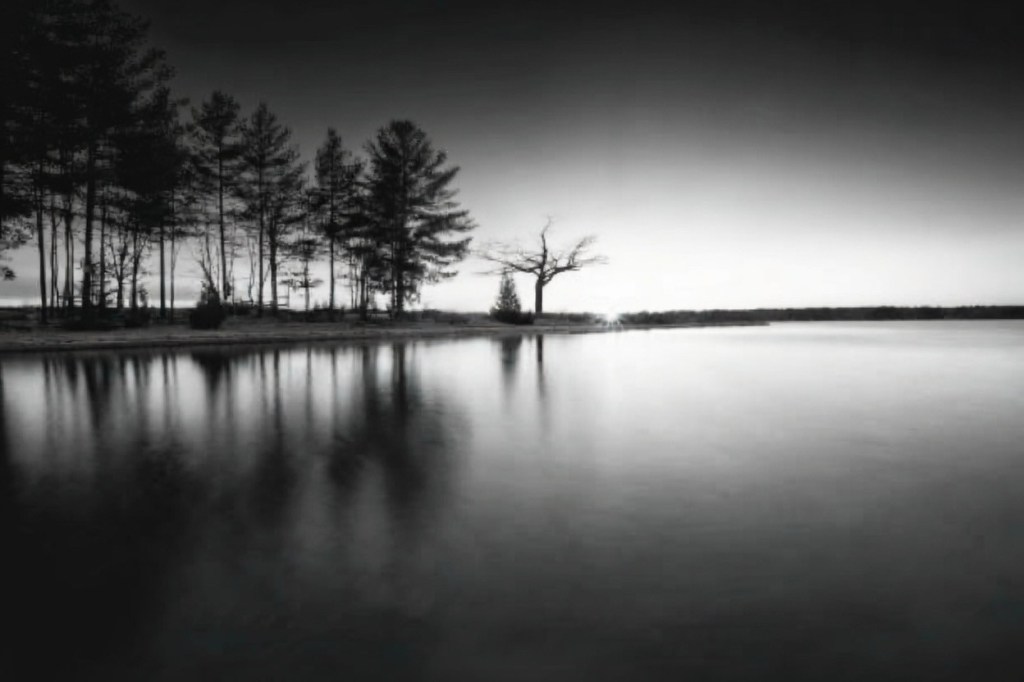
It was a small, oval-shaped lake with a cloudy gray sky hanging low overhead; and there was in the air a curious and inexplicable sadness. Light gray and gently descending sandy shores surrounded the pool of water in the center of the concavity; standing ominously in the background of the sandy shoreline on the left was a stretch of dark green pine trees.
A figure on the left bank where the trees stood—a young woman who reminded him of his own little sister, with her head lowered and her eyes on the ground—was slowly walking on the sandy shore, coming seemingly in his direction.
It was a scene he had once seen in a dream but had since forgotten; he now also remembered when that was: it had occurred on the eve of his first day on the job and just days after the departure of a college friend.
2
The day started sunny but chilly. As he was walking to the hotel’s dining hall on the first floor for breakfast, he ran into a cardiovascular physician whom he had met several years ago at the New York hospital. The two chatted for a few minutes in the hallway. This was the first time they had seen each other since returning from abroad.
The breakfast service had been under way for some time when the two walked in; some had finished and were already on their way out. Dr. Kai and his colleague joined a few other latecomers at a table where he had been eating meals for the past three days. Most of the people at the table—including the physician he had just run into—quickly finished their meals and left, apparently trying to catch the three huge tour buses parked just outside the hotel; the rumble of the engines could be felt from where he was sitting.
Before he knew it, he had become the only diner at the table.
Presently several young waitresses came out through a swinging door to clear the tables. The one coming to his corner was a girl who had served this part of the hall in the past several days at almost every meal and had become something of an acquaintance of Dr. Kai’s. The two had exchanged brief greetings on earlier occasions.
The girl, nimble and diligent in her work but rarely smiling, carried herself in a restrained but gracious way. She had clear eyes, a thin but full and round face with a healthy flush, and she tied her rich hair in a short, tight braid at the back of her head.
“Good morning, Doctor!” the girl said softly, keeping her eyes low as she came to clean the adjacent tables. “Please take your time.”
“Good morning!” he said, and, strangely, felt moved by her greeting.
“Isn’t the doctor going with the rest to the resort?” she asked.
“I’m skipping the tour,” he said. “I have a few things that need to be taken care of before I leave the city.”
She was leaning over a table at that moment, trying to reach some dishes. “You will not miss it very much if you do not go,” she said. “The place is probably crowded on a weekend like this.”
The girl started to push her filled cart toward the swinging door. After she was gone, he made an effort to finish his food despite his poor appetite.
The girl returned with her emptied cart not long after he finished his meal.
“I hope the doctor enjoyed the meal,” she said, and started to pick up the dishes on his table.
“Yes, thank you,” he said, not really thinking about what he was saying.
“Is the doctor leaving the city soon?” she asked.
“I’m leaving tomorrow,” he said.
He watched as she pulled off the tablecloth and proceeded to fold it. At that moment he thought of something, and thought he might as well ask her about it.
“I’m planning to make a trip to the Railroad Hospital this afternoon,” he said. “To pay a visit to someone there. Do you by chance know how to get there?”
“Yes,” she answered. “I know it well.”
She wiped her hands on the tablecloth a couple of times.
“I could write down the directions for you,” she said.
He handed her his pen and pocket schedule book.
She sat down next to him at the table and started to draw a map with bus stops and numbers. “May I ask whom you plan to visit?” she asked without raising her head. “I know the hospital well; perhaps I could…”
He told her the name.
The girl did not respond, but continued until she finished the map. Standing up, she handed back the pocket book and the pen.
“The person you wanted to visit,” the girl said slowly but curtly, “she was my late mother.”
He was astonished.
“Did you mean…” He found his voice trailing off halfway.
“Yes,” she said, not showing any sign of disturbance on her face. “She passed away a few years ago.”
He was speechless for a long time.
Seeing him react in this unusual way, she asked, hesitantly, “Was there any particular reason you wanted to see my mother?”
She lowered her eyes as soon as she finished.
“No,” he muttered. “Yes… I mean.”
He was still in shock and could not continue for a moment.
“She was a good friend,” he uttered with difficulty. “We met in college. I had not seen her since she left.”
He raised his head to look at her. He now understood why she had given him a sense of familiarity, and why in the past several days he had felt a strange affinity toward her, as if they had met somewhere before. The thin but full and round face, the very light eyebrows, the clear eyes, and the restrained but gracious posture in which she carried herself—everything showed a strong resemblance to the person he had known many years ago.
“I’m deeply saddened,” he said. “I’m… I don’t know how…”
She remained silent.
“Thank you for your kindness, Doctor,” she said after a while. “But I must go now.”
He was in a very confused state of mind after coming out of the dining hall, and was at a loss about what to do next. There now seemed to be no reason to make the trip to the hospital as he had originally planned, but neither did he feel like going back to his hotel suite. The real significance of the news had just begun to bear down on him.
He took a sofa in a corner of the now empty and quiet lobby and sat down. There were too many things going on in his head, and he needed to sort them out, if only to get a clear idea of what he had to do next. All his life he had been a person who always knew what he had to do, and a goalless condition of this type was not something he was used to.
Later someone approached him. It was the girl. Apparently she was on her way out and was no longer in her hotel uniform. She had on a dark-colored sweater and carried her gray overcoat in one hand and a handbag in the other. She was so quiet when she approached him that he hardly noticed her until she was already by his side.
“Doctor,” she said softly.
“It’s you!” he said, and was very pleased. Apparently he had not expected to see her again. “Please have a seat.”
The girl took the nearby sofa and sat down, her overcoat in her lap.
Though hesitant at first, he eventually raised the unavoidable question.
“I hope you won’t think I’m being inquisitive,” he started. “But, being a doctor myself and a friend of your late mother, I would like to know how it happened. Would you mind telling me something about it?”
“Not at all, Doctor,” she said, her voice soft but calm. “About five years ago, or three years prior to her passing away, Mother discovered a lump in her breast. Hospital examinations showed that it was cancer. She immediately made the decision to have a mastectomy, as well as radiation therapy and chemotherapy…”
He subconsciously nodded several times as he heard that, as if showing approval of his friend’s quick and correct—in his view—decisions.
“But a year later,” the girl continued, “a bone scan revealed that her cancer had recurred and spread into her bone marrow. A transplant was performed half a year later, and she remained cancer-free for five months. She resumed routine household work, and even helped me with my schoolwork. We found out shortly afterward that it had recurred. She died not long after that. But she was calm from beginning to end. At her suggestion the family took a vacation at a beach resort, and we have fond memories of that final period of her life.”
The two chatted about a few other things after the difficult topic was over: about the city, and her job at the hotel. She looked at her watch after a while and told him she had to leave.
“I remember you telling me that you were not leaving until tomorrow,” she said.
He nodded.
“In this late season there are not many places to go around here,” she said. “But there is one place you could perhaps go this afternoon. The place is called ‘Black Pine Woods’; there are still a lot of green trees there at this time of year. It is not far from the city and attracts few tourists.”
She handed him a folded piece of paper.
“To get there you need to take the suburban bus,” she said. “Here are the directions.”
He looked at her gratefully as they shook hands.
The girl walked across the hotel lobby toward the revolving door and soon disappeared into the street, leaving him standing by the seat with a dazed look on his face.
He returned briefly to his hotel suite not long after the girl left to retrieve some clothes; he had decided to get out of the hotel for the afternoon and go somewhere, though he did not yet know where.
3
It was a partly sunny autumn day outside. Though the weather was still a bit chilly, the return of the clouds suggested a mild day ahead.
While walking in the streets he came across a bus stop and caught a glimpse of the name of the hospital on the itinerary posted on the bus-stop sign. Not particularly knowing what he was doing, he got behind the waiting passengers and boarded the bus.
He could still recall their first encounter. It was on a late August day. He was on his way to report to the medical school as a graduate student. The admission letter had indicated that there would be a welcome post at the train station for new students. Naturally, the first thing he did as he came out of the station was to look for his school’s welcome center.
It was an unusually hot autumn day; the loud chirping of cicadas in the maple trees along the streets added to the drowsiness already hanging heavy in the afternoon air.
It did not take him long to spot the overhead banner with the school’s name. She was the only person there. Sitting at the table under the beach umbrella with her head resting on her bare arm on the desk and her eyes slightly narrowed in the bright sunlight, she looked very young, and her thin but full and round face showed a healthy flush. She wore a short-sleeved shirt of very light color—perhaps light blue, or light pink, or perhaps white.
Not expecting to see anyone at that moment, she looked startled when he appeared at the desk.
“Welcome to our school!” She quickly recovered from the surprise and rose from her chair. “Please excuse the lack of support here; we’ve had fewer arrivals in the last couple of hours, so my co-workers all went to cool off in the shopping center nearby…”
While waiting for the school’s shuttle bus to arrive, the two chatted a bit. She told him that she was an undergraduate in her third year, and said that the few others who were also in charge of the welcome post that day were undergraduates from the same department.
The shuttle arrived soon after her returning colleagues helped him retrieve his luggage. As the bus started to drive off and the students sank back into their chairs, she waved goodbye to him. Even now he could still recall the image of her on that hot summer day—a relaxed young girl sitting under a beach umbrella with her head resting in her hand.
He was the only passenger to get off the bus at the hospital. In his twenty-year career as a physician he had visited many hospitals, and to him they all looked more or less the same. This one was no exception. As soon as he passed the cedar trees at the entrance, the main building came into view—a newly constructed white, ten-story building. There were also a few smaller buildings to the sides of the new one, but their rusty look indicated that they were relics of a bygone era.
A map in the main hall of the new building indicated that the liver and spleen division was located on the 7th floor. He remembered that she once told him she was a specialist in that division. Luckily, before he stepped into the elevator, someone told him that the new building had been in use for only two years. “The liver and spleen division used to be located in the yellow building to the right of the new building,” the same person told him.
A footpath with lawns on both sides linked the two buildings. As he walked, he thought more of his college years.
The second time he met her was at the beginning of the spring semester on a train. He was on his way back from a trip to Beijing, a trip he sometimes took on behalf of his graduate advisor. She was on her way back to the university after the winter break.
She recognized him, and the two had a chat on the train, mostly about schoolwork and campus life.
The trip took about an hour, a very short one compared to the ones he used to take when he traveled home for vacations. After the train arrived, she ran into a friend of hers on the platform, and they parted there as the other person began to speak to her.
He had thought of calling on her after that encounter on the train, but the many exams he had to take that semester, and some other things that turned up later, prevented him from making the visit. He was not able to see her until the fall term began, when the two finally started to see each other with some regularity. They went to a few movies in town, and visited a large book exhibition at a museum, sponsored by Cambridge University Press. It was at this exhibition that he first learned about some advanced studies in cardiology.
She was a rather reserved and modest person and carried herself with poise, which was remarkable given her youth. He could not deny to himself that he was gradually becoming emotionally attached to her.
Then many things kept him busy and they did not see each other for some time. But as soon as the hectic period was over, he went to see her, believing he had gathered enough bravery to tell her his true feelings. He waited for her outside her dorm under a silk tree as the doorkeeper went to deliver the message. It was late May and the silk tree was in blossom.
“Our commencement is one week from now,” she told him that afternoon.
“Commencement!” he exclaimed. “Heavens! How could I have forgotten that you are graduating this summer!”
“I’ll be returning to the city I come from,” she said calmly. “I have been assigned a job at the regional railroad hospital.”
On the day she left the city he went to see her off. A few of her friends were also there for the same purpose. And that was the last time he saw her.
Resting in the peaceful surroundings of evergreens, the yellow two-story building appeared to have been refurbished very recently and was empty. A sign by the entrance indicated that the hospital was planning to use the building as its rehab center.
The building appeared to have been erected in an era—most likely the fifties—when the tasteless later concern with functionality had not yet become the dominant philosophy of architecture; it was a fine example of how functional and stylish elements could be artfully combined to produce something of unassuming beauty.
It was extremely quiet inside. Slowly he walked the halls, traced the dead ends, and climbed the deserted staircases. His footsteps echoed in the empty hallways. Everything here—the worn-out cement floor, the plaster walls that had apparently undergone multiple refurbishings, even the faded paint on the battered doors and windows—told a tale of bygone days when life and death, weal and woe, and the waxing and waning of the stream of humanity were part and parcel of the daily goings-on here.
Slowly he sank onto a bench in the main lobby after coming down the main staircase.
So this was where she spent every day of the last fifteen years of her brief life. The many doors, stairs, and hallways were still here, intact, resting in silence, but where was the person who once used them? And where were the hands that once turned these doorknobs? When the building was still in use, the hallway where he now sat and pondered must have been a busy place, full of continuous foot traffic day and night. Even now, he seemed to hear the echoes of the footsteps that once filled the hallways. Of the many footsteps—there could be little doubt—some had to be hers, and he knew which ones they were: the soft, light, and silent ones, like the person who left them. And if she were to suddenly appear at this moment from the other end of the footpath outside, or if she were to appear on the staircase leading to the doors, he would immediately recognize her. And this time, he knew, there would be no hesitation—he would rise, proceed to open the doors, and meet her halfway on the footpath outside, just as he had done twenty years ago at the train station.
It was still early when he came out of the hospital’s main entrance. While he waited for the bus, he thought of the note the girl had given him at the hotel. Perhaps there was still time to make the trip to the park she had suggested; there was nothing in particular he had to do that afternoon anyway.
In less than half an hour he had boarded a bus at the suburban bus station. The two-car bus departed soon after; it was almost empty for most of the forty-five-minute ride.
The line’s final stop looked like the middle of nowhere; the highway seemed to end here as well. At the end of the road he saw an ornamental brick structure with the words “Black Pine Woods” inscribed on its cement face. As if reminded by the sign, he took a quick look around, but the survey failed to reveal anything that might resemble a park.
“I’m looking for Black Pine Woods,” he asked a man waiting to get on the inbound bus. “Could you tell me where it is?”
“This is Black Pine Woods,” said the man, pointing at the bus stop.
“No, no,” he explained. “I mean a park—one that has perhaps pine trees and…”
“Never heard of such a thing,” said the man. “But if you’re looking for pine trees you might be able to find some over there.”
The man made a gesture. As he looked in the direction the man was pointing, he saw a few small rolling hills on the far end of a stretch of newly harvested crop fields. Most of the trees on the hillsides were bare, but in the mostly brown landscape a few dark green spots were vaguely visible in the valley behind the hills.
He thanked the man. The green dots might well be the pine trees, he thought. The bus was about to depart for its return trip, and he was not sure whether to venture into the hills or simply go back to the city.
It took him only a brief second to decide. He had nothing to lose if there turned out to be no park here. At most it meant he took a stroll in the field, which was not necessarily a bad thing; the weather was mild—almost a bit warm for this time of year—and the scent of the open field was enticing. The fresh country air seemed to penetrate the lungs and the body with every inhalation. It wouldn’t be long before this land would be ruled by harsh winter cold. But even if the hills were unsuitable for a stroll, in forty-five minutes another bus would arrive, and he would have no trouble getting back to town in time for the evening reception.
The dirt path that ran across the crop field felt soft underfoot, and he soon started to feel relaxed in the solitary walk.
He had finished his graduate studies a year earlier and became a resident at the college’s teaching hospital after she returned to her home city. The thing he regretted most in those early days on the job was the missed opportunity. He had failed to tell his now-deceased friend his true feelings while they were still in college. He now believed the failure was mainly due to his lack of courage.
The first time he told her how he felt was in his first letter to her after she returned home. She was gracious and appreciative in her reply, but silent about his passionate plea. He was initially hurt, and thought she was being unreasonable. Only later did he begin to understand her better, when reality started to set in. Given their situations, there was no way they could be together. But if there was no hope of bringing together two people living in separate places and pursuing their own careers, letters alone would not be enough to sustain passion.
Though the correspondence continued for some time, as his career began to take off the intervals between letters grew longer. He also started to date the girl who would later become his wife. Then, one winter day, he received a letter from her; it contained a snapshot of her, in uniform, probably taken at her workplace—somewhere near the yellow building he had visited that afternoon. “I am getting married in a couple of days,” she wrote.
Perhaps partly due to the walk, and partly due to the unseasonably warm weather, he found himself slightly sweating when he reached the end of the crop field. As he stopped to catch his breath before resuming the walk, he looked up at the long, rectangle-shaped ascending slope that rose abruptly in front of him. It looked like the dam of a reservoir.
It occurred to him then that earlier the daughter of his college friend had mentioned a certain lake when she suggested this place. “This must be what she meant,” he thought as he started to climb the slope.
What a coincidence! He thought about his encounter with the daughter—and how much she resembled her mother. She could be no more than eighteen or nineteen, and yet the restrained demeanor and the ability of her eyes to convey deeply buried emotions were unmistakably inherited from her mother.
The correspondence between him and his friend stopped sometime after she got married. By then his relationship with his current wife had also become steady, and the two were preparing for their marriage as well. What followed was the life of a successful professional: too busy, too occupied by work to have time for reflection. Though memories of her still flashed back occasionally, for a long time he believed he had already overcome the fleeting passions of a young man.
As he reached the top of the dam, the groups of clouds that had been blocking the sun now and then for the past several hours seemed to join forces; this time they managed to shield the sun completely.
Immediately, as he stepped onto the flat top, he felt a stream of cool breeze coming from the water’s surface some distance off. Under the low-hanging clouds, a shore of sand and small pebbles—light brown and white—rolled gently down and ran for about a dozen yards until it reached the edge of the clear water.
He was happy to have reached the top, and out of an almost childish joy at having conquered an obstacle, he dashed down the descending sandy shore like a small child, not realizing what was unfolding in front of him.
But the moment he reached the water’s edge and raised his head, he froze, as if struck by an invisible force.
Lying before his eyes was the scene he had once dreamed and had only recollected the night before—a small, oval-shaped lake, surrounded by gently descending sandy shores of light brown on all sides except the left, where a stretch of dark green pine trees rose in the back of the curving shoreline. Overhead, the cloudy gray sky hung low, and a light touch of sorrow permeated the solemn atmosphere.
Speechless, he remained standing on the sandy ground in the same posture as when he had first stopped after running down the dam. Eons, it felt, elapsed before he was able to recover from the shock. With his dazed eyes fixed on the green background beneath the low-hanging gray sky, he began to walk slowly toward the farther side, following the shore on the left.
4
He ran into several conference participants in the hotel lobby on the morning of departure while waiting for the airport shuttle bus. Most of those who greeted him left after a few brief exchanges of goodwill; a few congratulated him on his latest research, mentioned in his keynote speech, and expressed a wish for future exchanges of views in their field. One person in particular—a female colleague and an old friend—came up to him and, after taking a close look, asked if he was ill. His complexion did not look so well, she said.
He thanked her for her concern, but told her he was fine. If he did look ill, he thought, it was probably due to lack of sleep the night before. He went to the dining hall that morning despite his poor appetite, hoping to say goodbye to the girl. But she was not there; a different girl served the tables in his corner that morning.
The student showed up in the lobby not long after the last friend left. The young man carried a briefcase and was still in the same black suit. He asked the student about the trip to the tourist resort the day before.
“The trip was fantastic, Professor!” the student answered. “It is really a pity that you did not come with us. Eastern Lakes is actually a group of man-made lakes formed by a dam over Eastern River. We toured two of the larger lakes on a cruiser, and made a half-hour stop on a small isle in the middle of the larger lake. The all-fish banquet at lunch was excellent; there were close to twenty dishes, all made of different species of fish caught from the lakes…”
At that moment the shuttle bus arrived.
“It’s our bus, Professor!” said the young man.
The ride to the airport was smooth; there was no traffic jam on the way, and no news of flight delays when they arrived. In less than an hour they were airborne.
While the student fixed his eyes on the scenes below, seeming to look for something on the ground, the professor began to feel a fit of dizziness and discomfort in his stomach. By the time the service cart was about to reach their seats, the discomfort had worsened. He got up and quickly made his way to the back of the plane, and no sooner had he closed the restroom door than he began to vomit; his stomach churned as if in a cramp.
He caught a glimpse of his reflection in the mirror after the initial violent reaction was over. The sallow face indeed looked awful. He thought of the remark his friend at the hotel had made earlier that morning; she was certainly right.
Just then the plane shook violently several times, as if it had been struck by a great force. Immediately he heard the pilot’s warnings over the loudspeakers. The plane was running into unexpected turbulence.
If the plane were to go down—he could not help thinking—that would be the end of it. And it would not be difficult to tell what would ensue should disaster strike: his position would quickly be filled, his patients would change hands, and his research taken over by others. Perhaps there would be a mention of his name in the local evening news: “Famous cardiologist Dr. Kai among the victims,” and a funeral would be held—assuming his body could be identified. But what would he, Dr. Kai himself, go down with?
“I’ve definitely changed,” he mused as he made his way back to his seat. In recent years he had been a frequent air traveler and had experienced air emergencies on more than one occasion, and yet at no time had he felt the way he did on this day.
He put the seat in a reclined position after returning to his place and leaned his head back. But just as he was starting to relax, a sudden sensation of weightlessness startled him and made him open his eyes. Everything in the plane, however, appeared normal; his feeling that the plane was going down was merely an illusion. As he resumed the reclining position and closed his eyes, the scene appeared once again—the small, oval-shaped lake, with a gray sky hanging low overhead and the air filled with a light touch of sorrow. A stranger, silent, with her head lowered and her contemplative eyes on the ground, was slowly coming toward him.
 Yego’s Chronicles