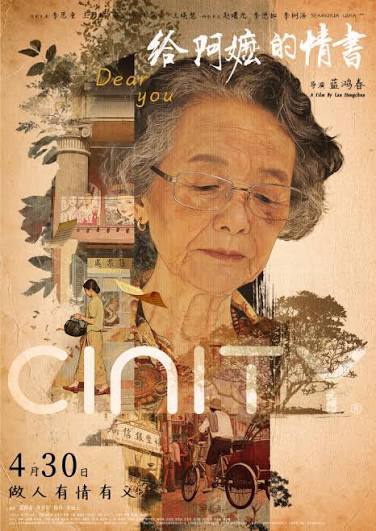
The first thing that came to my mind when I heard the plot of the movie 《阿嬤的情书》 was Angela’s Ashes by Frank McCourt. Published in 1996, the memoir brought into mainstream cultural consciousness the emotional reality of Irish poverty, migration, and humiliation. Perhaps 《阿嬤的情书》 signals that Chinese society, too, is finally beginning a similar process regarding the Nanyang diaspora.
For the Irish, works such as Angela’s Ashes helped transform the memory of migration, poverty, and humiliation into literature and collective remembrance. Perhaps 《阿嬤的情书》 signals that Chinese society, too, is finally beginning a similar process regarding the Nanyang diaspora.
The poignancy of 《阿嬤的情书》 lies not merely in the story it tells, but in the fact that China has finally become ready to tell such a story at all.
The movie came late. Very late, perhaps. But as the saying goes, better late than never.
I have not seen the film, nor do I particularly plan to. Yet even from afar, judging from the reactions it has provoked in mainland China and among the Chinese diaspora, one can already sense that the movie has touched something deep and long dormant. The emotional force seems to come not only from the plot itself, but from a larger historical realization slowly emerging into consciousness: that the migration of Cantonese people to Southeast Asia was not a marginal footnote in Chinese history, but part of one of the great human movements of the modern age.
For many Chinese families, especially in Guangdong, Fujian, Hong Kong, Macau, Singapore, Malaysia, Thailand, Indonesia, and among overseas Chinese communities elsewhere, the story exists only in fragments. A grandfather “went to Nanyang.” A great-grandmother waited in the village. Someone sent money home. Someone never returned. Someone vanished into Singapore, Penang, Batavia, Manila, or Saigon. There are old letters, fading photographs, ancestral homes with locked doors, stories half-told at family dinners and then interrupted by silence.
Yet strangely, despite the scale of this historical experience, it has rarely occupied a central place in the emotional imagination of modern China.
That, perhaps, is why the release of this movie feels so poignant.
To understand why, however, one must place the Cantonese migration into its proper historical context. Otherwise, many Chinese viewers may unconsciously assume that their ancestors’ suffering was somehow unique, exceptional, or peculiarly Chinese. In reality, the migration of southern Chinese laborers and merchants overseas during the nineteenth and early twentieth centuries was part of a worldwide phenomenon.
At roughly the same time Cantonese laborers were boarding ships for Malaya and the Dutch East Indies, millions of Europeans were leaving their homelands as well. The Irish crossed the Atlantic in enormous numbers. Italians departed southern Italy for America and Argentina. Germans, Poles, Jews, and other Europeans poured into North America. The world was in motion.
One of the hidden causes of this great migration wave was something deceptively simple: food.
The introduction of New World crops after the Columbian Exchange dramatically increased the carrying capacity of entire societies. Potatoes transformed parts of Europe. Corn, sweet potatoes, and other high-yield crops transformed China. These crops could grow on poorer land, sustain larger populations, and produce more calories than traditional staples. The result was a demographic explosion.
China’s population during the Qing dynasty expanded enormously. Europe’s population surged as well. Suddenly, traditional agrarian societies contained far more people than their economies could comfortably support. Land became fragmented. Rural poverty deepened. Young men looked outward toward ships, ports, colonies, railroads, plantations, mines, and distant cities.
The Cantonese coolie sailing southward and the Irish laborer digging canals in America were, historically speaking, figures born of the same age.
The Irish case is especially illuminating. Today, Irish identity in America is celebrated, romanticized, even sentimentalized. But the original experience was often brutal. The Irish arrived poor, hungry, Catholic, and unwelcome. They faced prejudice, mockery, exclusion, and hard labor. Many worked on dangerous infrastructure projects, including the Erie Canal and railroads. There were sayings and stereotypes attached to them. They drank heavily, fought heavily, and suffered heavily.
Yet over time, Irish suffering entered literature, politics, film, and public memory. The wounds became narrativized. Memoirs such as Angela’s Ashes helped transform private pain into collective remembrance. Irish music, Irish-American political influence, and later popular culture gradually turned an immigrant trauma into a recognized and even celebrated identity.
Something similar happened with Italians in America. Today, the Italian-American story is inseparable from food, family, neighborhoods, and cinema. But the early immigrants from southern Italy were once viewed with suspicion and contempt. They were poor, crowded into slums, stereotyped as criminals, and often treated as racially inferior Mediterraneans who did not quite belong in Anglo-America.
Yet here too, healing occurred through narrative and mythology. Even gangster stories played a role. Films such as The Godfather and Once Upon a Time in America transformed humiliation, poverty, and exclusion into memory and myth. Through literature, music, religion, cinema, and political participation, Italians gradually processed and absorbed the trauma of immigration into a larger cultural identity.
The Chinese diaspora experience, by contrast, remained strangely under-articulated for a very long time.
Part of the reason was historical circumstance. China itself spent much of the twentieth century consumed by war, revolution, invasion, civil conflict, famine, and reconstruction. There was little room for sentimental reflection on overseas migration. Overseas Chinese networks were also politically awkward at times — too commercial for revolutionaries, too Chinese for some Southeast Asian nationalisms, too dispersed to form a single unified narrative.
Another reason may lie in culture itself. Chinese immigrants often coped through endurance rather than narration. They worked, saved money, raised children, sent remittances home, and kept silent. Many were semi-literate laborers who left few memoirs. Their suffering dissolved into practicality.
Thus, while the Irish and Italians gradually transformed migration trauma into novels, films, public rituals, and collective memory, the Chinese diaspora often transformed theirs into silence.
That silence lasted generations.
Which is why the appearance and acceptance of 《阿嬤的情书》 matters.
The film arrives not at the beginning of a historical experience, but at the end of a very long silence. It arrives when China is finally economically strong enough, culturally confident enough, and emotionally secure enough to look backward without shame.
And perhaps that is the healthiest way to approach this history: not with bitterness, nor self-pity, nor grievance, but with remembrance and even celebration.
After all, those emigrants endured extraordinary hardship. Yet from their journeys emerged some of the most vibrant Chinese communities on earth. Singapore, Penang, Kuala Lumpur, Bangkok, Jakarta, Manila — the story of overseas Chinese migration became part of the making of modern Asia itself.
The proper response, therefore, is not to cry endlessly over suffering, but to acknowledge it, understand it historically, and finally bring it into the open where it belongs.
In that sense, the movie may have come late.
But perhaps China, too, has finally arrived at the emotional moment when such a story can truly be heard.

