“I Want to Die in Europe”
In 1949, two years before his death, Ludwig Wittgenstein traveled to the United States to visit his friend and former student Norman Malcolm, who was then teaching at Cornell University. During the visit, Wittgenstein became seriously ill. The illness was later found to be related to the cancer that would eventually kill him.
According to Malcolm’s memoir, Wittgenstein grew deeply distressed at the prospect of dying in America. At one point he exclaimed:
“I am a European—I want to die in Europe. What a fool I was to come!”
I first encountered the remark as a graduate student in China sometime in the late 1980s.
It made an immediate impression on me.
Not because I understood it. Quite the opposite. I did not understand it at all.
For the next forty years, every now and then, the sentence would return to me. I would think about it for a few minutes, fail to make sense of it, and move on. Life intervened. Work intervened. Other interests came and went. Yet the remark remained, lodged somewhere in the back of my mind.
Recently it returned once more.
This time I decided to confront it directly.
What could Wittgenstein have meant?
The obvious interpretation is that he meant he was a white man. But that explanation seems too shallow. In 1949, Ithaca, New York was hardly a place where Wittgenstein would have felt racially alien. Everywhere he turned he saw faces that looked much like those he had known in Vienna, Cambridge, and elsewhere in Europe.
Nor do I think he simply meant that he was Austrian.
Had that been the point, he could have said so. Instead, according to Malcolm, he chose a larger word.
European.
That choice has always intrigued me.
Wittgenstein was not a nationalist. He spent his life moving from one country to another. He was born in Austria, studied in England, lived in Norway, visited Russia, served in the Austro-Hungarian Army, and traveled to the United States. Few philosophers of the twentieth century lived a more international life.
Yet when confronted by illness and the possibility of death, he did not identify himself as a philosopher, a logician, an Austrian, a Cambridge don, or even a citizen of the world.
He said:
“I am a European.”
Why?
For years I searched for an intellectual answer. Perhaps Europe represented a particular philosophical tradition. Perhaps it referred to a common cultural inheritance. Perhaps it was a shorthand for a certain way of life.
The more I thought about it, however, the less convinced I became that the answer was intellectual.
I began to suspect that Wittgenstein was not expressing a theory.
He was expressing a sense of belonging.
There are attachments that lie deeper than argument.
A man can change his political opinions, his religious beliefs, and even his profession. Yet certain places continue to exert a pull upon him. He may not be able to justify the attachment. He may not even fully understand it. Nevertheless, it remains.
Odysseus longed for Ithaca.
Dante longed for Florence.
Millions of immigrants have spent decades building new lives in distant lands only to discover, near the end, that they still wished to be buried where they were born.
Wittgenstein’s Europe may have been something of that sort. Not a political entity. Not a geographical expression. Not a theory.
Europe to him meant home.
But this is where things get interesting.
The notion of home, as in “my hometown” or “my home,” is, by its very meaning, exclusive. What is home to you is, by that very fact, not home to me, unless I belong to it. What you call your hometown is, by definition, a place that excludes me. For me to call it my hometown, I must be someone who was born or raised there.
In contrast, terms such as citizen, legal resident, or of the same race or ethnicity carry no such implication.
Europe, to the dying Wittgenstein, was “home”—the place where he wished to die and be buried. Read in that sense, when he said, “I am a European,” European no longer functioned as a geographical designation but as another name for home. His Europe therefore did not naturally include a Pole, a Finn, a Romanian, or even a native Frenchman. Home, for him, meant Austria, where he was born and raised, England, where he studied and taught, and Norway, where he once lived as a hermit.
There is a temptation among intellectuals to dismiss such attachments as parochial. One might even argue that a philosopher who spent his life examining the foundations of language and thought should have transcended them altogether.
Yet I am not so sure.
Perhaps the opposite is true.
Perhaps Wittgenstein’s remark is interesting precisely because it reminds us that even the greatest philosophers remain human beings.
We are not composed entirely of propositions.
We do not live by logic alone.
Beneath our theories and arguments there often lies something older and more stubborn: a sense of where we belong.
For forty years I have returned to Wittgenstein’s sentence, trying to understand it.
I am not certain that I do.
But I think I understand it better than I once did.
When death seemed near, Wittgenstein did not reach for a philosophical doctrine.
He reached for home.
And in the language available to him, the name of that home was Europe.
Appendix: A Letter Home
Ludwig Wittgenstein to Barbara (“Betty”) Gaun
Trinity College, Cambridge
8 October 1917
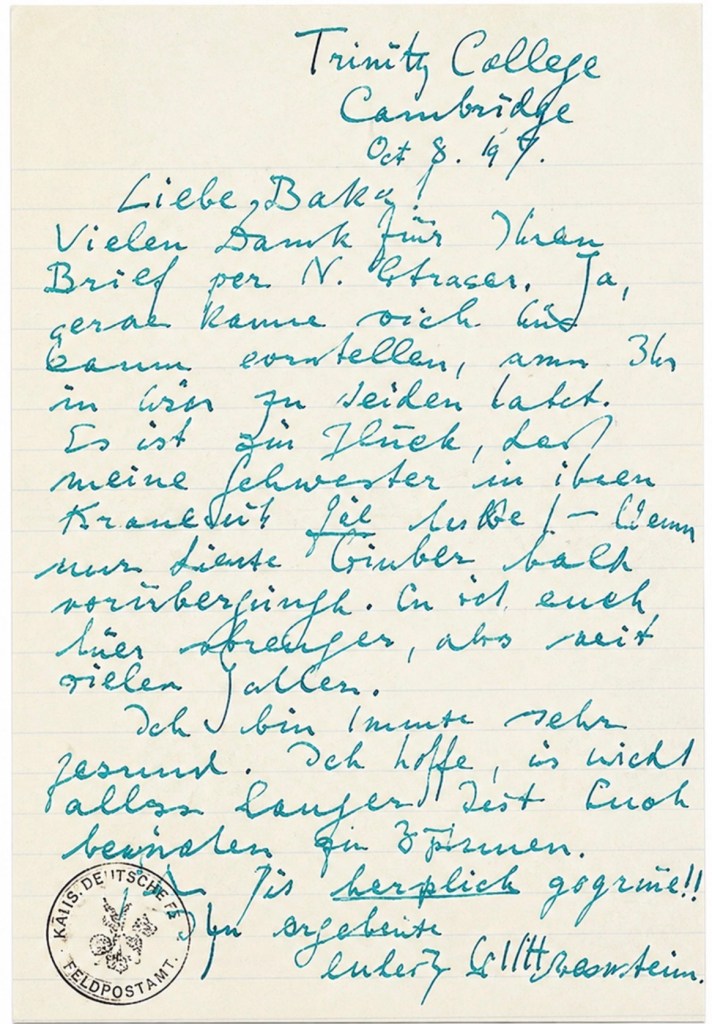
The photograph of the letter reproduced as the lead image of this essay is a wartime letter written by Ludwig Wittgenstein from Trinity College, Cambridge, on 8 October 1917, to Barbara (“Betty”) Gaun, the longtime housekeeper of the Wittgenstein family. Although only a brief personal note, it offers a revealing glimpse of what “home” meant to Wittgenstein during the First World War. The following pages present a diplomatic transcription of the German text, together with an English translation.
German (diplomatic transcription)
Trinity College
Cambridge
Oct. 8. 1917.
Liebe Baky!
Vielen Dank für Ihren Brief per N. […]. Ja! Gerade kann man sich kaum vorstellen, was Ihr in Wien zu leiden habt.
Es ist ein Glück, daß meine Schwester in ihrer Krankheit viel […].
Wenn nur dieser Winter bald vorüberginge. Es ist auch hier schlechter, als seit vielen Jahren.
Ich bin immer sehr gesund. Ich hoffe, in nicht allzu langer Zeit Euch besuchen zu können.
Seid herzlich gegrüßt!!
Ihr ergebener
Ludwig Wittgenstein
English
Trinity College
Cambridge
8 October 1917
Dear Baky,
Thank you very much for your letter, sent via N. […]. Yes, one can hardly imagine what you must be enduring in Vienna.
It is a blessing that my sister had you during her illness.
If only this winter would soon pass. Things here, too, are worse than they have been for many years.
I remain in very good health. I hope that before too long I shall be able to visit you.
With heartfelt greetings,
Yours devotedly,
Ludwig Wittgenstein
Editorial Note
The above German transcription is based primarily on the surviving manuscript reproduced here. A few words remain illegible in the available image and are indicated by ellipses. Where the handwriting is unclear, the reading has been corroborated, where possible, by a contemporary auction-house description of the letter. The field-post seal visible on the manuscript reads “KAIS. DEUTSCHE FELDPOSTAMT” (“Imperial German Field Post Office”).
This brief wartime note, written thirty-four years before his death, already reveals what “Europe” meant to Wittgenstein. It was not an abstraction, nor a civilization, nor a political ideal. It was simply home.
 Yego’s Chronicles