1
Years ago, I read a book called Events and Their Names. Says weddings, explosions, the killing of Caesar by Brutus, my being thrown for a loop, and your being a pain in my ass all morning—these are events. Says that there was a wedding, that there was an explosion, that Caesar was killed by Brutus, that I was thrown for a loop, and that you were a pain in my butt all morning—these are facts. It may not be everybody’s cup of tea, but it was pretty fun stuff to me, as I was thrown for a loop, so to speak, if you know what I mean.
A quarter of a century later, I still have the book. Recently, I went to the spot on the bookshelf where I always suspected it must be, found it, and took it down from the dusty shelf. Why I thought of the book and bothered to look for it, I don’t know. Perhaps I had no particular reason to do so, or perhaps I did—for plenty of reasons—only I wasn’t able to name them. In any case, the book was just the way I remembered it: a paperback edition of one of those academic books Hackett Publishing was known for, familiar to those of us who went to graduate school around the time I did.
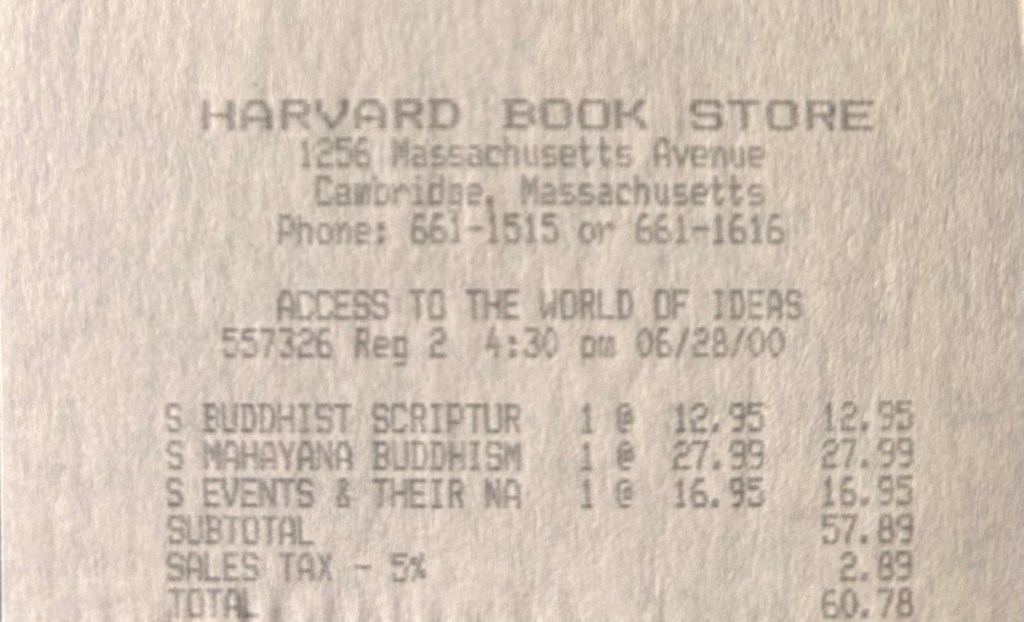
I held the book in my hand for a brief moment, feeling its smooth covers before opening it and giving it a quick flip-through. To my pleasant surprise, tucked away between the pages was the original receipt, half torn and turning gray. The pale blue ink had faded, but not enough to erase the words: “Harvard Book Store. Access to the World of Ideas.” Beneath them were the register information—557326 Reg 2—and the time stamp: 4:30 p.m., June 28, 2000.
I can’t now recall what kind of day it was, but I do have an image of myself pushing through the swinging doors and stepping out into the street. Harvard Square was a place I frequented in those days, and the bookstore was often a mandatory stop. The roof ridge of Harvard Library, rising above the buildings across the street, was glowing in the early evening sun. On my right was a restaurant called Hong Kong House; on my left, across a tiny alley, was a store called Serendipity—a rather fitting name for a place next door to the bookstore you visit in the hope of finding something surprising.
Back to the book—or rather, to what it says.
It says that events are the sort of things that always have a time and a location. OK, that makes sense. If an event is a happening, or something that has happened, then it must make sense to ask where and when it happened, right? You can’t have a wedding unless there’s a time and a place for it, and there can’t be a killing—let alone the killing of Caesar by Brutus—unless there was such a time as 44 BC and such a place as the Roman Senate.
So far, so good.
But then the book goes on to say things that were much less obvious, even to a philosophy graduate student. Here’s one of them:
“Events are facts of a certain type.”
And you think to yourself: “But a few pages back I just read that facts, unlike events, don’t have space-time locations. So why is the book lumping together things that have space-time locations with things that don’t?”
Then, just for the fun of it, comes another line:
“Facts are truth-makers.”
I had some vague idea of what that might mean, but I wasn’t entirely sure. I mean, when you think a thought like They threw me for a loop, or That was some nasty stuff, your thought is either true or false, right? And if it’s true, then there must be something that makes it true.
But not just anything can be a truth-maker. To be the truth-maker for my thought They threw me for a loop, whatever makes it true has to match the shape of the thought itself. And you know what? The fact that they threw me for a loop has exactly the same form as my thought that they threw me for a loop.
2
Thumbing through the book, I was surprised by the amount of highlighting—and, in some places, double highlighting—I had left on the pages of Bennett’s bone-dry book on a bone-dry subject. There must have been something about the metaphysical nature of events that made me willing to sweat my way through it. What could that have been? Events, names, events and their names? That seems unlikely. Language, thought, and their truth-makers? That doesn’t seem right either. Perhaps I got into the book simply out of boredom? That, too, is unlikely. There were no smartphones in my postgraduate years, and TikTok would not become a thing for many years yet. But that doesn’t mean the world was so dull that one could find amusement only in the metaphysics of events.
There was a period after I finished Axia Yiruo when I simply could not come out of it. The story arrived by accident. I had never planned to write it. It simply dropped out of nowhere. But it hit me hard, and completely by surprise. The little Mongolian tune I kept listening to after I had finished writing only made things worse.
Looking for some sort of solace, I did a random online search to see whether someone out there might actually have the name Axia Yiruo. The search returned no Axia Yiruo, but plenty of Axias, much to my relief.
Among this multitude of Axias was one that turned out to be the title of a short story by Pu Songling, the author of Liaozhai Zhiyi, or Strange Tales from a Chinese Studio. A young woman who had just lost her mother was driven from home by a relative after refusing his advances, but her suffering did not end there. She endured betrayal after betrayal before finally finding peace. Near the end of the story, she encountered one of the men who had taken advantage of her misfortune.
The man cried out,
“Lady Xia! How could you forget our old vow?”
She answered,
“You faithless man, how dare you show your face before me? You wronged your wife far more grievously than you ever wronged me.”
The words that stayed with me were words such as vow, betrayal, and to wrong someone. Looking back now, it begins to make sense why Pu Songling’s “Axia” caught my attention and, once I had read it, refused to leave me.
In Bennett’s terminology, vows, betrayals, and the wronging of another person are all events. They occur at particular places and particular times. They involve particular people and the interactions among them. The man’s vow to Axia is an event. His betrayal is another. His wronging of his wife is yet another. And so on.
Bennett’s book has a great deal to say about events and their relation to facts. But I can’t recall reading anything in it about where events go after they have come to pass.
Do they simply vanish into thin air, “done done hit,” like the motorist who has just become “a-nudder one done done hit” in the opening pages of Robert Penn Warren’s All the King’s Men? Or perhaps, once they have happened, they never quite leave the world, but linger, like ghosts, around the places where they occurred?
One might say that, once an event has taken place, it simply becomes history—a part of the history of that place and time. But I find that both unsatisfactory and unconvincing. To call something “history” is almost to say, “Now it’s gone,” rather like saying it after burning a document to ashes in a trash can.
But I do not believe events disappear like puffs of smoke.
If they do not, then where do they go? What is their status? What sort of ontological limbo do they inhabit? More importantly, where do they derive the extraordinary power they have over us once we learn the facts that arise from them?
At roughly the time I was reading Bennett, I was also reading Kant in preparation for a course in moral philosophy.
In The Metaphysics of Morals, Kant imagines an island whose inhabitants have decided to disperse forever. Before doing so, he insists, they must first execute the last murderer remaining in prison. Otherwise, the blood guilt would remain upon the people.
The murder was over.
Its fate was not.
Kant writes:
“Even if a civil society were to be dissolved by the consent of all its members… the last murderer remaining in prison would first have to be executed… so that blood guilt does not cling to the people…”
When I recalled this passage recently, I suddenly realized its relevance to what had been troubling me.
The prisoner is in jail because of a fact: namely, that he committed the murder.
But blood guilt cannot arise merely from knowing a fact.
It arises because the fact is about something morally terrible—an event.
Facts can generate guilt, but only because the events to which they refer can themselves be evil.
Another story from Liaozhai, 公孙九娘 (Gongsun Jiuniang), opens with the account of another terrible event:
“In the Yu Qi affair, those executed by implication were most numerous in the counties of Qixia and Laiyang. On one occasion, several hundred prisoners were taken in a single day and all were put to death on the military parade ground. Green blood covered the earth, while bleached bones seemed to prop up the heavens. The local officials, moved by compassion, donated coffins for the dead. The timber shops in Jinan were emptied of lumber. For this reason, most of the ghosts of those executed in the east came to be buried in the southern outskirts of the city.”
The story concerns the daughter of one of those wrongly executed. She dies upon learning of her father’s fate and becomes a ghost among those graves. She later marries, through the help of a ghostly matchmaker, but when she begs her husband to take her bones home for a proper burial, the worlds of the living and the dead become hopelessly entangled, and they lose one another.
The executions of these hundreds of men, and their burial in shallow makeshift graves, are horrific events.
Pu Songling’s sentence—“Green blood covered the earth, while bleached bones seemed to prop up the heavens”—is almost unbearable.
Today, the execution ground lies beneath Jinan’s Quan Cheng Square. Tourists stroll across it every day, taking photographs amid fountains, flowers, and greenery. Few know what once happened beneath their feet.
If those executions are now nothing more than history—one chapter in the history of the square, and of Jinan itself—then we should not feel what we do upon learning about them. We should not feel that something remains profoundly wrong, that something still awaits redress.
But we do.
Which brings me back to my original question:
Where do events go after they have come to pass?
3
The Bennett book has been lying on my desk for days now. Every time I reach for a cup of coffee, I find it in the way.
Where do these things we call events stay after they have come to pass?
I know they must be somewhere. I also know they cannot exist in some metaphysically inert limbo. Otherwise it would be impossible to explain the power Gongsun Jiuniang still has over us, or the deep conviction that a wrong, once committed, does not simply disappear from the world.
Perhaps it is time to return the book to the bookshelf and let it, as before, quietly gather dust. Each time I return to the subject, it grows a little heavier.
I have a feeling it isn’t quite finished with me yet.
But until it comes looking for me again, I think I’ll let it rest.

