1
Thursday, October 15, 2026, at 2:48 PM.
I had just come down from the Rondaxe fire tower and was about to begin my descent of Bald Mountain in the Adirondacks of northern New York.
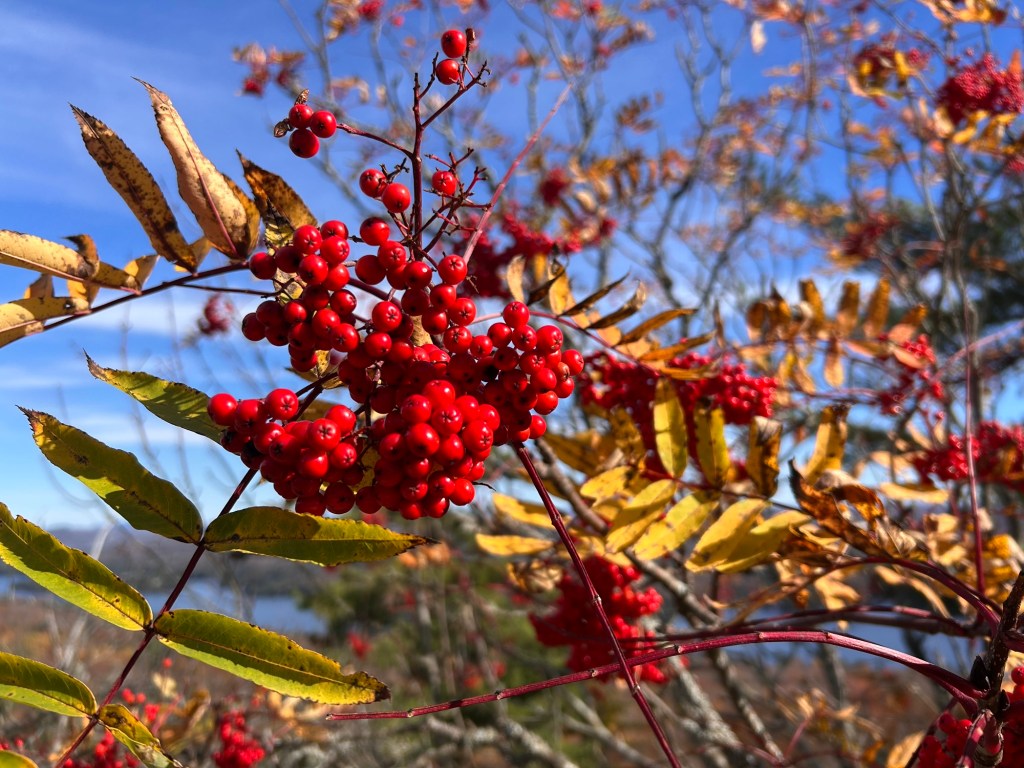
No more than ten yards from the base of the tower, I came upon a small grove of American mountain ash. Brilliant red clusters of berries hung heavy from the branches, while the long, narrow, serrated leaves were beginning to turn brown.
The sight caught my eye and went straight to my heart.
I jumped down from the great boulder I was standing on and took a close-up photograph of a branch near where my feet landed.
Coordinates: 43°44′19.1″N, 74°54′46.3″W.
I raised my head and cast a brief look around.
There it was, the Adirondacks in the middle of October. A high, clear autumn sky, thin clouds fanning out overhead, deep blue lakes lying like gemstones among the autumn foliage, and forests in every imaginable shade of yellow, orange, and red stretching as far as the eye could see.
That night, before putting away my phone, I sent the photograph to my wives, girlfriends, and significant others, as they say when there’s a big match in the Premier League attended by celebrities.
2
The next morning, I woke up and reached for my phone out of habit. Your habit too, if you’re a normie.
“Red beans.”
Just two words. All right, two Chinese characters, not two words. Sheesh! That was the reply from my significant other to the photograph I had sent her the night before.
You would have to be an alien, as far as the Chinese people are concerned, if red beans meant to you nothing more than something you put into a Dutch oven with chopped onions, carrots, parsley, oregano, and fat-free chicken broth.
I stared at the two characters.
I wished she had said a little more. Something like, “Lovely picture!” Or “Lovin’ it!” Or “Thanks for thinking of me, sweetie!” Or any of those affectionate things people say to their Premier League significant others.
But no. Été, being Été, had said just two words. Red beans. Dry and short.
I sighed and contemplated whether I should roll out of bed or stay under the warm covers for a few more minutes, keeping company with those two meager words.
It was a cold morning.
My Été is a woman of few words. A learned woman, thoroughly acquainted with the classics of Chinese philosophy, poetry, elegance, culture, and affection. Yet, despite all these accomplishments, she remains a woman of few words.
I sometimes wish she were more forthcoming with the words she keeps in that generous bosom of hers, words she knows so well but so seldom lets out.
Significant others come in different types. There is the flamboyant type, the showy type, the all-over-you type, and the needy type.
My Été is none of these.
She is the quiet type, 敏于事而慎于言, quick in action and cautious in speech, a Confucian gentlewoman of virtue and modesty. She smiles when others laugh out loud, whispers when another woman would chatter, and remains reserved when others make out in public.
But if I have learned anything from Été, it is that you need words, touches, and closed eyes just as much as you need a fancy sandwich and coffee delivered to your door.
Yes, Été!
I wish I could have sent you not merely a photograph of the mountain ash, but the berries themselves, the whole tree, the wind blowing against my face, the boulders left behind by the last ice age, the smell of late autumn in the Adirondacks, the dead leaves and the rotting forest floor, the high blue sky and those thin, fanned-out clouds.
All of it.
Only a few days earlier, I had congratulated her on an honor bestowed upon her by her university in recognition of the outstanding academic achievement of one of her students.
It had given me immense satisfaction and joy, although it had not surprised me in the least. I had known for many years what a remarkable person she was, and what a wonderful teacher she had become.
And now she had given me two words. Red beans.
3
The tree I photographed on Bald Mountain belongs to the genus Sorbus, commonly known as rowan or mountain ash.
The name is somewhat misleading. Mountain ashes are not true ashes at all. They belong to the rose family, Rosaceae.
Rowans grow across the colder parts of the Northern Hemisphere, including northern Europe, Russia, northern Asia, and North America.
The American mountain ash, Sorbus americana, is native to northeastern North America. Its Eurasian relatives include the European rowan, Sorbus aucuparia, and several species found in northern China.
In Russia, the rowan is called рябина, or ryabina.
And here we come to something that botanists, with all their admirable learning, may not be able to tell us.
For the Russians, the rowan is not merely a tree. It is a woman. A lonely woman, more often than not. A woman who loves, who waits, who longs for someone she cannot reach.
There is a famous Russian song called Тонкая рябина, or The Slender Rowan, based on a nineteenth-century poem by Ivan Surikov. In it, a slender rowan stands alone, swaying in the wind. Across the way stands a tall oak tree. The rowan wishes she could bend toward him, lean against his trunk, and rest among his branches. But she cannot. The two trees stand apart, and there is nothing either can do about it. The rowan is the woman, the oak the man.
What a wonderfully melancholy image of impossible love! And I, of all people, know how much melancholy Russian songs can contain.
There is another celebrated Russian song, Уральская рябинушка, or The Little Ural Rowan, in which a young woman, torn between two suitors, turns to a rowan tree for advice.
The rowan also appears in the poetry of Marina Tsvetaeva, where its red berries become entangled with memories of Russia, exile, homesickness, and longing.
In Russian literature and song, the rowan has come to carry a remarkable burden of human emotion. Loneliness, separation, fidelity, longing, the bitterness of a woman’s fate. All borne by a small tree with clusters of red berries.
Now, tell me, what could be more romantic than that?
And there is something else. Été grew up in northern China, where rowans also grow. The tree on Bald Mountain was American, its Russian relatives have inspired generations of poets and singers, and its Chinese relatives flourish in the northern country of her childhood.
Three distant regions of the Northern Hemisphere, connected by a genus of trees and, at least in my imagination, by a woman.
I have no idea whether Été ever saw a rowan when she was growing up. But I like to imagine that she did.
4
“Red beans,” of course, is a reference to the celebrated poem by Wang Wei, the boy-wonder poet of the great Tang dynasty. The poem is called Xiangsi, or Longing. Its four lines are among the best-known in Chinese poetry:
Red beans grow in the southern land,
How many branches burgeon in spring?
Gather as many as you can, my friend,
For memories of love are what they bring.
The association between red beans and love may well be older than Wang Wei’s poem, but there is no denying that he helped make it famous.
There is, however, a delicious twist in this business of red beans and love. It is already there in the first line.
“Red beans grow in the southern land.”
What did Wang Wei mean by the southern land? And what, exactly, were those red beans? Believe it or not, scholars have argued over both questions.
There is a plant called Abrus precatorius, a member of the legume family, Fabaceae, which grows in the warmer parts of southern China and elsewhere in the tropics and subtropics. Its Chinese names include 相思子 and 鸡母珠. It produces small, striking seeds, usually brilliant red with a black spot at one end. They are not the red beans you buy at a grocery store. Those belong to a different genus of legumes. And the seeds of Abrus precatorius are poisonous. Very poisonous.
Whether these were Wang Wei’s red beans is another matter, but they have become closely associated with the literary tradition surrounding his poem.
Now, if you have ever seen pictures of these seeds, you may well wonder how on earth they came to symbolize love.
My own suspicion is that some dull-minded ancient emperor issued a decree requiring them to do so. How else could it have happened?
Let us begin with Wang Wei himself.
Dude was a native of Shanxi who spent much of his adult life in Chang’an. Both are in northern China, where various species of rowan can be found.
Now, I cannot prove that Wang Wei ever stood before a rowan tree. But I would like to think he had at least a passing acquaintance with the northern flora.
And if he had seen one of those trees in autumn, with its brilliant red clusters of berries against a blue northern sky, how could he possibly have chosen a little poisonous bean from the south instead?
If God had intended a plant to symbolize love, surely He would have chosen the rowan.
But no!
Literary men like Wang Wei are notoriously weak in science and strong in cheap sentimentalism. Mention the south, and their fickle minds immediately conjure up beautiful women in scanty clothing, mist, palm trees, sandy beaches, and all manner of romantic nonsense.
Most important of all, the south is far away. And distance, as every poet knows, is the mother of romance.
But literary men who actually live in the south know better. They know that romance is nearly impossible in places where these tropical plants grow, for such places are often plagued by mosquitoes, biting flies, and all sorts of flying, stinging insects.
Try arranging a rendezvous with your significant other in the middle of such vegetation. You’ll get bug bites, not romance.
So what do literary men in the south do? They date in town. Take the old neighborhoods of Guangzhou, the kind depicted in Three-Family Lane. Stone-paved alleys, wooden sliding doors, arcaded streets, teahouses, the noise of the marketplace, and the endless entanglements of human relationships.
Now, that is romance! Urban romance, ordinary human romance, romance thick with the smells, sounds, and troubles of everyday life.
But there is one small problem. Red beans don’t grow in those alleys. Neither the red ones nor the black ones. They grow in the countryside, at the edges of forests, on vines, shrubs, and trees. They do not grow between the paving stones of Guangzhou’s old streets.
A poet may be thinking of a love affair in the lanes of Xiguan when he writes about red beans. Botanically speaking, however, the beans are nowhere to be found.
Consider a more contemporary example.
Not so long ago, there was a singer named Faye Wong, or 王菲. A Beijing native. A northerner, like Wang Wei. Meanwhile, somewhere down south in Hong Kong, there lived a lyricist named Lin Xi, 林夕, who made a living writing sentimental things about urban love. Convenience stores, teahouses, sleepless nights, breakups, and all the other misfortunes that befall lovers in a modern metropolis.
One day, this fellow wrote the lyrics to a song called Red Bean. Faye Wong sang it. And the rest, as they say, is history.
Now, examine those lyrics.
Snowflakes, barren sand dunes, red beans, wounds, and the promise of a love that might flow on like a gentle stream.
What on earth have these things got to do with one another? Geographically, botanically, logically, nothing! Snowflakes belong in one place, sand dunes in another, red beans somewhere else entirely.
And then there’s the extraordinary business of cooking red beans into a lingering wound.
What kind of recipe is that? Even my Dutch oven would refuse to cooperate. But Lin Xi wasn’t writing a field guide to the cultivation and consumption of red beans. He was writing a love song. The snowflakes and sand dunes evoke distance and desolation. The red beans and wounds evoke tenderness and pain. The gentle stream promises something that might endure after everything else has come to an end. The images serve the emotions, not the requirements of geography or botanical classification.
In that respect, Lin Xi was doing exactly what Wang Wei had done more than a thousand years earlier. Wang Wei borrowed a red bean from the southern country. Lin Xi borrowed Wang Wei’s red bean. And Été borrowed the red bean and gave it to an American mountain ash.
Nobody was writing a botanical treatise. The name was borrowed. The feeling was real. And that, I suppose, is the whole trouble with poets.
They make things up.
Wang Wei made things up, Lin Xi made things up, and now a woman from northern China has looked at a photograph of an American rowan and called it a red bean. The entire Chinese nation has been deceived!
But who deceived whom?
Wang Wei was a northerner. So was Faye Wong. Lin Xi was a southerner. And Été, who grew up in northern China, has now joined the conspiracy. Perhaps the southern people never deceived anybody. Perhaps the whole thing was invented by northern poets dreaming of the south.
A bona fide case of literary fabrication.
5
And yet.
There I was, lying in bed on a cold October morning in central New York, looking at two Chinese characters sent to me by a woman who grew up thousands of miles away.
红豆.
Red beans.
The photograph had been taken on a mountain in the Adirondacks. The tree was American. Its relatives grew in Russia and northern China. Its red berries reminded me of Russian songs about lonely women and impossible love. And the woman to whom I had sent the photograph had called them red beans.
Not mountain ash. Not rowan. Red beans.
I could have corrected her. I could have told her that the tree belonged to the genus Sorbus, family Rosaceae, and that Wang Wei’s red beans, whatever they were, belonged to an entirely different botanical tradition. I could have explained the distinction between the American mountain ash, the European rowan, and the various species native to northern China. I could even have told her about the poisonous seeds of Abrus precatorius.
But why would I want to do that?
The Russians have their rowan, the Chinese have their red beans, and I have my Été.
And if the Russians can turn a rowan into a lonely woman longing for an oak tree, why shouldn’t Été turn an American mountain ash into a red bean? After all, I have already turned a little grove of trees on an Adirondack mountaintop into a love story.
I suppose that makes me no better than Wang Wei or Lin Xi. Another literary man, weak in science and strong in cheap sentimentalism. Only this time, the tree really was there. I saw it with my own eyes. I touched its leaves, stood among its red berries, felt the cold October wind against my face, and took a photograph.
At 2:48 PM, on October 15, 2026.
Coordinates: 43°44′19.1″N, 74°54′46.3″W.
The rest, I suppose, I made up. Except for the two words.
Red beans.
Those were hers.

