1
I’ve been in Bali for several days now and plan to stay for a few more, if not longer. But with each passing day, I become more confused, more uncertain of what exactly it is that I have come here to see.
The inn where I am staying is in Ubud. Every day when I go out, I encounter the same sense of chaos. Holes are constantly being drilled into the pavement and patched over again. One family is building a new frontage to its house; workers stand on bamboo scaffolds, chiseling stone under the tropical sun. Drills, piles of black volcanic rock, and sacks of cement spill onto sidewalks that were narrow to begin with.
A shop selling sarongs and souvenirs sits next to a silver workshop on one side and a scooter rental on the other. Everywhere, businesses crowd against one another, competing for space along the narrow streets.
In the more fashionable parts of town, restaurants line the roads. Italian trattorias, French boulangeries, Turkish eateries, smash burger joints—Bali offers anything and everything that might make foreign visitors feel at home.
Then there is the traffic. Endless streams of scooters weave through the congestion. Japanese cars of every imaginable make and model inch forward bumper to bumper. The noise never seems to cease.
Walking through town, I encounter tourists everywhere—Europeans from east and west alike. In bars and fashionable warungs that cater to visitors, women stroll by in flowing sarongs while men lounge in white linen shirts.
Apparently, many of these people live here long-term. You see them riding scooters up and down narrow alleys, slipping through crowds with such ease that, were it not for a tuft of blond hair protruding from beneath a helmet, you might take them for locals.
I go to Seminyak on the west coast. The beach is broad and beautiful, with fine sand and the inviting waters of Kuta Bay. Yet if no one told you where you were, you might think yourself in Huntington Beach in Southern California, or on Surfers Paradise Beach in Australia. Loud music pours from bars packed to capacity. Beach clubs stretch along the shore as far as the eye can see. Rows of sunbathers occupy beach chairs facing the sea.
In the morning I went down for breakfast. Sitting at the sidewalk table waiting for my food, I saw scooters zoom by, local women returning home from the produce market, and I saw a woman emerge from the compound gate across the street and place canang sari on the ground in front of the entrance.
I thought, this can’t be Bali, can it?
2
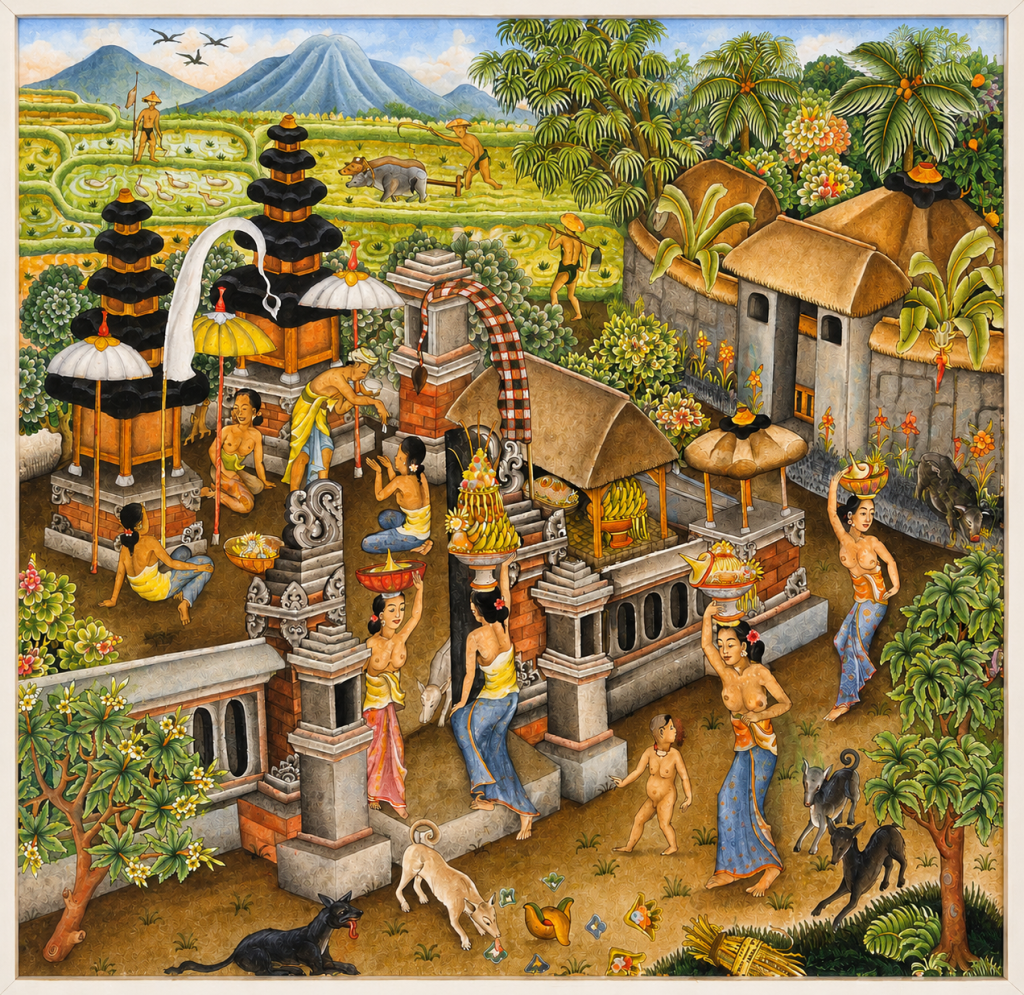
Traces of Indian influence are everywhere on the island. The names of gods sound familiar. The Ramayana and Mahabharata are known here. Religious ceremonies employ Sanskrit-derived words. Even the script one sees around town ultimately traces its ancestry to India.
But the more I looked, the less convinced I became that India held the key to understanding Bali.
Everywhere I walked, I noticed plaques mounted beside compound gates. On the wall to the left of the entrance there would often be a small stone or metal plaque bearing the name of the household in Balinese script. Above the gate itself, on a silver-colored plate, there might be a short blessing, invocation, or religious phrase written in the same script.
At first glance, the writing looked Indian. Yet the longer I looked at it, the less Indian it seemed. To be sure, Sanskrit may lie somewhere in its distant ancestry. But whatever connection once existed has long since been transformed. The script belongs unmistakably to Bali.
The same thing seemed to have happened to religion.
One thing a visitor will never see in Bali—not in the way one sees it in India—is a human image of a deity dominating a sacred space.
This is not to say that Bali lacks images of supernatural beings. Quite the contrary. Guardian figures, demons, spirits, and otherworldly creatures are everywhere: beside gates, in gardens, on walls, at crossroads, and in temple courtyards.
But where are the gods?
A shrine standing outside a family compound is usually little more than stone arranged in certain forms. Walk into one of the larger community temples in Ubud, and what impresses itself upon the eye is not an enthroned deity, but gateways, courtyards, towers, pavilions, and altars. The sacred seems to reside in the place itself rather than in a divine image occupying its center.
I looked for India in the stories as well. The Ramayana is alive in Bali. So are Rama and Hanuman. Yet even they seemed somehow transformed. The stories had survived the journey from India, but after centuries on the island they no longer felt entirely Indian. They had acquired a distinctly Balinese face.
The more I looked, the more it seemed that Bali had not been Indianized. Rather, India had been absorbed, reshaped, and made Balinese. The script had become Balinese. The stories had become Balinese. Even the gods, it seemed to me, had become Balinese.
Far from being Indianized, Bali appeared to have Balinized the Indian influences.
The following morning, while having breakfast at the hotel front, I saw the same young woman emerge from the compound gate across the street, carrying a tray of canang sari at shoulder level. I noticed that she wore a white kebaya, a deep-pink patterned selendang, and a kain of the same color.
She paused briefly to place the offerings in their customary spots before disappearing behind the angkul-angkul.
For some reason, the image lingered in my mind.
3
Lately, whenever I go out during the day, I find myself paying more and more attention to the peculiar gateways that stand before nearly every home in Ubud.
If there is one word that describes what these gates arouse in me, it is weight.
The gate through which family members enter and leave their compound is usually quite narrow. Built of stone and cement, it often appears less constructed than accumulated, as though layer upon layer had been piled atop one another over many years. From base to summit, and especially near the top, every surface is crowded with decorations: floral motifs, geometric patterns, and intricate carvings patiently chiseled by hand.
Looking at these gateways, I often have the strange feeling that they might topple over and crush me. Rationally, I know they will not. They have stood there for years, perhaps decades. Yet the sensation remains.
What impresses itself upon me is their mass.
The stones seem to possess a gravity beyond their actual weight. They rise above the street like compact mountains. One almost imagines the earth beneath them straining under the burden. If the ground could groan, it would.
There is another type of gateway in Bali, built of similar materials but on a grander scale. The locals call it a candi bentar. Unlike the gate of a family compound, it is split down the middle, its two halves facing one another like a mountain cleaved in two.
The candi bentar produces the same sensation of weight, only magnified. Its form is so unusual that it is often among the first things visitors notice upon arriving in Bali. One encounters them at temples, palaces, and public monuments throughout the island.
Every family compound in Bali contains its own temple, and the entrance to that temple is invariably a candi bentar. The family temple of Ketut, the owner of the inn where I am staying, is entered through one such gate. Every morning I pass it on my way to breakfast. Every morning I feel its stony weight.
And every morning when I went down for breakfast, I would see the same young woman from across the street emerge through the gateway, a tray of canang sari balanced in her hands.
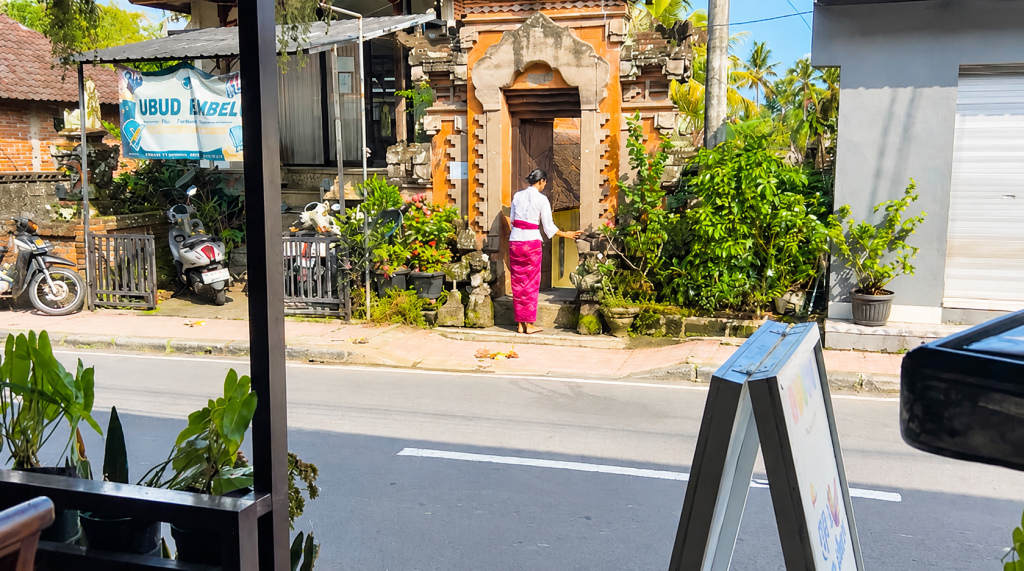
Watching her disappear once again behind the stone gateway, I found myself wondering whether the answer I was looking for lay not in the gods of India, but in these stones themselves.
4
The hotel in Ubud where I’m staying is a family-owned lodging place called Ketut’s Place.
I have no idea why, out of the half dozen hotels AI recommended to me before the trip, I picked Ketut’s Place. It could simply be because of the sound of the name.
Ketut.
Two syllables. Easy to say. Nice and clean. It sounds cute. It would make a great name for a child, or even a pet.
It’s the exact opposite of names such as Puri Dajuma or Bidadari, words that, if you are Chinese-speaking, you want to make sure there are no little children around before you attempt to pronounce them.
Anyways, you get the idea.
The morning after I checked in, I went down to the kitchen for breakfast.
An old woman standing near the family shrine kept looking at me.
There was a twinkle in her eyes. The gaze was kind, but at the same time a little unnervingly probing. She struck me as a person who had lived a privileged life, someone who had never known hardship for even a single day.
Oddly enough, she made me think of my grandmother—not because of privilege, but because of her appearance and the ease with which she regarded complete strangers.
“She’s Ketut’s mother,” the young receptionist told me.
The remark made me take a second look.
Now everything seemed to make sense.
Just look around.
The private family temple. The elaborate Balinese decorations covering the walls and eaves of the social pavilion, the ceremonial pavilion, and the family’s living quarters. Everything spoke of prosperity, stability, and standing.
I asked the receptionist to take a photograph of me with Ketut’s mother, and she gladly did.
When it was done, the old lady made it perfectly clear that she wanted to see the picture.
What impressed me was that she communicated this without saying a single word.
A gesture. A look. A slight movement of the hand.
Everyone understood immediately.
It was not difficult to see her status within the family.
Ketut’s Place offered me the best opportunity I had yet found to become familiar with the traditional Balinese family compound.
Once through the front gate, one encountered the ceremonial pavilion, the family temple, the rice-storage pavilion, and the shrine dedicated to the Rice Goddess. Nearby stood the family’s living quarters.
Every structure was built of stone and masonry and adorned with rich decorations carved down to the smallest detail.
More than anything else, they conveyed a sense of permanence.
Every pavilion felt as solid as a block of stone, as though it had always stood there and would remain standing long after its present occupants were gone.
5
Ketut, whose name appears both in the inn’s name—Ketut’s Place—and on the plaque mounted beside the entrance, has largely handed over the management of the business to his son Nyoman, who also teaches at a local university.
One day, Nyoman showed me one of his academic publications, which, to my surprise, was also available on JSTOR. I noticed that the author’s name was given as I Nyoman Purnawan.
I asked him whether Purnawan was his family name.
To my surprise, it was not.
In Bali, Nyoman explained, people traditionally do not have family names. What appears to a foreigner to be a surname is usually a personal name, often carrying meanings such as accomplished, prosperous, fortunate, or auspicious.
I also learned that Balinese names often reflect birth order.
Nyoman’s name begins with I, a marker indicating that he is male. As for Nyoman, he received that name because he is the third-born child in his family.
“What about Ketut, your father?” I asked.
“Ah,” Nyoman said with a smile. “He is the fourth-born. That’s why he’s Ketut.”
He then explained the sequence to me.
Wayan, Made, Nyoman, Ketut.
First-born, second-born, third-born, fourth-born.
“And if a family has a fifth child,” he added, “the cycle simply begins again.”
Ever since learning this naming convention, many things around Ubud have suddenly begun to make sense.
Not far from the inn is a silversmith whose sign reads: Wayan’s Silver Class. The other day I asked him whether he happened to be a first-born child. He laughed and turned the question back on me.
Farther down the road, near the center of town, is an upscale restaurant called Made’s Warung.
For a while I felt delighted by the discovery. Then I became confused.
Where I come from, there is hardly anything more important than ownership. Every piece of property has an owner, and every owner has a name.
Suppose someone asks, “Who owns this land?”
“John Smith owns it.”
The answer is perfectly clear.
But suppose I ask Nyoman:
“Who owns the family compound?”
“My father.”
“And what’s your father’s name?”
“Ketut.”
The answer somehow leaves me unsatisfied.
Who is Ketut?
The fourth-born.
But every family seems to have a Ketut. Every family also seems to have a Wayan, a Made, and a Nyoman.
The more I thought about it, the more puzzling it became.
Surely the Balinese possess a concept of ownership. Families live on the same compounds for generations. Property is inherited. Boundaries are recognized. Disputes occur.
Yet I could not shake the feeling that the relationship between people and place here differs somehow from what I am accustomed to.
In the world I come from, land belongs to individuals.
In Bali, I began to wonder whether individuals belong, in some sense, to the land.
6
It was the second day of Eid al-Adha.
As I was having breakfast on the front porch of the hotel, the young woman from across the street emerged from the compound gate. She was Ni Putu, the daughter of Ketut’s neighbor, as I later learned from Ketut’s staff. As usual, she wore a white kebaya, a deep-pink selendang, and a kain of matching color.
but this time around, i knew better. From Nyoman i already learned that Putu is just another word for “the first born,” so since her name was Ni Putu, that makes her the family’s oldest daughter.
But this morning, before placing the small offering trays in front of her family compound, as she had done every day since my arrival, she walked toward a shrine standing in a far corner along the compound wall. In her tray, in addition to the usual offerings, was a small bowl of water. Floating on its surface were several white flower petals.
Standing upright before the shrine, elegant in her simple white kebaya and pink kain, she raised the bowl to eye level. Dipping her fingers into the water, she sprinkled the shrine once, twice, three times.
The sprinkling was immediately followed by a series of slow, graceful, and carefully controlled motions of the hand. With her fingers extended, she swept them through the air before the shrine, as though fanning away an invisible veil of smoke or mist suspended in the empty space before her.
She repeated the ritual a second time. This time, however, the final motion lingered. The movement gradually slowed, softened, and eventually dissolved into stillness.
I watched the entire scene with a mixture of astonishment and awe. Never had I imagined that I would one day witness something at once so dramatic and yet so utterly ordinary.
All around her, life continued uninterrupted. Scooters and cars streamed past on the street. Music drifted out from Ketut’s foyer. Pedestrians walked by. Yet she seemed entirely unaware of the world around her. There was no self-consciousness in her movements, no sense of performance, no acknowledgment of the attention she might have attracted.
For those few moments, there was only Ni Putu, the shrine, and the ritual.
And for the first time since arriving in Bali, I had the feeling that I was looking at something essential.
7
I woke to the sound of rain.
For a while I lay in bed, watching streams of water rushing down the gutters outside my window. Only small patches of sky were visible through the foliage, and what little I could see was gray. A light mist hung in the air.
My room was one of the few at the very rear of Ketut’s Place, built on the steep slope of a ravine. Long tropical vines and broad-leafed plants draped themselves from the branches of tall trees growing along the edge, trailing all the way down toward the bottom.
Eventually I got up, dressed, and went down for breakfast.
Everything in the courtyard was wet.
I sat at my usual spot, taking my time with my coffee. But by the time I finished, Ni Putu had not appeared.
The canang sari that had been placed on the ground the day before lay in ruins. The little baskets had come apart, their flowers scattered by the rain. It was impossible to tell whether they had been placed there that morning or the morning before.
For the first time since my arrival, the ritual seemed fragile.
After breakfast I returned to my room and spent the rest of the morning listening to the rain.
By noon it had stopped.
Unable to think of anywhere in particular to go, I eventually decided to visit the Puri Lukisan Museum.
The museum courtyard was spacious and peaceful. Old banyan trees and coconut palms lined the gardens. It was hard to imagine that just beyond the walls lay the noisy and congested streets of Ubud.
Never much of a museum-goer, I nevertheless lingered longer than usual in one of the exhibition halls, drawn less by the paintings themselves than by the stories they told.
One painting depicted the adventures of the hero Amad Mohamad and his three magical possessions: an arrow that returned after striking its target, a bag that could never be emptied of food, and a shirt that allowed its wearer to fly.
Another illustrated the tale of Lutung Kasarung, a monkey rescued from the sea by a turtle. Having reached land, the monkey and a tiger promptly killed their rescuer and turned him into grilled meat.
As I walked out of the exhibition hall and into the garden, I looked at the ground, then at the sky, and wondered why Ni Putu did not show up that morning.
As I returned to Ketut’s Place, I saw Nyoman emerging from behind the ceremonial pavilion. He greeted me and asked how my day had gone. Then, almost as an afterthought, he asked whether I would like to visit a few places the following day. He had no classes to teach and offered to drive me somewhere “up north.”
I did not catch all the names he mentioned, but I thought the offer extraordinarily kind, and so I accepted.
I went to bed early that night.
Sometime after midnight, I woke from a dream. I had been in some wet, muddy place—rice fields, perhaps—battling gigantic red ants and praying mantises, while the insects themselves fought one another amid the muck. For a long time after waking, I could not shake the feeling of disgust that came from having been in such close combat with those creatures.
I attributed the dream to one of the paintings I had seen earlier in the day, but it could just as well have come from my walk along the Kajeng Rice Field Trail on the way back from the museum.
But after that I could not fall back asleep. So I sat up in bed and found myself thinking about water. Why was so much rice grown here in Bali? Why did everything seem wet? Why was there water everywhere one turned? And why had Ni Putu mixed flower petals into the water she sprinkled upon the stones?
I thought about these things for a long time, until eventually my head began to ache.
8
Nyoman was on the faculty of the public health department at a local university here in Ubud. Only five years earlier, he had earned his Ph.D. and begun teaching at the University of Yogyakarta in Java. Teaching was going well, his research was taking off, and he had even secured a grant from an institute in the United States.
One day, however, he received a call from his mother, who asked him to return to Bali and take over the family business. He did.
He moved back to Bali, took a position at his current university, and began juggling academic life with the responsibilities of managing Ketut’s Place.
I learned all this from Nyoman during our drive to “the temples.”
“Now I look back,” said Nyoman at the wheel. “I miss my days at Yogyakarta. They were the highlights of my life.”
I felt for Nyoman, but did not know what to say. Having come into contact with Balinese culture for the first time, I had no way of knowing how such things worked. But I did sympathize with him, having been a college teacher myself at one point.
When we arrived at the site, Nyoman parked the car and accompanied me to the park entrance. There were hardly any tourists here.
“Take your time to explore,” Nyoman said. “I’ll wait for you out here.”
I thanked him and walked over to the park worker, who wrapped a maroon sarong around my waist.
“You look great in the sarong!” Nyoman said, giving me a thumbs-up.
It is strange what a simple piece of local fabric can do to your mood. I was already feeling very much a Balinese even before I stepped onto the park grounds.
I turned and made a quick survey of the scene around me. Pristine white clouds drifted across the sky; rice fields and tropical trees stretched in every direction as far as the eye could see.
Beyond the sarong checkpoint, the only way forward was down a long series of stone steps. As I started down them, I remembered what Nyoman had said about going down—and then back up—hundreds of steps.
Nyoman must have thought me unfit for such a walk. In truth, I had climbed and descended some of the world’s toughest valleys. Besides, it was a bright, sunny day, and I was wearing a handsome sarong that fluttered whenever a cool breeze rose from below. I felt light-footed and was thoroughly enjoying the descent.
Little did I know that I was descending into Bali’s Valley of the Kings.
9
The legend goes something like this.
More than a thousand years ago, Mahendradatta, a Javanese princess, was married to the Balinese king Udayana. Together they ruled the kingdom and had three sons: Airlangga, Marakata, and Anak Wungsu. During the reign of the youngest, Anak Wungsu, the kingdom prospered and its authority extended across much of the island. Peace prevailed, and the realm flourished.
It was Anak Wungsu, so the story goes, who ordered the construction of the monuments at Gunung Kawi. They were dedicated to his father, his mother, his brothers, and perhaps to himself as well. Over the centuries, the story of the royal family became entwined with that of the valley. History merged with legend, and legend with myth, until it became difficult to tell where one ended and the other began.
Yet learning this half-history, half-legend did little to help me make sense of the monuments themselves.
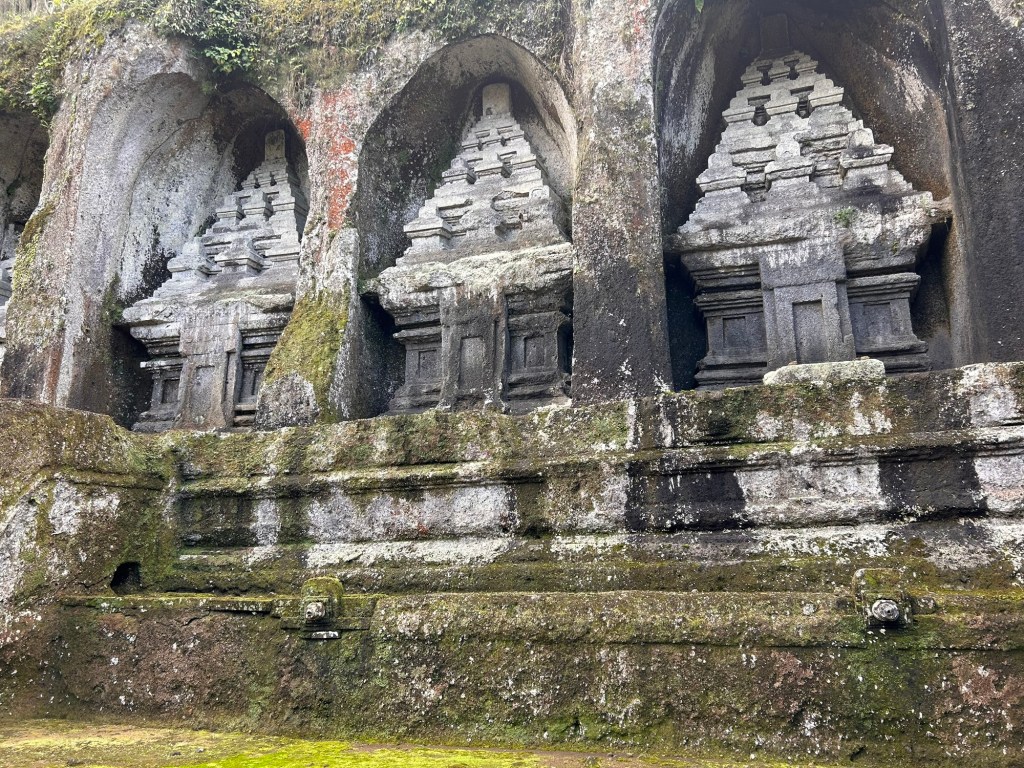
It is immediately obvious to any visitor standing in the valley that the great carvings on either side of the Pakerisan River bear no resemblance to human beings, let alone to particular kings. Everywhere I looked, the candi appeared to be nothing more than stone forms carved into the cliff face—rocks arranged in a certain geometric order. These were not monuments modeled after human bodies. If they resembled anything at all, they resembled the shrines I had been seeing everywhere in Bali: the small shrine outside Ni Putu’s home compound, the family temple at Ketut’s Place, the gateways and shrines that dotted both private homes and public spaces throughout the island.
Yet Anak Wungsu surely did not order these things built for nothing.
Anyone who stands before the monuments can appreciate the immensity of the undertaking. They are not the work of a day, nor of a handful of men. An entire conception of the world seems to have been carved into the cliffs above the river.
But what exactly was that conception?
Did the king somehow imagine that his parents, his brothers, his ministers, and perhaps even himself would ultimately become stone? Did he believe that the best way to preserve a human life was not to carve a human likeness, but to create a monument that resembled the sacred shrines already scattered across the landscape? If so, where did such an idea come from? What vision of the world lay behind it?
Standing in the Pakerisan River and looking up at the monuments, I found them awe-inspiring, to put it mildly. Yet there was also something difficult to describe. The river, the trees, the steep valley walls, and the monuments themselves seemed to belong to a single living whole. One had the strange feeling that the carvings were not merely relics left behind by the dead. Like the river flowing past them and the trees growing above them, they somehow remained alive.
Perhaps that is why they continue to occupy such an important place in the imagination of the Balinese. The kings may be gone, but the monuments endure—not merely as memories of the past, but as living presences woven into the landscape and the life of the island itself.
10
Tomorrow I leave the Ketut family for Amed.
I do not know what awaits me on the northeastern coast of Bali, where the beaches are strewn with black volcanic stones rather than the smooth sands of Seminyak, where the sea opens onto a world of coral and clear water, and where Mount Agung is said to appear at every turn as one strolls the quiet shoreline in the early morning.
I am looking forward to it.
But I am equally certain that by then I will already be missing the Ketuts, Ni Putu’s canang sari, and even that strange dream of red ants and praying mantises.
Most of all, however, I suspect I shall miss the stones of Ubud.
The stones in the shrines. The stones in the family temples. The stones stacked beside roads and hidden in corners. The stones carved into cliffs above the Pakerisan River. The stones that, somehow, the Balinese have persuaded me are not entirely dead.
Tomorrow I leave them behind.

