1
The morning after I arrived in Amed, the fishing town that sits on the shores of the Bali Sea northeast of Ubud, I went snorkeling on a rented jukung.
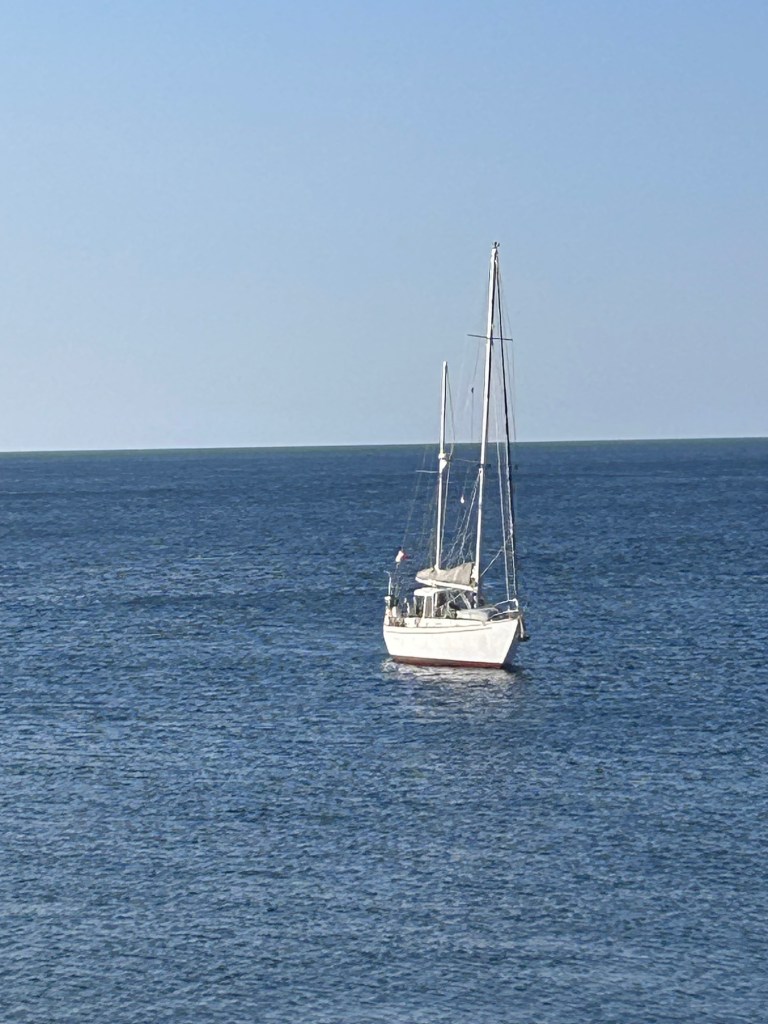
When I returned to my hotel room slightly after noon, I stepped onto the balcony and spotted a small sailboat, sails furled, gently bobbing on the blue waters of the Bali Sea. The boat was lying bow-to the wind and sea. Two small flags fluttered from the rigging. One was Canadian; the other Indonesian. How odd, I thought to myself, to see the maple leaf flying above the waters of a quiet fishing town in eastern Bali.
The sight was so unexpected—and the neat, streamlined shape of the boat so captivating—that I forgot I had my room key halfway to the keyhole. I stood there gazing at it, watching it pivot gently around a point fixed on the seabed.
The boat could not have been more than five hundred yards away. From where I stood, the boat lay directly in line with the sliding doors of my room. It had two masts, the forward one noticeably taller than the aft one. Later I would learn that such a vessel is called a ketch.
“But why?” I found myself wondering. “Amed Beach stretches for miles, and there’s nothing about this particular spot that stands out. Just look around—simple, inexpensive lodging places, short beaches, sleepy family-run warungs beneath the afternoon sun. No chandlery, no marina, no supermarket. Why here, of all places?”
In any case, I inserted the key, slid open the doors, and stepped inside. I threw my wet backpack onto the floor. I was exhausted from the snorkeling, had been wearing salt-saturated clothing for too long, and was ready for a shower to wash off the sea.
2
I went down to Bubu’s warung for lunch on the beach, not far from my hotel.
Bubu came over with the menu.
“I’m so ready for lunch,” I said. “I haven’t eaten since seven-thirty. May I please have some grilled mahi-mahi?”
“I’m sorry,” Bubu said. “We’re out of mahi-mahi today.”
“How about tuna? Grilled.”
“Sorry. We’re out of tuna as well.”
Disappointed—and, I admit, slightly exasperated—I asked what fish he did have.
“We have barracuda.”
Immediately the image of a predator fish with oversized teeth and sideways-looking eyes came to mind.
In a million years, I muttered under my breath.
But I also knew I had little choice.
“Barracuda, then,” I said grudgingly.
After a few sips of a cold Bintang, I felt somewhat better. Fish or no fish, barracuda or mahi-mahi—what difference did it really make?
The blue waters of Amed Beach were only a few yards from my chair, stretching all the way to the horizon. In the far distance I noticed what looked like a giant ship. A tanker, perhaps. A long plume of smoke trailed behind it.
That’s interesting, I thought. I didn’t know tankers passed through these waters.
Then a cat came up and meowed. A little girl of preschool age wandered slowly past, carrying a small box filled with frangipani petals and other items in one hand. She appeared to be a novice peddler of offerings.
I glanced at my phone for a few moments.
When I looked back toward the sea, I was astonished. The tanker had moved to a position so different from where it had been before that it seemed impossible such a gigantic vessel could have traveled so far in so short a time.
The tables at Bubu’s sat only a few yards from the water. Beyond them, the blue Bali Sea stretched northward to horizons and countries I could not see.
A woman arrived shortly after I did. She looked to be in her late forties or early fifties, thin, and was accompanied by an equally thin dog that settled beneath her chair. The dog was on a leash and shook almost nonstop. The woman ordered a drink and sat facing the sea.
A while later a middle-aged man appeared.
What followed was the familiar drama of two people who had not seen one another in some time. There were exclamations, laughter, hugs, and the rapid exchange of questions that accompanies an unexpected reunion. The man spoke with an unmistakable Australian accent. The woman’s accent was more elusive. It was clearly neither French, German, nor Spanish, and I found myself unable to place it.
The man pulled up a chair and sat down. Before long they were catching up on one another’s lives.
I was not trying to eavesdrop. The tables were simply too close together.
From what I gathered, both had once worked in information technology. Neither had enjoyed it. They spoke of offices, managers, clients, and the commercial side of the business with the sort of disdain usually reserved for an unpleasant former spouse.
The woman now worked as a diving instructor in Amed. The man had left his job as well, hoping for something different, but was considering returning because money had become an issue.
Again and again the conversation returned to the same word: freedom. Freedom from offices, from schedules, from bosses, meetings, and expectations.
The sea sparkled peacefully a short distance away. Yet it looked as though the two would not stop anytime soon. Apartments, visa issues, construction noise, the good side and bad side of living away from one’s own country—there seemed to be no end to it.
My time in Amed was limited and precious. I had not come here to spend an afternoon listening to discussions about apartment rentals and expatriate woes.
I asked Bubu to find me a table farther from the pair. It was not that I disliked either of them. But there was something wearying about the conversation.
3
It appeared the ketch was not going anywhere anytime soon.
The entire afternoon, from the time I returned from lunch, it remained more or less in the same position. The two figures I had noticed earlier—a man and a woman, both young, or appeared to be so—were no longer visible on deck.
What was noticeable was the dinghy. During my absence it had appeared on deck near the bow. Or perhaps it had been there all along and I had simply missed it.
Were they planning to come ashore later? Was that what the dinghy was for? The thought seemed plausible enough.
I sat on the balcony for a while and then went inside.
Later that afternoon I went for a walk, wading through the warm waters of the Bali Sea and heading west. The beach was lined with jukungs pulled tightly beside one another. To my right stretched the sea; to my left, beyond the villages and coconut groves, rose Mount Agung, its lower slopes wrapped in cloud while its summit hovered in the afternoon haze.
I walked a long way, nearly reaching the far end of the bay.
On the return journey I spotted two more large vessels on the horizon. One was a white, almost box-shaped cargo ship; the other a more traditional tanker painted brown below and black above. Unlike the tanker I had seen earlier, these two were heading west.
There had to be some shipping lane out there, some invisible route along which these giants traveled.
But where were they going?
I knew Australia lay somewhere to the east of Amed. To the west were Java, Singapore, and Malaysia. Farther still, to the northwest, lay China, Korea, and Japan.
Was that where these ships were headed?
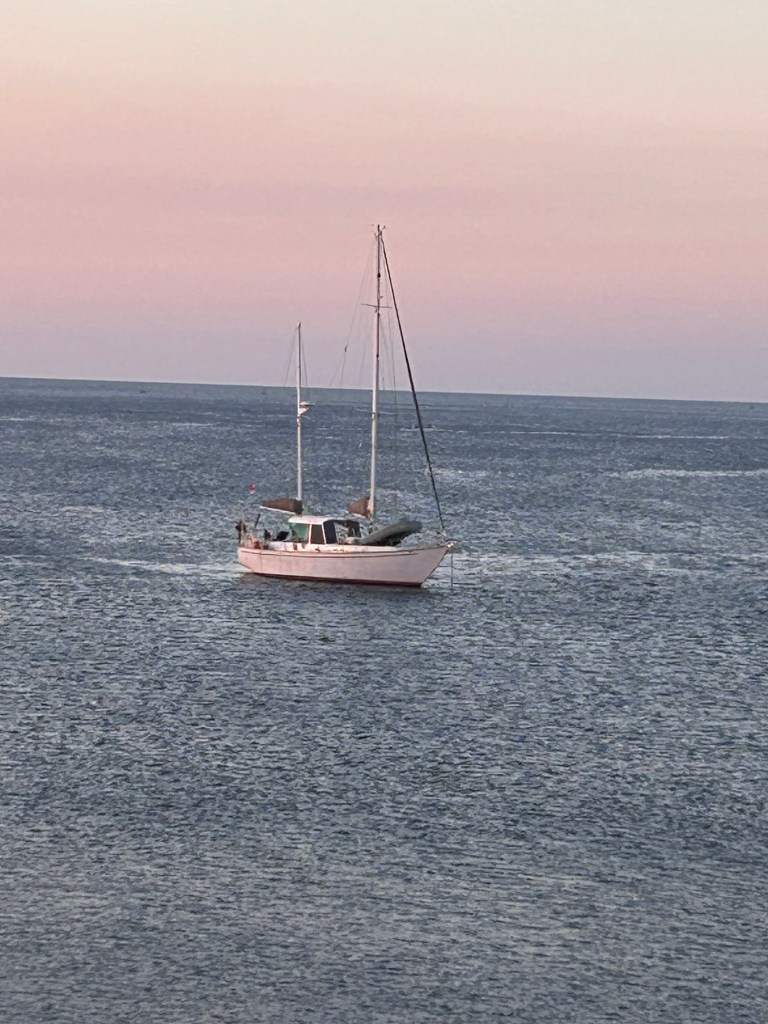
Again, from the balcony, I spotted the ketch, bobbing gently on the water against the darkening eastern horizon, its westforwad-facing side brushed with faint streaks of pink from the setting sun.
4
They say Mount Agung has many faces, and that for people merely passing through Bali, which face they see is largely a matter of luck.
After two days in Amed, I could see why.
Mount Agung is at its prettiest at sunrise, when the moon still hangs to one side, the sky is washed in pale blue and pink, and the air remains cool and clear. At that hour, the deep cuts left by past eruptions are visible, etched sharply into the mountain’s flanks.
But as the day progresses, moisture rises into the air and clouds drift in. Some gather around the summit, while many more conceal the lower slopes. By afternoon, all that remains is a fragmented Agung—steamy, distant, and distorted by haze.
Mount Agung is awe-inspiring. Yet its magnificence can only be fully appreciated up close. Mountains inspire thoughts of stability, permanence, and steadfastness. Agung does this, much like many of the great mountains of the world.
For me, however, a vast ocean inspires something entirely different.
Possibility is the first word that comes to mind.
What if one were to sail into it, far beyond the horizon? What would happen? Where would one end up? Nobody can really tell.
The ketch was anchored here now, only a few hundred yards from shore. Yet the moment its anchor was raised and its bow turned toward the open sea, anything seemed possible. Very little would remain certain.
The beaches of Amed were crowded with jukungs, the traditional outrigger boats of Balinese fishermen. The boat that took me snorkeling was a jukung. The boats pulled up on the beach were jukungs, and the tiny vessels one spotted throughout the day far offshore were usually jukungs as well.
Yet even these small and seemingly primitive fishing craft can stir the imagination once you watch them head toward the horizon. In Amed, some jukungs venture remarkably far from shore. From the beach, they eventually become little more than dark specks against the sea, sometimes so distant that one has to search for them deliberately.
There is something about the sight of those tiny specks on the immense ocean that awakens a feeling difficult to describe—a sense of beckoning, perhaps, as though something unknown were calling from far away.
5
In Bali—in Amed just as in Ubud—evening arrives without fanfare.
There is no announcement. By the time it occurs to you that dusk has come, the sun is already gone and night has fallen.
When I returned to my hotel room after dark, I put down my backpack and settled in. Then I realized I had forgotten to check whether the ketch was still there.
I stepped onto the balcony and looked toward the stretch of water in front of me.
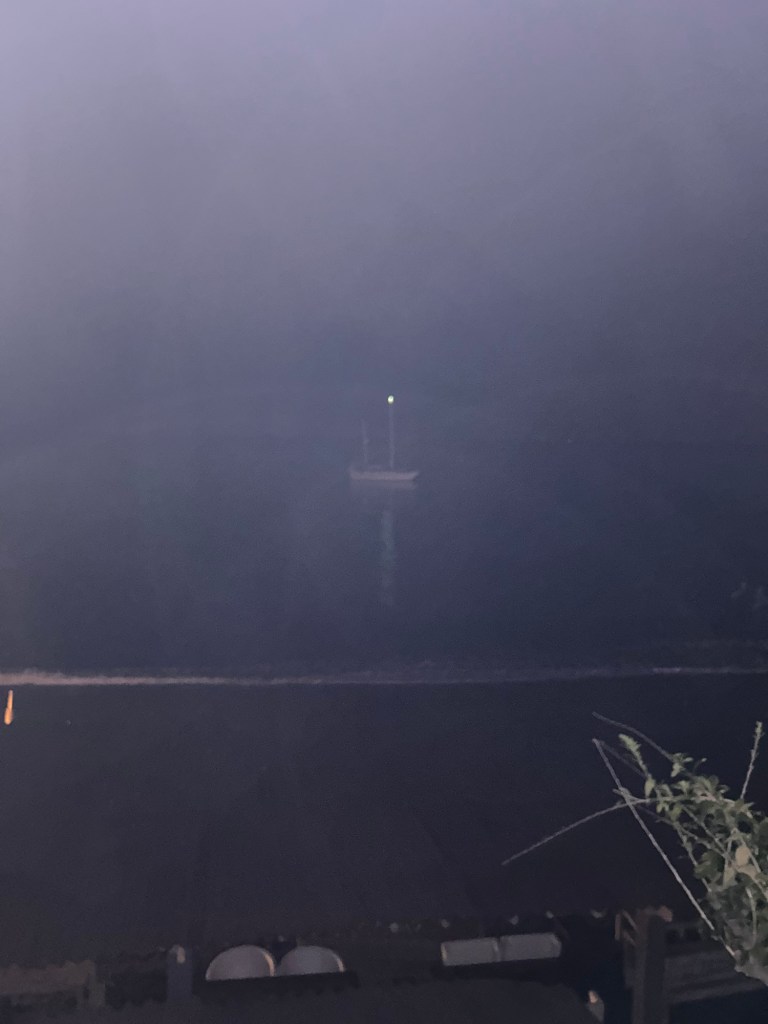
At first I saw only a light—white, or perhaps pale blue, I could not tell. It shone from the very top of the forward mast.
Gradually my eyes adjusted to the darkness, and I could make out the faint white line of waves breaking on the shore below.
The ketch was still there, although by now it was impossible to see the dinghy, or even tell whether it remained aboard. Most likely it did; otherwise it would be difficult to explain the anchor light.
I washed up, changed into my night clothes, and settled into bed. I picked up my phone and began my daily catch-up with family and friends.
But then I stopped.
My thoughts had drifted back to the ketch a mere five hundred yards away.
It is difficult for someone like me to imagine what it would be like to live on a yacht for weeks, perhaps even months, working on it during the day and sleeping on it at night. The sea was calm now, but even then it could not have been quite like sleeping in a hotel bed. And if you were on a voyage from Canada to a place like Amed, a calm night such as this surely had to be the exception rather than the rule.
But why are people willing to endure this?
Years ago I watched a movie called The Dove. It told the story of a young man who sailed alone across the ocean, and of a young woman who later joined him. Together they crossed vast stretches of sea.
I remember very little of the movie now. What stayed with me was the endless sunlight, the brightness of the air, and the man’s frustration whenever the sea became calm and the boat nearly stalled.
Why do people undertake such journeys?
Some things people do are easy to understand; others seem almost beyond comprehension. The voyage in The Dove was one of those. Nobody had to do it. No livelihood depended upon it. Yet they did it anyway.
Another movie I watched years ago was also about the sea, though in a very different way. Its name was Papillon. I do not know how many people today still remember it. I watched it while teaching at a university in central Michigan, during a low point in my career.
The film tells the story of Henri “Papillon” Charrière, a safecracker sentenced to a brutal penal colony in French Guiana. Refusing to accept imprisonment, he spends years enduring hardship, solitary confinement, and repeated failed escape attempts. The entire movie revolves around a single idea: a man’s determination to regain the freedom that has been taken from him.
The movie ends with Papillon’s final escape attempt. The camera faces the vast, boundless waters of the South Pacific. No one knows what became of Papillon. Some say he drowned at sea. Others say he survived and eventually made it back to land.
He probably drowned, I thought to myself. Yet at the same time, I found myself hoping that he hadn’t—that somehow he had survived and made it back to shore.
Papillon was a movie I understood. What I cannot quite understand is what leads people to choose journeys so strenuous and demanding—cramped quarters, loneliness at sea, constant exposure to the elements, and a life stripped down to the bare minimum.
The story of The Dove is different. Its characters are not escaping imprisonment. They are pursuing something else entirely, and the journey is wholly of their own choosing.
The people on this ketch, anchored now in front of my hotel room, appeared young from the way they moved about the boat. But the sailors could just as easily have been a couple in their sixties, halfway through a voyage from Vancouver to some distant destination unknown to an observer like me.
Despite differences in age and generation, they would share something in common.
But what?
It then occurred to me that my earlier thinking might have been premature. Perhaps the voyage in The Dove is simpler than I had imagined, and perhaps Papillon touches on something deeper than a jailbreak from a tiny island in the South Pacific.
6
All morning I sat in Pakel’s warung, watching the lone ketch bob on the gentle sea.
Sunlight flickered across the water. The sea was calm.
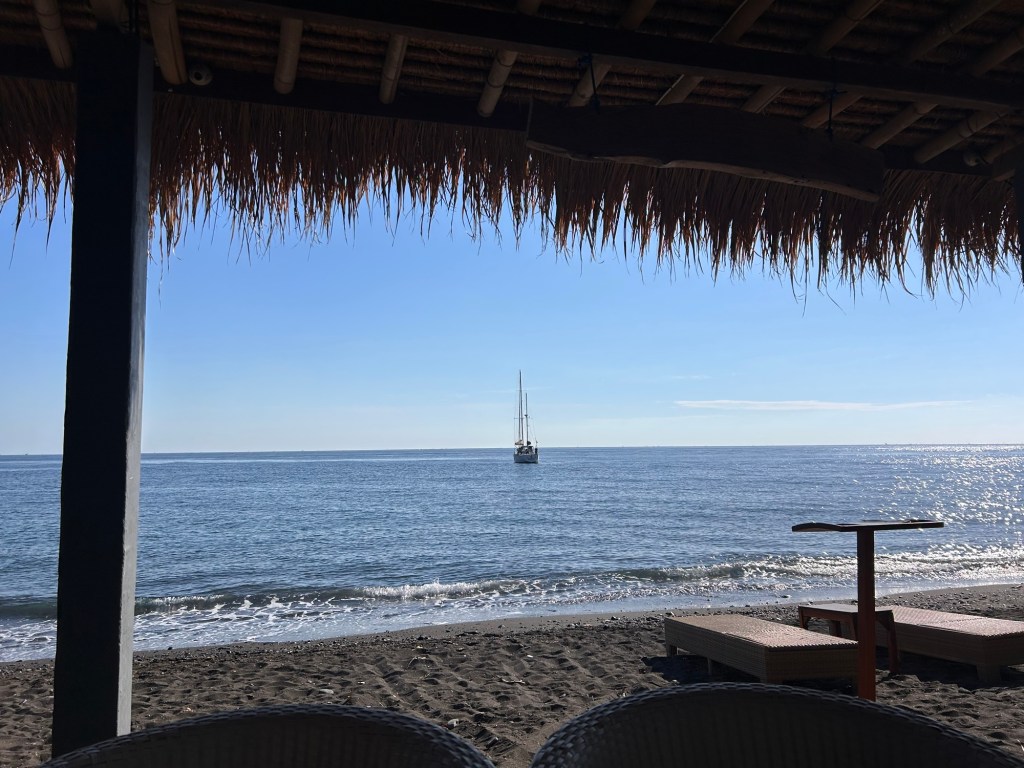
I wondered when the sailboat would pull its anchor and depart, and when it did, whether it would head east toward the morning sun or west toward the darker blue waters farther along the coast.
Whichever direction it eventually chose, the ocean would not change. The distance would not change. The sky would remain immense, and the water vast.
At one point I noticed something hovering above the bow.
At first I thought it was an object dangling from a line. Then, when it began to move, I assumed it was a seabird.
Only later did I realize it was a drone, a rather small one, apparently controlled by someone aboard the boat.
It was probably too small to serve any navigational purpose. Most likely it was there simply for fun. The fact that someone had brought a toy aboard made me appreciate the light-hearted side of a solitary voyage.
7
Today is my last day in Amed. A driver will stop by tomorrow morning to take me to the airport for my flight home.
I have no idea whether, when I step out through the sliding doors tomorrow morning, the ketch will still be there, bobbing in the sunlight as it has for the past two days, or whether it will be gone—its anchor raised sometime during the night, its bow turned toward some destination unknown to me.
Either way, it makes little difference.
I never learned who the people aboard were. I never learned where they came from, or where they were going. For all I know, they may have arrived from Canada months earlier and spent the better part of a year wandering through the islands of Indonesia, and it was purely by chance that they happened to anchor in front of my hotel a day after I arrived.
The truth is that I know almost nothing about them. Yet for two days I found myself returning to the ketch again and again.
Perhaps it was because the little vessel seemed to embody something I had been sensing all along while sitting on the beaches of Amed and watching the distant jukungs disappear into the horizon.
There is something about the sea that invites speculation.
A mountain, however magnificent, is content to remain where it is. The ocean is different. The moment a vessel appears upon it, questions arise. Where has it come from? Where is it going? What lies beyond the horizon?
The ketch never answered any of those questions.
Perhaps that is why I found it so fascinating.
Meanwhile, there is still a day left in Amed.
I think I shall go enjoy it.
 Yego’s Chronicles