7
Everything is handled on her mobile phone, from booking train tickets to finding hotel accommodations to ordering food. She held her phone carelessly and walked stumblingly, as many people her age do. Every time you see her walking, with the phone held in front of her, you want to say, “What will you do if that little baby of yours falls on the ground and breaks? What will you do if it’s out of power, or if the internet connection is lost? What will you do, little girl, if you get lost? How will you find your way home?”
Everywhere you look, you see them with their phones in hand. When they’re not calling a taxi, they’re looking for directions, talking to friends, searching for a place to eat, or feeling emotional and tearing up:

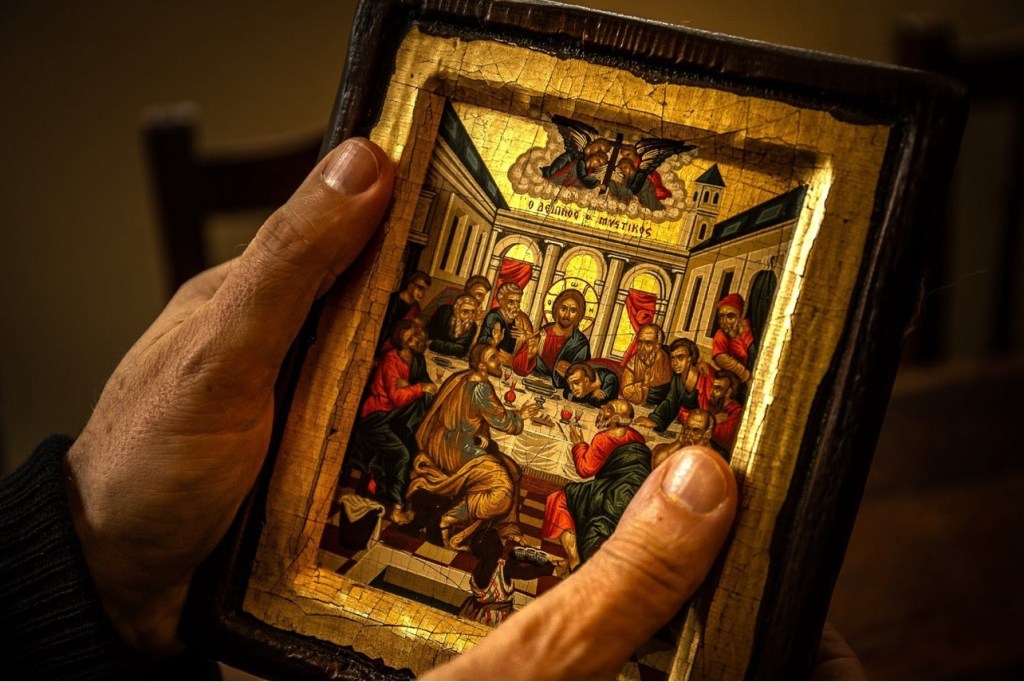
In Orthodox countries such as Russia, Serbia, and Romania, images of God, the Virgin Mary, or saints are framed. You see priests holding them during services or processions, and you see them in churches and monasteries, where the faithful kiss them. You also find them in the private homes of ordinary people. When I see a young person walking, their eyes glued to a screen, the image of an Orthodox priest holding an icon always comes to mind:
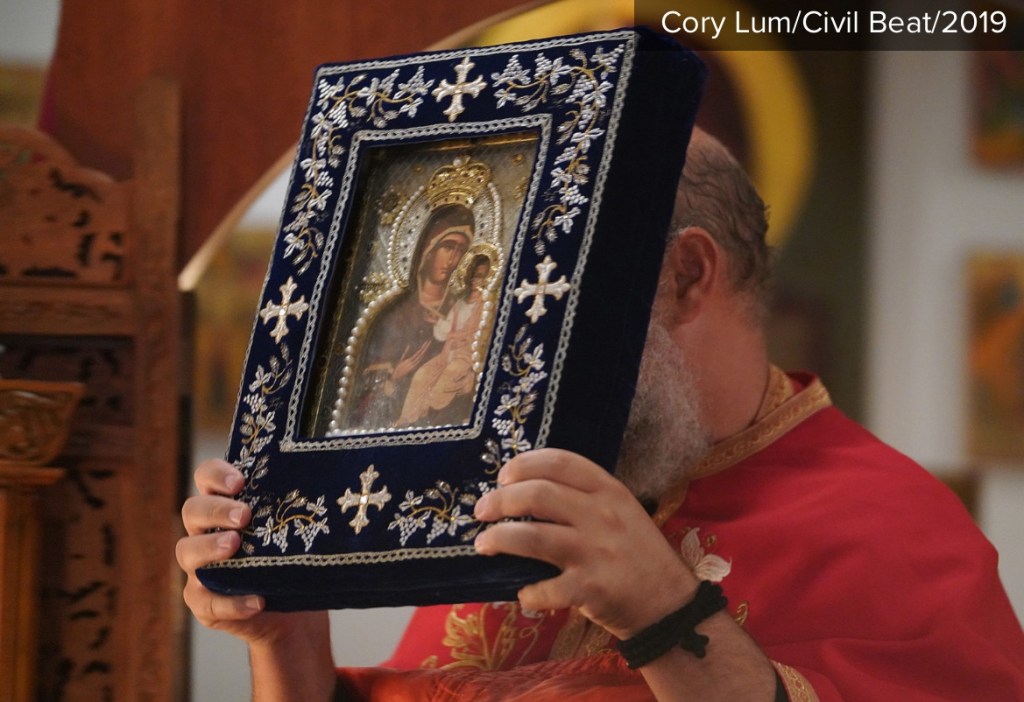
And the two do indeed have something in common. In both cases, even though the eyes are fixed on something physical – the phone screen in one case, the wooden frame in the other – it is what lies beyond that physical object that matters to them. In the case of the cell phone, it is the digital world, a virtual reality made up of numbers; in the second case, it is the heavenly kingdom to come, promised to saints and sinners alike, provided they repent of their sins and entrust themselves to God the Almighty.
This way of navigating the world works fine in most situations, but it can sometimes lead to trouble. This is what happened to us when we wanted to go to Mâcon Ville.
When you travel from Lyon to Mâcon by the regional train, you take the train at Gare de la Part Dieu, go directly to Gare de Mâcon, and there you are, in the famous land of Chardonnays. But my girlfriend’s phone told her, or maybe she told her phone, to get off the train at Mâcon-Loché, and that’s what we did. We found ourselves standing in the middle of nowhere:

From Mâcon-Loché to Mâcon Ville, it’s a two-mile walk, which isn’t much when you think about it. But if you’re the one walking, it’s bothersome. At first, you’re annoyed at having made a mistake, then you realize that walking in the French countryside is not always as poetic as the books make it out to be. As you walk, the scenery becomes more rural. You don’t see any signs of human habitation — just fields, and more fields.
But then again, you’re in France, a place where anything can happen! And so, just like in the stories, a passenger car came up behind us, and as we stepped to the side of the road to let the driver pass, it stopped in front of us.
The driver rolled down the window and asked us if we were going to Mâcon Ville. He was a middle-aged man who looked like an office worker, or maybe a high school teacher.
“Indeed, that’s where we’re going!” my girlfriend answered the man in French.
“I can take you there,” the man said. “I’m going myself.”
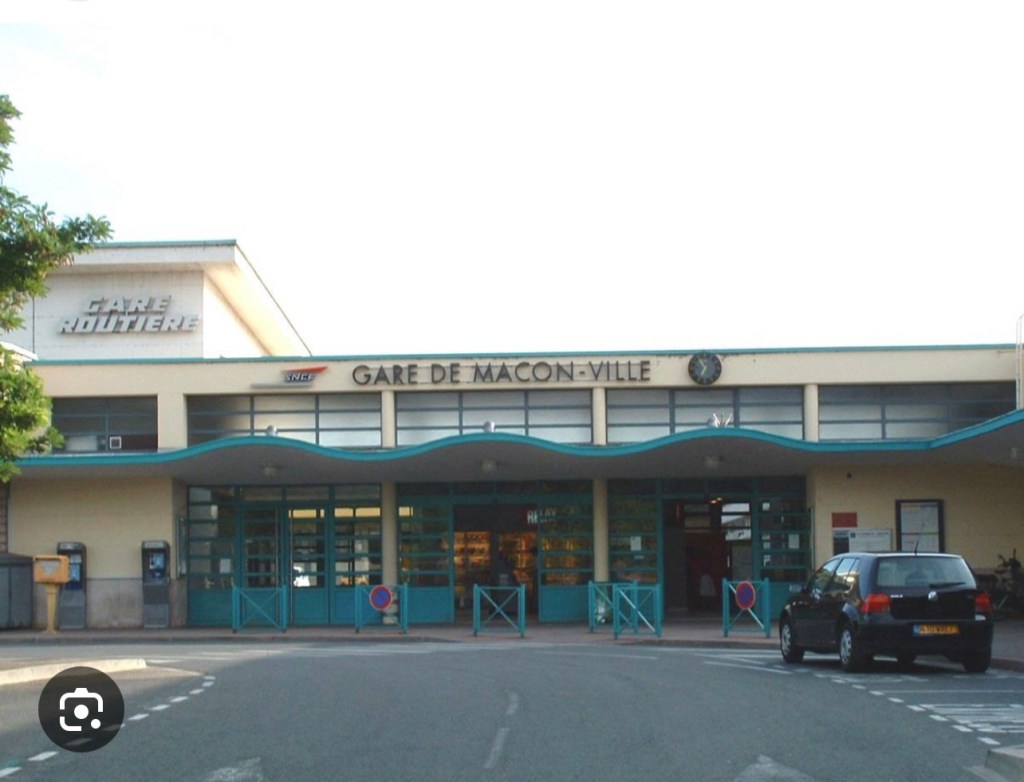
And that’s how we arrived in Mâcon. The man dropped us off at Mâcon train station:
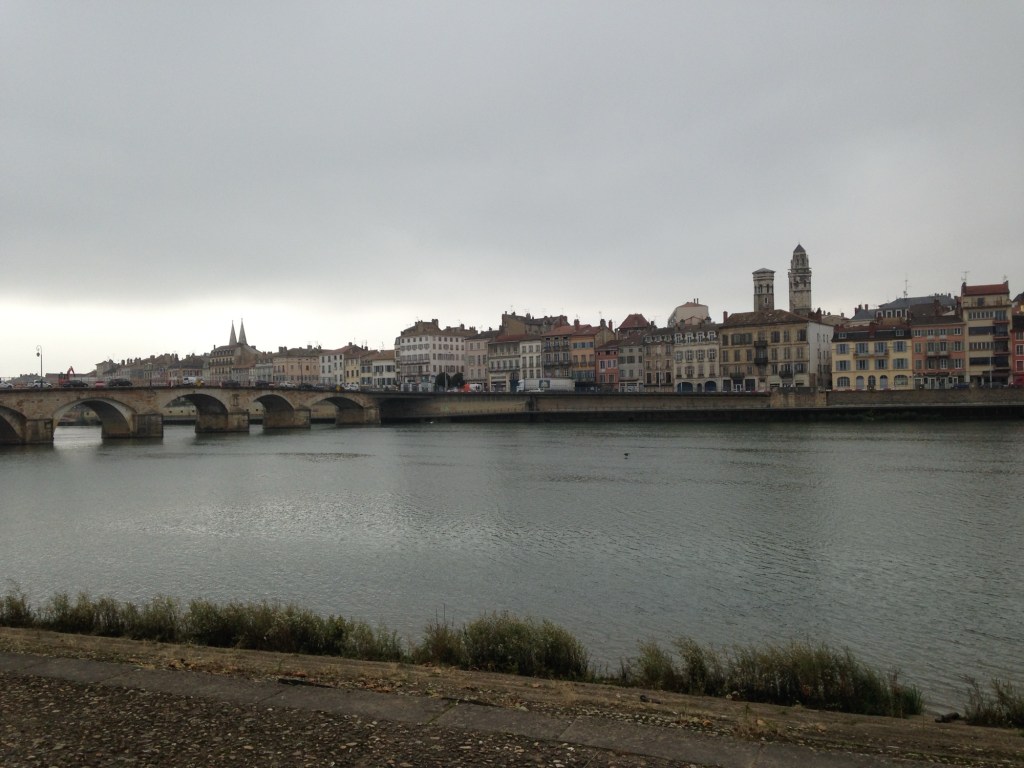
We went into town and wandered around a bit. It was a gloomy day, and the sky was overcast. You might think we had come on a bad day, but this was typical Burgundy weather at this time of year. In fact, it was typical of many places in France. When you read books about the French, you learn that they are a people who feel perennially unhappy, that they complain a lot, and this is why they have a penchant for street demonstrations and revolutions. Psychologists’ surveys on well-being levels often score them low. If you go to Mâcon, you’ll understand why. That’s what I thought.
Later, we had lunch in a restaurant near the Pont Saint-Laurent. The Saône flowed past the window. I ordered a half-bottle of Chardonnay. After all, we were in the land of Chardonnay, weren’t we? It’s an excuse, but that half bottle bothered me for a long time, because it broke my rule of not drinking before dinner. As for the food, I don’t remember what I ordered, but I do remember what my girlfriend ordered. I’ve always had a hard time understanding why cuisses de grenouilles are on the menu in French restaurants. When I was little, I used to catch them in the rice fields, but I always thought they were horrible to eat. And there, standing next to her, was the waiter, showing her that the way you play the harmonica is how you eat grenouilles.
 Yego’s Chronicles