1
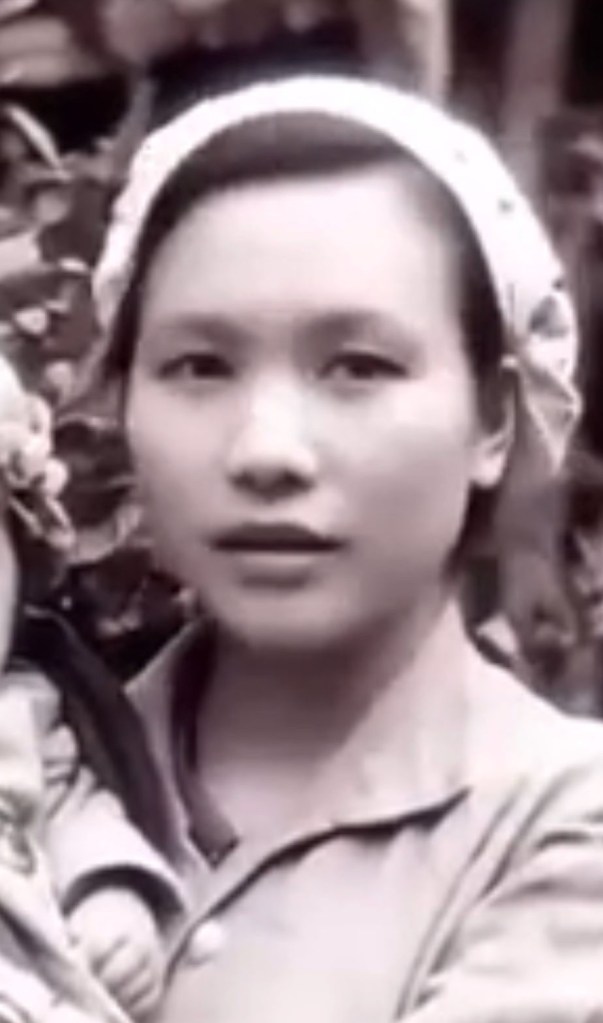
I’m looking at this picture of this young woman, probably taken when she was twenty-five, or no older than twenty-six. Lately, I’ve been looking at it quite a bit. But the more I look at it, the more confused I become. I don’t mean I’m getting confused about the identity of the person in the picture. Of course I know it’s her. It’s a photo we grew up seeing. It’s in the family album; it’s also in the family photo album on my phone in scanned form. If you had waved it in front of my face while I was asleep, I would still know it’s Mother.
But I’m not talking about Mother, and that’s not what I’m feeling confused about. What I’m confused about is the person herself, the young woman anyone who doesn’t know me and happens to see the photo would see. What I see when I look at the young woman in the photo, after having “checked at the door”—as they say—all the memories and conceptions of Mother accumulated over my lifetime, is a person I suddenly no longer recognize. I feel as though I’m looking at a young woman displayed in a store window, a girl I happen to see in a merchandise catalogue that came in the mail.
A stranger.
She looks rather young, so much so that one can even discern a whiff of an underage look in the way she looks—a trace of uncertainty, or hesitation, at entering adulthood, or motherhood, at such a young age. At the same time, the unwavering look in her eyes seems to suggest a person with a well of inner strength to draw on if situations arise, as if saying straight to the camera: this is my territory; expect resistance if I’m pushed. The slightly angled stare at the camera even has a bit of defiance packed into it. And then the narrowly parted lips, a giveaway of all the above: a sign of youthful naïveté, inexperience. And finally, the full facial contour: the high cheekbones and the soft, round face. It reminds one of facial features seen in Vietnamese or Malay women. If there is such a thing as a Hakka face, hers is it.
2
One time I was returning home from college for the summer. As I got off the long-distance bus, I saw Mother there waiting for me. Standing beside her was a young girl. I recognized immediately that she was from the same high school as me, but one grade below. At the same time, I was surprised that she was there with Mother, as if she too had been waiting for me.
In any case, when, later that summer, she asked me out on a few occasions, once to watch a movie, I realized that she was interested in me. But I did not feel the same way about her. When I eventually told her that we could not continue, I felt bad about it.
When I told my mother about it, she did not say anything at first. But after a while, she said something to comfort me. It wasn’t so much that she said something; it was what she said that really took me by surprise.
“When you have to turn someone down, it’s not just that you know the other person will feel hurt. You yourself feel awful too.”
And I was like, That’s something only someone who has experienced such a thing would know. Does that mean Mother had, at some point in her life, had to turn down someone who loved her?
Of course I did not say this aloud. But it was a great revelation to me. At that moment, at least, she ceased to be Mother and became a person—a woman who knew something about love, and who knew what it felt like to have to reject someone who loved her.
I never asked her about it.
Now, decades later, looking into the eyes of the twenty-five-year-old woman in the photograph, the questions come back to me with an entirely different force: Who had loved her? Whom had she loved? Had she ever had to tell someone no?
3
Mother flew to Luoyang when she was six months pregnant, carrying my brother. That was in the early sixties, probably 1963. What the occasion was I no longer remember, but it might have had something to do with her older brother. Maybe he was ill or something.
This was at a time when air travel was rare, even unheard of for ordinary people. On the plane she met another passenger, “a very nice gentleman,” who offered to help her because the pregnancy made traveling difficult for her. He accompanied her almost all the way, except for the last leg of the journey. He helped her on and off the plane, stayed with her at the layover airport, and did not leave until he saw that Mother had boarded her next flight and was all right.
When telling us this story and talking about the “nice gentleman” who had helped her, Mother was casual, almost matter-of-fact. But I always felt that, in addition to gratitude and a sense of good fortune at having met someone so kind, there was something in the way she spoke of him that suggested she might have taken a liking to the gentleman.
I have no way of knowing, of course. She never said anything of the sort. It was simply something I thought I heard in the way she remembered him.
4
At sixteen, she must have been one of the youngest in her class. This can be inferred from the way she referred to her female classmates as her “study sisters.” Given her looks, her quiet but somewhat disconcerting manner, and that stare, all too clear to miss in the photograph, it is difficult for me to imagine that she did not have admirers.
And admirers she indeed had.
One time, when we were talking about such things—about how girls in college sometimes evade boys they do not wish to see but do not want to hurt either—Mother chimed in and dropped a little tale of her own.
There was a classmate, a young Cantonese boy, who would come looking for her. Whenever this happened, her roommates would help her hide, then go out of the dorm and tell the boy waiting outside that she wasn’t in.
Her roommates were all so protective of her.
And when I examine the photo, I understand why.
5
Mother was given away to a Wong family as a child wife at around school age. She never told us the whole story. It always came out as a side note, something mentioned in passing.
From roughly her preteen years to sixteen, when she left home for Yunnan to attend nursing school, she lived with the young boy—and later young man—to whom she had been betrothed. Over the years, bits of tales would drop from her casual remarks, allowing us to piece together something of what their relationship had been like.
On the surface, it all sounded like pure affection between siblings. But I have always wondered whether there might have been more to it than that. I wonder because of the many little details that survived in her memory.
The boy who was destined to become her husband was sick with pneumonia, and the family had to pawn one thing after another to buy the expensive penicillin that kept him alive. He accompanied her through all the work she had to do at that tender age: working at the loom, helping prepare meals, going with her to the pond so she wouldn’t drown, and so on. In all this, he was there with her—coughing constantly, I imagine.
Mother always referred to him as “Brother.” Perhaps that was all there was between them. I cannot be sure. She never told us, not even a hint.
All I know is that when the time for marriage approached, she took the opportunity to enroll in a nursing school in remote Yunnan and left home for good.
“How could I?” she later said. “He was a brother to me.”
6
It might have been when I was a junior in college. I was turning twenty, at the worst of my rebellious period, on the eve of escaping the reign of the Freudian Oedipus complex, if there be such a thing.
One afternoon, the family, sans our father, was having a good time together in a relaxed atmosphere. On a whim, and right in front of my siblings, to their greatest astonishment, I pulled Mother over and made her sit on my lap.
At that moment, all the girlhood came out of her. She curled up with shyness and giggled, as if she had traversed all those years and gone back to the young woman in that photograph. With her face lowered as though trying to bury it, she said, “I’m going to tell your father about it.”
But she kept on giggling.
 Yego’s Chronicles