There are works of art that belong to a civilization in a deeper sense than simply being admired within it. They become part of the equipment with which people imagine the world. Their words are repeated until people no longer remember who first wrote them; their images migrate from churches into paintings, poems, novels, symphonies, and ordinary speech; their assumptions become so familiar that even those who reject them continue to think partly through them. For centuries in Europe, the Dies irae was such a text.
Today, most people who encounter the words Dies irae probably encounter them through music. They know Mozart’s Requiem, perhaps Verdi’s; they may recognize the famous four-note chant without knowing its name. A film score introduces death or catastrophe, and somewhere underneath the orchestra those old notes appear. The melody has become a musical shorthand for doom. Yet this familiarity is deceptive. We still recognize fragments of the language while having largely forgotten the world in which that language once made sense.
The Dies irae is a medieval Latin poem, probably composed in the thirteenth century and traditionally attributed to Thomas of Celano. Its title comes from its first words:
Dies irae, dies illa
Day of wrath, that day.
The day in question is the Last Judgment.
Already we are some distance from the ordinary emotional world of the modern funeral. When someone dies today, we speak chiefly of the person who has died. We remember a life. We console a family. We celebrate what the person meant to us. Even when the funeral is religious, its emotional center is often biographical: here was this particular person, here were the things she loved, here are the people who loved her, here is what remains of her among us.
The Dies irae begins elsewhere.
A person has died, but suddenly the imagination expands beyond that single death to the death of the world. History itself comes to an end. The trumpet sounds. Graves open. The dead rise. Humanity is summoned. A judge takes his seat. A book is opened in which everything has been written down. Nothing remains hidden. Every human being who has ever lived stands exposed before judgment.
Liber scriptus proferetur,
In quo totum continetur,
Unde mundus judicetur.
A written book will be brought forth, in which everything is contained, from which the world shall be judged.
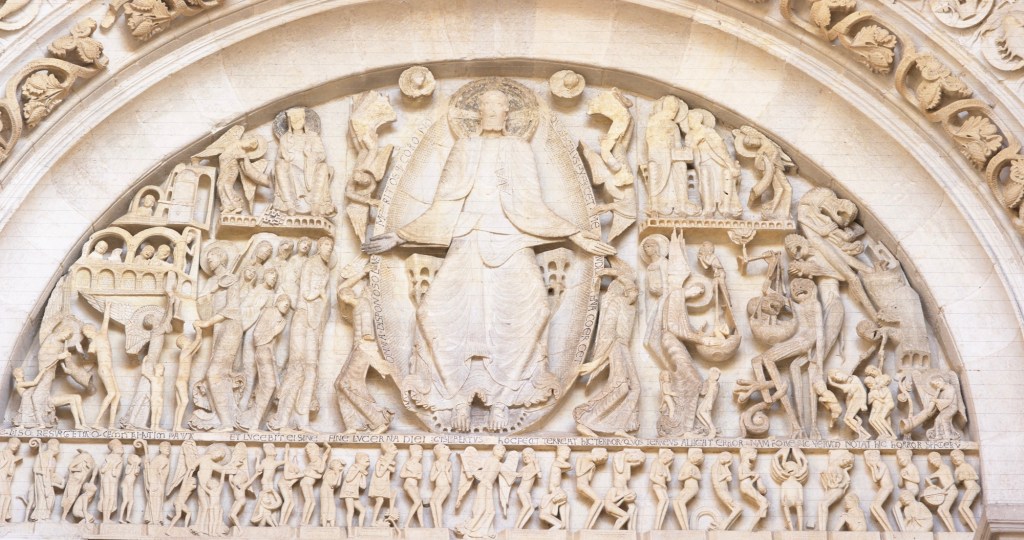
It is difficult for a modern secular reader to recover the imaginative force these words once possessed. We tend to encounter the Last Judgment as an item of Christian doctrine, one proposition among others: Christians believed that at the end of time God would judge the living and the dead. But doctrine alone does not explain what the Dies irae was. The Last Judgment was not merely something medieval Europeans were told to believe. It was something they were repeatedly taught to imagine.
They saw it above church doors and on cathedral walls. They saw Christ enthroned, the blessed gathered on one side, the damned driven toward hell on the other. They heard sermons about it. They encountered it in scripture and prayer. They saw it painted and carved in stone. And when death entered their own household, the language of judgment entered with it.
The Dies irae therefore stood at an extraordinary intersection: theology became poetry; poetry became chant; chant became ritual; ritual accompanied actual human death. Ideas that might otherwise have remained abstract were attached to voices, bodies, buildings, bells, incense, graves, and grief.
This is what it means to call the Dies irae one of the great cultural texts of European civilization.
Its importance cannot be measured simply by asking how many people could recite all its verses. A cultural text works more deeply than that. It supplies images. It establishes emotional associations. It teaches a civilization what certain experiences are supposed to look and sound like. jo
And the experience at the center of the Dies irae is perhaps the most universal one available to human beings: I will die.
But the poem immediately adds a second thought:
My death does not make me disappear from moral reality.
That is a profoundly consequential idea.
Death is not an escape. Rank disappears. Wealth disappears. Political power disappears. Beauty disappears. Reputation disappears. The distinctions by which human societies organize themselves collapse before a judge to whom none of them matters. Emperor and peasant, bishop and beggar, scholar and fool arrive at the same place.
The medieval imagination could be ferociously hierarchical in this world while being startlingly egalitarian before the next.
Everyone becomes homo reus.
The phrase occurs near the end of the poem, in the lines Mozart would make immortal:
Lacrimosa dies illa,
Qua resurget ex favilla
Judicandus homo reus.
Tearful will be that day, when from the ashes shall arise the guilty human being, to be judged.
The choice of homo matters. Not king. Not sinner of some particular class. Not enemy. Not heretic. Not murderer.
Homo.
The human being.
At the beginning of the poem, the whole universe trembles. By the end, what remains is a human creature standing before judgment.
That movement—from cosmos to individual—is one of the extraordinary achievements of the Dies irae. The poem begins almost cinematically. The world burns. The trumpet sounds across the graves. Death itself is astonished:
Mors stupebit et natura.
Death and nature shall be amazed.
But gradually the spectacle recedes. The speaker realizes that he is not watching the Last Judgment. He is in it.
And the grammar changes accordingly.
What shall I say?
Who will defend me?
Remember me, merciful Jesus.
Do not lose me on that day.
You sought me.
You suffered for me.
Forgive me.
The apocalypse becomes autobiography.
This is the point at which the poem ceases to be merely terrifying and becomes deeply human. Fear of cosmic destruction is finally less important than the much quieter terror of being known completely. The book is opened. Everything is there. Every excuse has fallen away. The speaker stands before someone who knows him better than he knows himself.
And what does he do?
He asks for mercy.
That movement—judgment toward mercy—is essential. To hear only terror in the Dies irae is to hear only half the poem. The speaker does not deny his guilt. He does not construct a defense. He does not say that the standards were unfair or that others behaved worse. He pleads instead upon the possibility that justice is not the final word.
Recordare, Jesu pie,
Quod sum causa tuae viae.
Remember, merciful Jesus, that I am the reason for your journey.
This is an astonishing sentence. In the middle of the Last Judgment, the frightened individual reminds Christ why Christ came into the world.
You came for people like me.
Therefore remember me.
The theological structure is Christian, but the psychological structure reaches much further. The poem has arrived at one of the permanent human questions: If I were known completely—everything I have done, everything I have failed to do, every motive stripped of its disguise—could I still be loved?
For centuries Europeans heard that question in the language of sin, judgment, grace, and salvation. Modern Europeans, and the societies descended from them, often ask it in different languages: psychology, authenticity, trauma, guilt, self-acceptance, reconciliation. The vocabulary has changed. The underlying human predicament has not.
This is one reason the disappearance of texts such as the Dies irae from common cultural knowledge matters even to people who have no desire to restore medieval Christianity.
When a civilization loses a common religious language, it does not necessarily lose the questions that language carried. It may simply lose the ability to recognize where some of its questions came from.
Consider how much European art becomes partially opaque without this background. A Last Judgment above the doorway of a Gothic cathedral becomes a collection of strange figures. Dante becomes an exotic tour of the afterlife. Michelangelo’s Last Judgment becomes an impressive mass of muscular bodies. Mozart’s Requiem becomes beautiful sad music. Verdi’s Dies Irae becomes an extraordinarily effective orchestral thunderstorm.
The works remain.
The grammar connecting them begins to disappear.
And yet the Dies irae proved remarkably capable of surviving the decline of the world that produced it.
Its chant escaped the liturgy and entered European musical memory. Berlioz used it grotesquely in the Symphonie fantastique. Liszt invoked it in the Totentanz. Rachmaninoff became almost obsessed with it, allowing its characteristic melodic shape to haunt work after work. Later it migrated into cinema, where composers discovered that audiences could respond to its association with death even when they had no idea what they were hearing.
This is cultural memory in one of its strangest forms: we remember after we have forgotten what we remember.
A few notes sound, and something feels ominous.
Why?
We no longer know.
The civilization knows, somewhere underneath us.
Mozart occupies a particularly poignant place in this history. By the time he composed his Requiem in 1791, the Dies irae was already centuries old. He did not invent its images or its terror. He inherited them. Yet in setting the medieval words to music, he made them newly immediate.
He divided the long sequence into separate musical movements. The opening Dies irae erupts. Tuba mirum announces the trumpet. Rex tremendae confronts majesty. Recordare turns inward toward supplication. Confutatis sets damnation against prayer.
Then comes Lacrimosa.
The poem that began with wrath returns to the same day under another description.
Dies irae, dies illa.
Day of wrath, that day.
And finally:
Lacrimosa dies illa.
Tearful, that day.
The day has not changed.
The point of view has.
From the standpoint of divine judgment, it is the day of wrath. From the standpoint of the human creature who must stand there, it is the day of tears.
And here history added something that no medieval poet and no composer could have deliberately arranged. Mozart died before completing the Requiem. His manuscript of the Lacrimosa breaks off after eight measures of the movement.
The fact has attracted legends, naturally. We should resist making Mozart’s death more theatrically prophetic than the evidence allows. But we need not embellish anything.
A thirty-five-year-old composer was writing a Mass for the Dead.
Before he could finish it, he died.
Other hands completed the music.
There is something almost emblematic in this. The individual dies; the text continues. One generation sings words inherited from another; a composer receives them after five centuries and passes them onward; singers not yet born give breath to sentences written by people whose names may already have been forgotten.
Perhaps that is another meaning of a cultural text.
It outlives the people who carry it.
For several centuries, Europeans could enter a church and hear words that their grandparents had heard, and their grandparents’ grandparents, and generations before them. The people changed. Kingdoms changed. Languages changed. Churches were built and ruined. Wars rearranged borders. But certain sentences remained available for the oldest human occasions: birth, marriage, suffering, death.
Modernity has given us many things in exchange for that inherited world, and one need not romanticize what was lost. A common religious culture could console, but it could also constrain. It could produce magnificent art and terrible persecution. The past should not be made innocent merely because it is past.
Still, something was lost.
We possess more information than almost any people who have ever lived, but information is not the same thing as cultural memory. One can know thousands of facts while lacking the few old stories, phrases, melodies, and images through which generations before us recognized the permanent situations of human life.
The Dies irae was one of those structures of recognition.
Death comes.
The world one has built cannot be carried away.
One’s actions matter.
One cannot finally hide from oneself.
Judgment is frightening.
Mercy is necessary.
And at the end, after the trumpets and flames and trembling and accusations, the immense medieval poem comes down to something almost unbearably simple:
Pie Jesu Domine,
Dona eis requiem.
Merciful Lord Jesus,
grant them rest.
Perhaps this is why the Dies irae survived even as the civilization that once knew it intimately became increasingly unable to explain it. Beneath its medieval cosmology lies something stubbornly human. We may cease to imagine the trumpet. We may cease to expect graves to open. We may no longer believe that a book exists in which every deed has been recorded.
But we have not ceased to know guilt.
We have not ceased to fear judgment.
We have not ceased to need mercy.
And we have certainly not ceased to die.
So the old melody keeps returning.
Sometimes in a cathedral. Sometimes in a concert hall. Sometimes almost invisibly in a film score heard by people who have never encountered a line of Latin.
Dies irae, dies illa.
The words have become foreign.
The experience has not.
 Yego’s Chronicles