1. The Poem
Dies irae began as words.
Sometime in the Middle Ages, probably in the thirteenth century, a Latin poem took shape around one of Christianity’s oldest and most terrifying ideas: that history will one day end, the dead will rise, and every human being will stand before God to be judged. Its authorship has traditionally been attributed to Thomas of Celano, a Franciscan friar who died around 1260, although modern scholarship is less certain that he wrote it.
The poem takes its name, as many old texts do, from its opening words:
Dies irae, dies illa,
Solvet saeclum in favilla,
Teste David cum Sibylla.
Day of wrath, that day,
when the world shall dissolve into ashes,
as David and the Sibyl bear witness.
It is a long poem by modern standards for something meant to be sung: a succession of short, tightly rhymed three-line stanzas. The Latin is remarkably forceful. Again and again the lines end in rhyme—illa / favilla / Sibylla; futurus / venturus / discussurus—giving the poem an almost relentless forward movement.
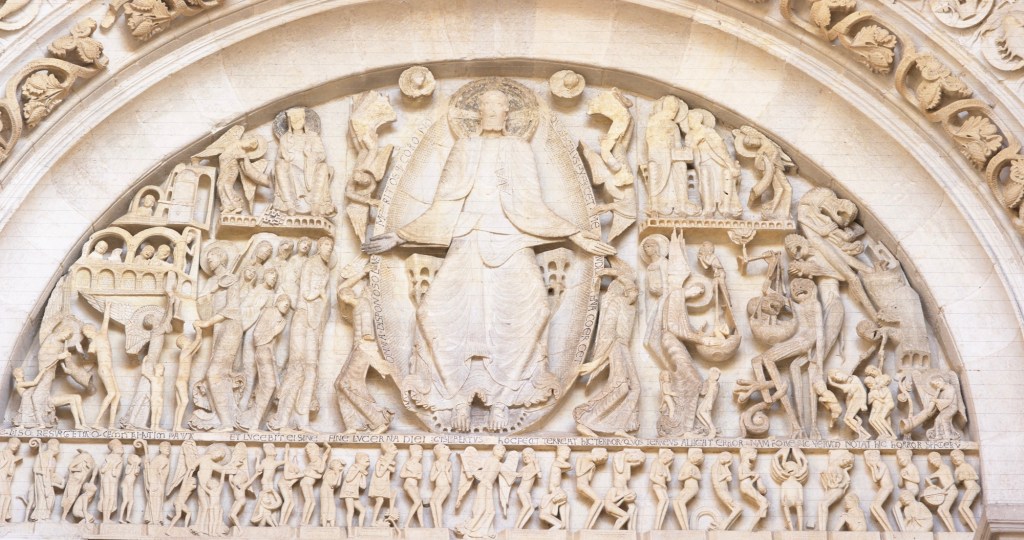
Its subject is the Last Judgment.
2. From the End of the World to One Human Being
At first the scale is cosmic. The world ends. A trumpet sounds through the graves of the earth. The dead rise. A book is brought forth in which everything has been recorded. The Judge takes his seat, and nothing that human beings have done remains hidden.
But then something remarkable happens to the poem.
The person speaking seems to realize that he is not merely describing the Last Judgment. He himself will be there.
The language becomes personal.
What shall I say then? Who will speak for me? Remember me, merciful Jesus. You came into the world for people like me. Do not let me be lost on that day.
The immense drama of the end of the world gradually contracts until only one frightened human being seems to remain before God.
And near the end come the words Mozart would make famous centuries later:
Lacrimosa dies illa,
Qua resurget ex favilla
Judicandus homo reus.
Tearful will be that day,
when from the ashes shall arise
the guilty human being, to be judged.
Then the poem ends not with thunder, but with a plea:
Pie Jesu Domine,
Dona eis requiem.
Merciful Lord Jesus,
grant them rest.
3. Before Mozart, There Was a Melody
The Dies irae was not originally a poem sitting silently on a page. It was sung.
The traditional music associated with it belongs to the world of plainchant, commonly called Gregorian chant: a single unaccompanied melodic line sung in Latin. There is no orchestra, no harmony in the modern sense, no pounding rhythm, no operatic chorus. The musical means are extraordinarily spare.
The opening words—
Dies irae, dies illa
—are carried by a short descending melodic figure. To modern ears accustomed to later settings of the text, the original chant can be surprising. There is none of the orchestral terror of Verdi and none of Mozart’s dramatic choral writing. The voice simply proceeds through the text, stanza after stanza.
Yet precisely because it was repeated over generations, that melody acquired an association far more powerful than any effect an orchestra could manufacture instantly.
It came to mean death.
For centuries, people heard these words and this melody in circumstances in which death was not an artistic subject. Someone was actually dead.
4. The Mass for the Dead
The Dies irae eventually became part of the Roman Catholic Requiem Mass, the Mass for the Dead.
For a modern reader unfamiliar with Catholic worship, the simplest way to understand this is to think of the Mass as possessing a basic structure into which different prayers and readings could be fitted according to the occasion. Christmas had its appropriate texts. Easter had its texts. Particular saints’ days had theirs. And when Mass was offered for the dead, there were texts appropriate to death, judgment, mercy, and eternal rest.
One of those texts was the Dies irae.
It was what Catholic liturgy calls a sequence—not a “sequence” in the ordinary modern sense of several things arranged one after another, but the name of a particular kind of liturgical poem or chant occupying a prescribed place in the Mass.
Thus Dies irae is one sequence, not a collection of separate hymns.
For centuries it was associated especially with Requiem Masses and therefore with funerals and commemorations of the dead. Imagine the cumulative effect. Generation after generation heard the same Latin words in the presence of death:
Dies irae, dies illa.
Day of wrath, that day.
The poem therefore became something more than literature. Words, melody, ritual, architecture and actual human bereavement became joined together.
The chant accumulated memory.
5. Then the Composers Arrived
There is an important distinction here.
Mozart did not take an old poem that had never been set to music and decide to compose music for it. The Dies irae had been sung for centuries.
What composers increasingly did was something different: they took this inherited liturgical text and gave it new musical forms.
Instead of one unaccompanied line of chant, there could now be several voices. Then choir and instruments. Eventually there could be a full orchestra, solo singers, enormous choruses and all the resources of European concert music.
And something else happened.
The long medieval poem could be broken into separate musical movements according to its changing imagery and emotional character.
6. Mozart
This is what Mozart did in his Requiem of 1791.
The medieval Dies irae becomes six successive movements:
Dies irae → Tuba mirum → Rex tremendae → Recordare → Confutatis → Lacrimosa
These are not six medieval hymns. They are six portions of one medieval poem, now treated as six distinct pieces of music.
The first erupts with the Day of Wrath.
Then the trumpet sounds.
Then comes the terrible majesty of the Judge.
Then remembrance and pleading.
Then the contrast between the damned and those begging for salvation.
Finally:
Lacrimosa dies illa.
The day of wrath has become the day of tears.
Mozart died before he could finish his Requiem. In the surviving manuscript, his setting of the Lacrimosa breaks off after its first eight measures. The movement we normally hear today was completed after his death, principally by Franz Xaver Süssmayr.
7. The Chant Escapes the Church
But Mozart was by no means the end of the story.
Other composers took the same inherited words in radically different directions. Berlioz made the Last Judgment gigantic and theatrical. Verdi’s Dies irae explodes with such violence that the medieval Day of Wrath seems to have become physically present in the concert hall.
Other composers did something even more interesting.
They took not necessarily the words, but the old chant melody.
Liszt used it. Rachmaninoff returned to it obsessively. Berlioz incorporated it into the grotesque witches’ Sabbath at the end of his Symphonie fantastique.
By then something extraordinary had happened.
The Dies irae no longer needed to be sung at a funeral.
It no longer even needed its Latin words.
A composer could quote only a few notes of the ancient melody, and listeners familiar with the tradition would understand the allusion:
death is here.
8. We Remember After We Have Forgotten
Eventually those notes migrated into opera, symphonic music and, much later, film music. They could accompany murder, supernatural terror, catastrophe or approaching doom.
Many modern listeners have heard descendants or quotations of the Dies irae melody without ever attending a Latin Mass, without knowing what a liturgical sequence is, and without recognizing a single word of the medieval poem.
That may be the strangest chapter in its history.
A thirteenth-century Latin poem became a chant. The chant became part of the ritual language surrounding European death. Its words were taken up by some of the greatest composers of Western music. Its melody escaped from the church into the concert hall and eventually into popular culture.
And after much of the religious world that gave the Dies irae its original meaning had receded from everyday life, the sound remained.
We hear it.
Something in it still tells us death.
But increasingly, we no longer know who told us.
We remember after we have forgotten what we remember.

