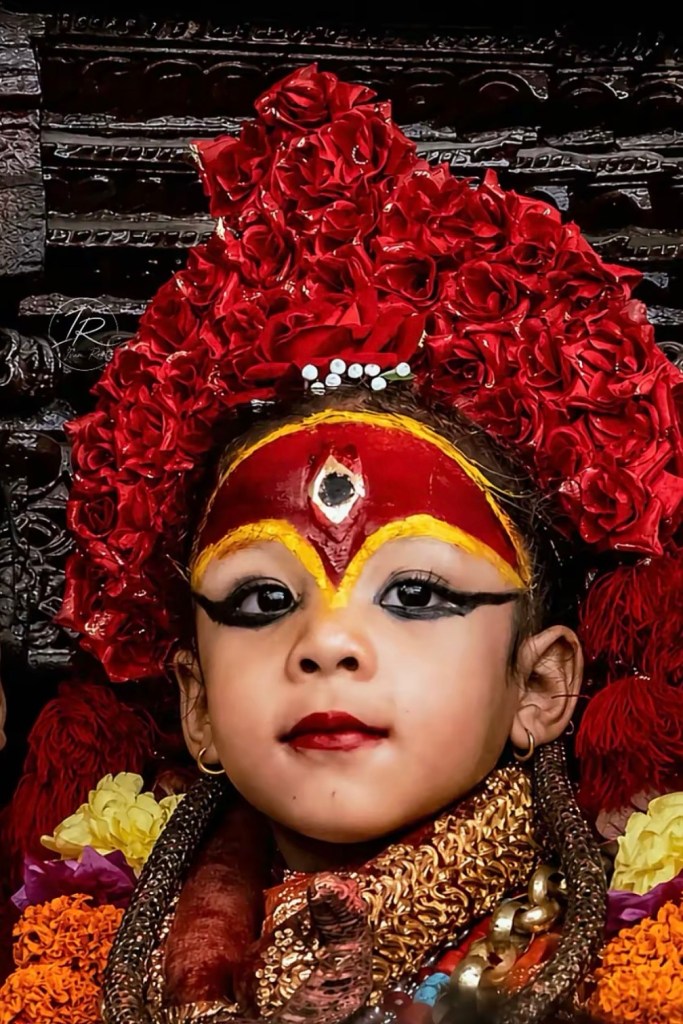
In Kathmandu, Nepal, there lives a little girl whom people worship as a goddess.
She is called the Kumari.
The word kumari means an unmarried young girl, or virgin. There are several Kumaris in the old Newar towns of the Kathmandu Valley, but the best known is the Royal Kumari of Kathmandu, who lives in a richly carved brick building called the Kumari Ghar, beside the old royal palace in Kathmandu Durbar Square.
She is not born a goddess.
She is chosen.
The girl traditionally comes from a Buddhist Newar family of the Shakya community. She may be only three or four years old when the search begins. Her family presents her as a candidate, and priests examine the girls according to a set of traditional requirements. Her health and physical appearance are considered, as are ritual and astrological signs. Eventually one child is selected.
From then on, she is no longer treated as an ordinary little girl.
She becomes the Kumari—the living embodiment of Taleju, the goddess who for centuries was closely associated with the kings of the Kathmandu Valley.
This produces one of the more remarkable sights in the religious life of Nepal. The child herself comes from a Buddhist family, while the goddess she embodies belongs to a Hindu tradition. Yet both Hindus and Buddhists come before the Kumari to receive her blessing.
The custom is centuries old.
According to one of the traditional stories, the goddess Taleju once visited the king of Kathmandu in human form. The king offended her, and she disappeared. After he begged for forgiveness, the goddess told him that from then on she would appear in the body of a young girl. The king was to find the girl and worship her.
Whatever the origin of the legend, the institution of the Kumari became firmly established under the Malla kings of the Kathmandu Valley. The Kumari Ghar in which the Royal Kumari still lives was built in 1757 by King Jaya Prakash Malla.
Once chosen, the girl leaves her ordinary home and takes up residence there.
Her life changes.
She wears red, the color associated with divine power, and on ceremonial occasions her face is elaborately made up. Her eyes are outlined heavily in black, with the distinctive painted third eye on her forehead. Devotees come to see her and receive her blessing. Traditionally her feet, themselves objects of reverence, are not allowed simply to walk upon ordinary ground when she leaves her residence for ceremonial purposes.
Most of the time she remains inside the Kumari Ghar.
But on certain festival days, the doors open and the little goddess comes out.
The greatest of these occasions is Indra Jatra, the great autumn festival of Kathmandu. The Kumari is placed in a great wooden chariot and drawn through the narrow streets of the old city. Crowds fill the squares, drums sound, masked dancers appear, and thousands wait for a glimpse of her.
For centuries, among those who sought her blessing were the kings of Nepal.
There is something extraordinary in the image.
The king was an adult man. He possessed a palace, an army, ministers, wealth and political power. Before him sat a little girl.
And the king bowed his head.
Dynasties came and went. The Malla kings were replaced by the Shah kings, but the new rulers continued the tradition. Nepal eventually abolished its monarchy altogether in 2008.
The Kumari remained.
Yet no girl remains the Kumari forever.
The goddess inhabits the child only for a time. Traditionally, the coming of puberty marks the end of her tenure. Other forms of significant bleeding may also bring it to an end. When the signs appear that the goddess has departed, the girl ceases to be the Kumari.
Then something remarkable happens in the opposite direction.
A child who had been approached with reverence, whose feet had been treated as sacred, before whom grown men and even kings had bowed, returns to ordinary life.
She goes home.
She continues her education. She learns to move through the everyday world outside the Kumari Ghar. She grows into adolescence and adulthood. Former Kumaris have gone on to study, work, marry and have families of their own.
Meanwhile, the old house beside Kathmandu Durbar Square cannot remain without its goddess.
The priests begin looking again.
Somewhere in the Kathmandu Valley there is another little girl playing at home, perhaps two or three years old, who does not yet know that adults are considering her face, her health, her horoscope and the signs surrounding her birth.
One of those girls will be chosen.
She will leave her family home and enter the Kumari Ghar.
People will come before her and bow.
For a few years, a little girl will be a goddess.
Then she will become a girl again.
And another little girl will take her place.
 Yego’s Chronicles