1
I watched four, not three, Russian movies that freezing winter in Utica. I’m sure it was four, not three. I know I’m not wrong about it, and I can’t be wrong about it. I don’t get things of this type wrong. If I did, it would be inconceivable. It would be like getting confused about my own identity, like thinking I’m Ivan Velikopolsky, or that Ivan Velikopolsky was the gay-sounding rifle shot that rang out in the evening sky. That would be crazy. That would be me going out of my mind. But I’m not crazy, and I’m not out of my mind.
I watched Andrei Rublev, The Cranes Are Flying, Ballad of a Soldier, and a fourth one. All in black and white. All Russian.
Mud, paralysis, Trinity, a freight-train ride home, searching through a crowd and not finding the one you love among those who returned.
But what was the fourth one?
The name is on the tip of my tongue. It’s right there, and I know it will drop from my lips at any moment. Just give me another minute and I’m sure it will come back to me.
I’m also sure—convinced, getting a feeling in my bones—that this fourth one, too, was in black and white, just like the other three. And, like the other three, even today I can still see vividly the scenes: bent birch trees by a meadow in late fall, their white bark peeling; clear streams running quietly through withered grass; a few clouds in the clear Russian autumn sky in the distance.
Somewhere, a tune hung in the air.
Bozhe, khrani svyatuyu Rus.
God, preserve Holy Rus.
2
The TV, like the movies I ran on it, was an old one. In fact, everything in the house on Dunham Street was old, including the house itself. The table on which the TV sat had elaborate ornamental carvings. The window glass was painted, and so was the shade of the lamp hanging from the ceiling.
When a movie was over and I started up the stairs, the wood creaked under my feet. My leg joints would be stiff from sitting on the floor in a room barely above 4 degrees Celsius. The house had not been built with energy efficiency in mind, and I was trying to save on heating. I kept the thermostat as low as I dared without risking the pipes.
It was January 2005, in a small city in upstate New York.
Only a few months earlier, I had accepted a job offer from a local college in the city. Now, having left my family behind in Mount Pleasant, Michigan, I alone occupied this old house, subleased to me by a colleague I had yet to meet, a professor of European history who was spending his sabbatical in Europe with his Hungarian wife.
Classes began Wednesday, January 19.
On Friday, after only three days of school in the new semester, I stopped by the college media center before going home and checked out a three-cassette VHS set of Andrei Tarkovsky’s Andrei Rublev.
As I parked the car in the detached garage and started walking toward the side door of the house, I saw snowflakes dancing in the air. I looked up at the bare branches of the tall trees around the house, piercing the sky, and then at the gray sky itself and the strange color of the low-hanging clouds. I felt heavy in my heart, though I had no clear idea what was to come.
Then it started.
Over Saturday and Sunday, a substantial snowstorm moved through the area. By seven o’clock Sunday morning, more than ten inches had fallen in Utica. Nearby New Hartford and Marcy had received a foot.
I woke to bitter cold.
The room was eerily bright, and there was silence all around.
Is this what they were talking about yesterday on the local radio?
I came downstairs and looked out the kitchen window.
Nothing but white.
Snow on the driveway, snow on the lawn, snow on the roofs of the houses next door, snow resting on the bare branches of the old trees. And it was still falling.
I walked around the house for a while. In my colleague’s study, by the bookcase, stood a harp. I plucked one of its strings.
Then I returned to the living room.
That was when I remembered the tapes I had brought home the day before.
I turned on the television, inserted the first cassette into the VHS player, and sat down on the area rug close to the TV.
Mud.
Horses.
Bare church walls.
A Russian man, emaciated and bearded, sat opposite a clean church wall, seemingly lost in thought.
It felt like hours must have passed. The same bearded monk, eyes on the ground, had barely moved. He was still lost in thought, with the face of a man whose thoughts had paralyzed his volition, who did not know what to do, or could not bring himself out of his mental paralysis to do something—anything.
Bare church walls. Mud. Horses. A river and dark land in the distance.
The same desolitude.
My legs had grown stiff. I got up and started pacing the room.
The room was dim. Small framed pictures hung on the walls: unknown landscapes of unknown places, a village, a bridge. In the far corner stood an old piano. I struck a key, my mind somewhere else. Then another.
Moderato cantabile.
I didn’t know where that came from.
Outside, the air was calm, and the snow continued to fall.
I returned to the movie.
Rublev, whoever he was—a saint, a monk, a muzhik, a lost soul—in some desolate place in God-forsaken Russia in God knows what era, still seemed to be sitting in the same spot, blank-faced and motionless. Outside the medieval gate, the same mud, half-melted snow, slowly moving laborers and their slowly moving horses.
My brain felt numb.
Occasionally there arose a faint, almost imperceptible desire—or was it a wish?—like an equally imperceptible ripple on a frozen pond, trying to form a ring that never came.
I did not know, and don’t remember whether I even wanted to know, what this man on the television in a monk’s robe was up to.
3
Days after the January snowstorm had passed, the town was still digging itself out.
I returned to the house on Dunham Street in the early evening after a day of classes at the college. I parked the car in the garage. As the garage door was closing behind me, I walked toward the kitchen door.
I raised my head.
Plowed snow was piled along the street and sidewalk, burying the trunks of the trees. Above them crows circled, cackling.
I kicked the snow from my boots on the steps to the kitchen door.
If mail service had resumed, I thought, today should be the day. The movie I had ordered ought to be lying on the floor behind the mail slot in the front door, inside the familiar little red Netflix envelope, waiting for me.
Years before, I had read some Russian stuff.
That was when I was still in college, in the college’s tiny but popular newspapers-and-magazines reading room, where readers sat elbow to elbow, perusing newspapers for news or devouring the pages of literary magazines. It is hard even for me to imagine now, consuming something as private as a story in so public a place, where you could hear the breathing of the reader sitting next to you.
It was there that I once read a story about a small team of Russian geologists working in the field, and about a man and a woman engineer who, rendezvousing in a tent, caught a rabbit and felt its little heart beating hard and fast in their hands.
It was also in that crowded and suffocating room that I read the novella The Dawns Here Are Quiet. I watched, through the eyes of the young woman, the blue morning sky and wondered why it was so blue, why the clouds were so pure and white, as I gradually sank into the marsh.
Russia had entered me long before I ever sat alone in that house in Utica.
The little red envelope was indeed on the floor by the front door, waiting for me.
Inside was Ballad of a Soldier.
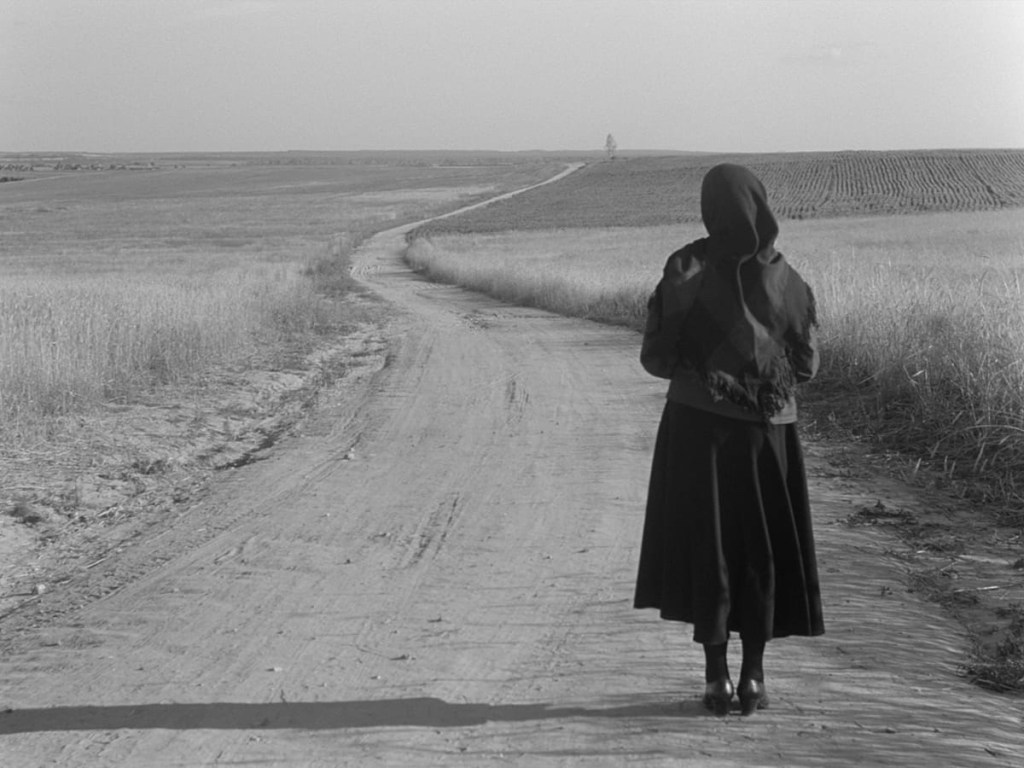
Over the years since, I have become so familiar with the country road that took the young soldier Alyosha Skvortsov toward home, and with the village women running at the news of his coming. But the image I remember most, and associate most strongly with Ballad, is the lone woman standing at the head of a country road running across the vast land.
A mother waiting for her son.
A son who would never reach home.
4
Recently I saw a forty-second home video of a young Russian girl singing while playing a guitar.
It was a home scene. A meal, or perhaps tea, had just ended. She sat on a chair pulled back from the table for the singing. She was barefoot, as was another girl—a younger child—who sat a little apart by the window.
It was a plain song, and yet a soulful one, and so was the girl’s singing. Distinctive, unmistakably Russian:
С сердцем покаянным,
С пламенной молитвою
Припадем к Создателю.
Боже, храни святую Русь.
Days after hearing it, I still could not get out of my mind the emphatic line that ended each stanza:
Bozhe, khrani svyatuyu Rus.
God, preserve Holy Rus.
And somehow, when I think about that fourth movie now, I hear it there too.
Oh, yes. My third movie.
The Cranes Are Flying.
Like Ballad of a Soldier, it came in Netflix’s little red envelope and lay on the cold floor by the front door.
One evening after the meal, which I had cooked in someone else’s kitchen and eaten with someone else’s utensils, I walked out of the kitchen, which still retained some of the heat from cooking, and into the cold living room, where strangers’ photographs hung on the walls.
Why cranes?
And why that particular moment—their departure from one place for another?
I imagined them white, their flight graceful, and the space high above them pure, untouchable by us featherless bipeds.
You search through the crowd.
Faces pass before you.
You look and look, and the one face you are looking for is not there.
You come up empty-handed. You hold back your tears. You bite your lips tight.
Then you raise your head.
The cranes are flying.
5
Things at school grew busy as the region slowly emerged from the unrelenting cold of the first two months of the year.
My meager but steady stream of Netflix red envelopes kept arriving through the mail slot at the front door. Most of the movies I watched. Most I no longer remember.
Spring break came in the middle of March. On Saturday morning I left the house on Dunham Street and began the long drive back to Michigan. It was called spring break, but there was no spring anywhere that I could see. Snow from the day before still covered the ground, and from time to time more snow came down as I drove west on the Thruway. The sky hung low over the road.
I was going home to see my family, whom I had not seen for more than two months. From Utica I drove west across New York, crossed into Canada near Niagara, continued through southern Ontario, then crossed back into Michigan at Sarnia.
Nearly six hundred miles. A long, cold, gray, intermittently snowy late-winter drive in which spring seemed nowhere in sight.
Somewhere past Buffalo, the Russian movies I had watched that winter came back to me.
Rublev sitting before the bare church wall.
Alyosha on his way home.
Veronika searching among the returning soldiers for Boris.
And the other one.
Southern Ontario. A featureless landscape. I knew I was going west, but had I made a ninety-degree turn and continued north or south, I would not have been able to tell the difference. No one would have. Everywhere you looked, the landscape was the same. The sky was the same. The horizon was the same. After a while, as you drove, you started to despair. It seemed it would make no difference whether you continued or stopped. You felt you would never reach where you were going.
And the image of Alyosha’s mother came back to me, standing alone at the head of that country road.
Then Rublev.
And the paralysis.
And the fourth one.
What was it called?
I hope, if and when I finally remember, it will turn out to be one of all the above—all those things I had read about, watched on a screen, and seen with my own eyes in life.
Only, I hope, not quite so sad, and not quite so helpless.
For, as that girl sings, perhaps, by His grace, we will all be saved.
 Yego’s Chronicles