1
A man is what he eats.
A man is what he wears.
A man is the company he keeps.
A man is what he reads.
A man is what he does when nobody is watching.
There seems to be no end to the things a man can be, provided somebody has first turned the thing into a proverb.
But there is one saying you don’t often hear, perhaps simply because nobody has thought to say it:
A man is the words in which he thinks.
Not the words he carefully chooses after thinking. Those are often useless. A politician chooses his words. A salesman chooses his words. A man trying to get a woman into bed most certainly chooses his words.
I mean the words that are already there before the choosing begins.
Those are the dangerous ones.
2
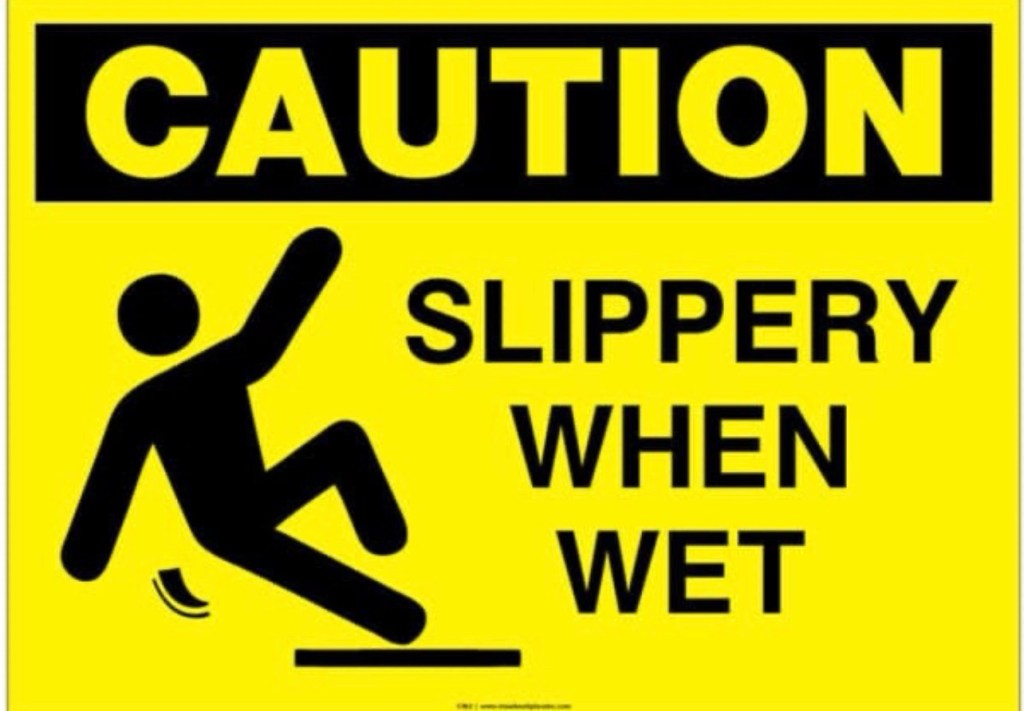
There once was a meme—I think it was a photograph of one of those yellow signs people put on a freshly mopped floor—which read:
MEN SLIPPERY WHEN WET.
Or perhaps there wasn’t. Perhaps I have invented the whole thing. It doesn’t matter. It ought to exist.
Men, generally speaking, are slippery when wet. You just can’t trust them when they’re in that condition.
Now imagine a man whose mind is furnished principally with words such as pussy, inside another, backyard, and a handful of similarly anatomical expressions. Imagine that these are not occasional visitors to his vocabulary but permanent residents, occupying most of the available real estate in what is already a rather meager mental subdivision.
What kind of man are we dealing with?
Why, a man who thinks with his dick.
What else could he think with?
This is not merely because he talks dirty. Talking dirty can be great fun. The interesting thing happens when the dirty word gets there before the thing itself. Show him a cat and somewhere, faintly but reliably, a pussy meows. Mention a backyard and the poor fellow’s geography immediately becomes anatomical.
At that point the man is no longer using the word.
The word is using the man.
3
Let us switch cases before somebody gets wet.
Instead of pussy and dick, let us talk about 厕所.
We could talk about outhouse, latrine, privy, lavatory, bathroom, washroom, restroom, the men’s room, the ladies’ room, or that wonderful American circumlocution facilities. But too many words will only disorient us, and disorientation is inadvisable when one needs to take a shit. With shit, time matters.
So let us stay with 厕所.
There is a generation of Chinese people—you know who you are!—who call the bathroom in their own home 厕所.
Young Chinese people, especially those who have grown up in homes with indoor plumbing, tend to say 卫生间. But listen to a man in his sixties. He gets up from the sofa after dinner and says:
“我去上个厕所。”
You almost don’t have to look at him. The word has already told you approximately how old he is.
These are people who grew up when indoor plumbing was by no means something you could take for granted. When they needed to take a dump, they went to a 厕所, and a 厕所 was a place where other people had taken dumps before them. There might be a pit. There might be a trench. There might be a row of squatting holes. Whatever else it was, it was not a room in which anyone in his right mind would have thought of taking a bath.
Fast-forward half a century.
The man now lives in a modern apartment. His bathroom has ceramic tile, hot and cold running water, a shower, a sink, a mirror, an exhaust fan, and a gleaming porcelain toilet connected to a municipal sewer system.
His grandchildren call it 卫生间.
He still goes to the 厕所.
The pit is gone.
The word remains.
And that is what interests me. The old man is not thinking about the pit when he says 厕所. He isn’t nostalgically remembering the public latrine of his youth. He hasn’t examined the available vocabulary and decided that 厕所 more accurately describes the sanitary facility into which he is about to disappear for ten minutes.
He just says it.
The old 厕所 has been demolished, paved over, built upon, perhaps replaced by a thirty-story apartment building whose bathrooms all have indoor plumbing.
But one last 厕所 survives.
It is inside his head.
He thinks he is using the word.
The word is also using him.
4
Shitty things have a peculiar tendency to resemble gold.
No joke.
There is another word I have been listening to all my life: 美金.
You hear it in mainland China. You hear it in Hong Kong and Taiwan. You hear it in Singapore. You hear it among aging Chinese diasporas in America, where the hairline may have retreated considerably farther than the linguistic frontier.
美金.
American gold.
Not 美元, the American dollar. Not 美钞, American banknotes. 美金.
Gold.
And what is this precious metallic substance?
A piece of paper.
Nowadays, increasingly, not even that. A number glowing on a computer screen, moved from one column to another by institutions whose employees have probably never touched a gold bar in their lives.
Yet out of the Chinese mouth it comes:
美金.
The funny thing is that the speaker usually isn’t making a point. He hasn’t examined the relative merits of 美元 and 美金, selected the latter, and declared: “I hereby express my confidence in the monetary power of the United States of America.”
Nothing of the sort.
He just says it.
That is precisely why the word interests me.
The United States once possessed a monetary prestige—and later an economic and cultural prestige—so immense that, somewhere in the history of Chinese speech, American money became linguistic gold. The historical reasons are more complicated than the word now remembers: actual gold, convertibility, trade, banking, American power, and eventually the extraordinary prestige of the dollar all lie somewhere behind it.
But the person saying 美金 need know none of this.
The history has disappeared.
The word remains.
This is where 美金 begins to resemble 厕所.
A man says 厕所 without seeing the pit.
A man says 美金 without seeing the gold.
And our unfortunate fellow from earlier hears pussy before he sees the cat.
We like to imagine that words are little servants waiting patiently inside our heads until we summon them to express our thoughts. Perhaps we have the relationship backward. Perhaps words have been living there longer than most of our thoughts have. They arrived from our parents, our villages, our schools, our governments, our religions, our pornography, our advertisements, our childhoods, our histories. By the time we begin thinking, they have already taken possession of the premises.
We speak them.
Then, quietly, they speak us.
A man is what he eats, they say.
Maybe.
But listen to him long enough.
A man is what he speaks.

